Claude Haiku 5.5 for Developers: Pricing & 100K Cliff

Claude Haiku 5.5 at a glance
- 1Released October 7, 2026. API ID: claude-haiku-5-5. 1M-token context, 128K max output.
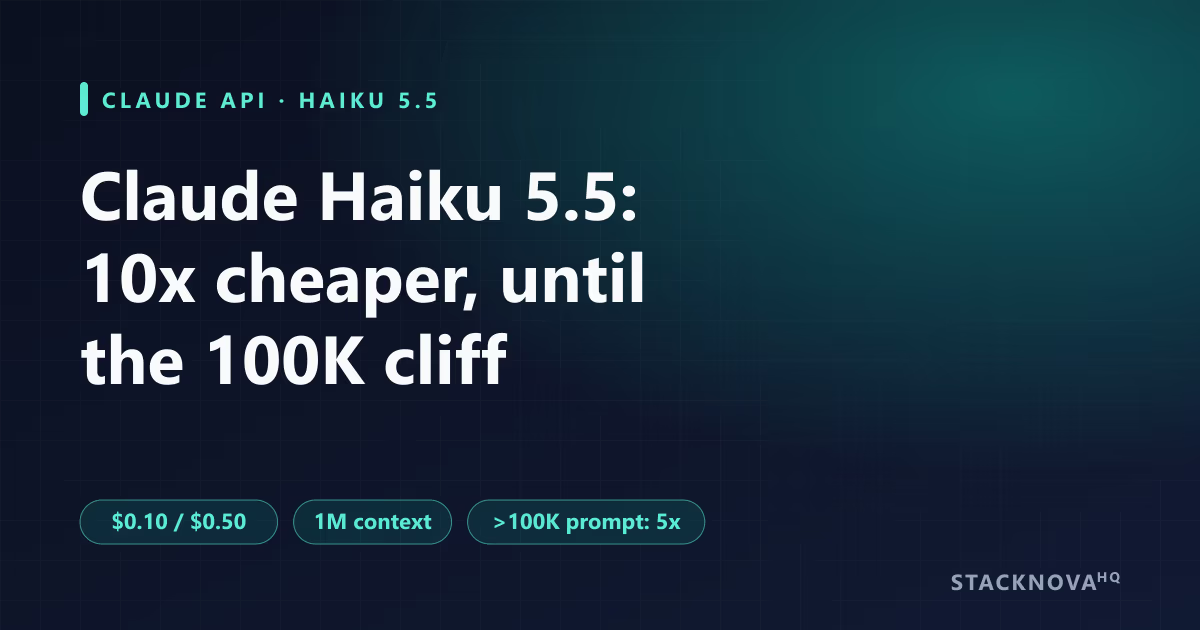
- 2Price → $0.10 input / $0.50 output per million tokens for prompts up to 100,000 tokens. That's one tenth of Haiku 4.5.
- 3The cliff → any single request whose prompt exceeds 100,000 tokens is billed at $0.50 / $2.50, five times more, for the whole request.
Anthropic released Claude Haiku 5.5 on October 7, 2026, and the headline number is hard to ignore: $0.10 per million input tokens and $0.50 per million output tokens. Haiku 4.5 costs $1 and $5. For a lot of background jobs, that's a 10x price cut from changing one string in your code. There's one catch the launch coverage mostly skipped. Haiku 5.5 is the only current Claude model priced by prompt length. Cross 100,000 tokens in a single request and the whole request costs five times more. This guide covers the numbers, the threshold, a small guard you can add to your code, and the jobs where Haiku 5.5 is genuinely enough.
Claude Haiku 5.5 Specs and Pricing
These figures come from Anthropic's models overview and pricing pages as of mid-October 2026. All prices are per million tokens (MTok).
- Model ID and alias: claude-haiku-5-5 (the same string on Bedrock is anthropic.claude-haiku-5-5).
- Context window: 1M tokens. Max output: 128K tokens on the synchronous Messages API.
- Thinking: adaptive, with a default effort of medium. The older manual extended-thinking mode (budget_tokens) isn't accepted on current models.
- Reliable knowledge cutoff: June 2026.
- Retirement: not sooner than October 7, 2027.
| model | input | output | cache hit |
|---|---|---|---|
| Claude Haiku 5.5 (prompt ≤ 100K) | $0.10 | $0.50 | $0.01 |
| Claude Haiku 5.5 (prompt > 100K) | $0.50 | $2.50 | $0.05 |
| Claude Haiku 4.5 | $1 | $5 | $0.10 |
| Claude Sonnet 5.5 | $2 | $10 | $0.10 |
| Claude Opus 5.5 | $4 | $20 | $0.20 |
The 100,000-Token Prompt Cliff
Every other current Claude model (Opus 5.5, Sonnet 5.5, Fable 5.1) charges the same per-token rate across its whole 1M context. Haiku 5.5 doesn't. Anthropic's pricing page spells out three rules that matter:
First, the prompt length that decides the price counts all input tokens, including cache reads and cache writes. A cached 90K-token document plus a 15K-token question is a 105K-token prompt.
Second, each request is priced on its own. A request over the threshold pays the higher rate on every token, input and output, even if part of the prompt was a cache hit.
Third, earlier requests aren't repriced. The threshold is per request, not per conversation or per day.
The jump is steep because the higher rate applies to the whole request, not only to the tokens above 100K:
| prompt size | rate applied | cost |
|---|---|---|
| 99,000 tokens in, 1,000 out | $0.10 / $0.50 | $0.0104 |
| 101,000 tokens in, 1,000 out | $0.50 / $2.50 | $0.0530 |
Guard Against the Cliff in Code
The Messages API has a token-counting endpoint, so you can measure a prompt before you send it. Counting costs nothing extra in tokens and gives you an exact number instead of a character-based guess. Here's a small wrapper that keeps Haiku requests under the threshold and sends oversized prompts to a model with flat pricing:
Count tokens first: stay on Haiku 5.5 below 100K, otherwise send the request to Sonnet 5.5.
import Anthropic from "@anthropic-ai/sdk";
import type { MessageParam } from "@anthropic-ai/sdk/resources/messages";

const client = new Anthropic();
const HAIKU_CLIFF = 100_000;
// Leave room for the system prompt and tool definitions you add later.
const SAFETY_MARGIN = 2_000;

export async function cheapCompletion(messages: MessageParam[], system?: string) {
  const { input_tokens } = await client.messages.countTokens({
    model: "claude-haiku-5-5",
    system,
    messages,
  });

  const model = input_tokens + SAFETY_MARGIN < HAIKU_CLIFF
    ? "claude-haiku-5-5"
    : "claude-sonnet-5-5"; // flat pricing across the full context

  return client.messages.create({ model, max_tokens: 2048, system, messages });
}- Count with the same system prompt and tools you'll send, because they're part of the prompt length.
- For chat apps, trim or summarize old turns before the history crosses the threshold.
- For long documents, split them into chunks under 100K and process each chunk separately, ideally in a batch.
Where Haiku 5.5 Is Enough
Anthropic describes Haiku 5.5 as the model for high-volume, latency-sensitive tasks such as classification, extraction and routing. Those share three traits: the output is short, the task is well specified, and you can check the result cheaply. When all three are true, a small model rarely loses anything that matters.
A minimal router: Haiku 5.5 decides whether a question needs a stronger model.
const ROUTER_PROMPT = `Reply with exactly one word: SIMPLE if the question can be answered
from general knowledge in a few sentences, COMPLEX if it needs multi-step reasoning,
code changes across files, or careful judgement.`;

export async function route(question: string) {
  const res = await client.messages.create({
    model: "claude-haiku-5-5",
    max_tokens: 5,
    system: ROUTER_PROMPT,
    messages: [{ role: "user", content: question }],
  });
  const block = res.content[0];
  const verdict = block.type === "text" ? block.text.trim().toUpperCase() : "COMPLEX";
  // Fail safe: anything unexpected goes to the stronger model.
  return verdict === "SIMPLE" ? "claude-haiku-5-5" : "claude-sonnet-5-5";
}
Classification and tagging
Support-ticket triage, sentiment, spam detection, labelling commits as feat/fix/chore. Ask for a single label from a fixed list and validate it against that list in code.
Structured extraction
Pulling invoice numbers, dates and totals out of emails or PDFs into JSON. Validate the output with a schema (Zod works well in TypeScript) and retry or escalate on failure.
Routing in front of bigger models
Let Haiku decide whether a request is simple enough to answer itself or needs Sonnet or Opus. At $0.10 per million input tokens, the routing call costs almost nothing compared with the expensive call it can avoid.
Bulk text transforms
Rewriting alt text, normalising product titles, translating UI strings for review. High volume, low judgement, easy to spot-check.
Where to Skip Haiku 5.5
The cheap price tempts people to use Haiku for everything. These are the cases where that usually backfires:
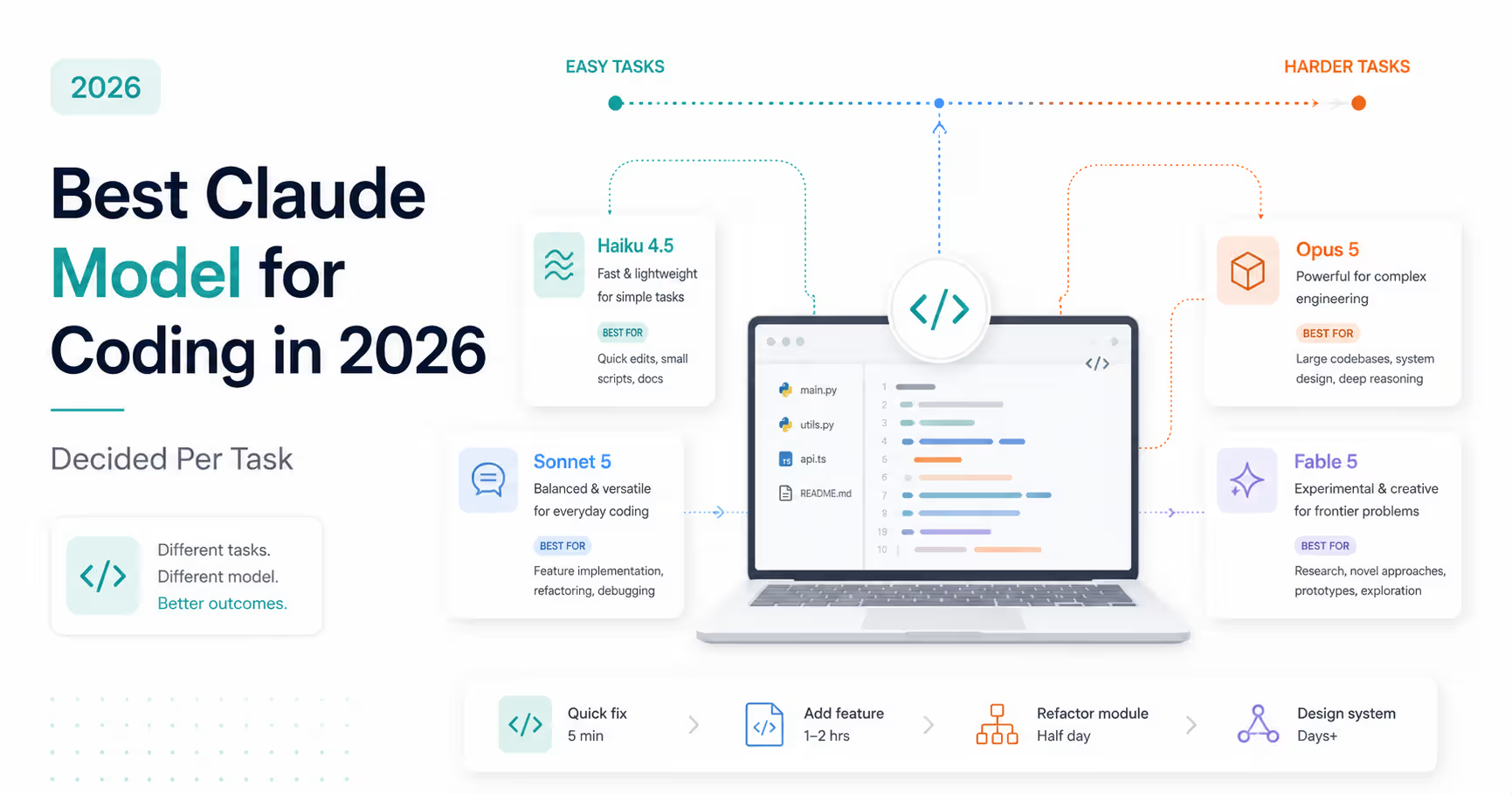
- Multi-file code changes and architecture work. Use Sonnet 5.5 as the default and Opus 5.5 when it struggles. Our guide to the best Claude model for coding covers that ladder.
- Long-document reasoning above 100K tokens. You lose the price advantage, and a flat-priced model is simpler to budget for.
- Anything you can't verify cheaply. If checking the answer takes a human ten minutes, a wrong cheap answer costs more than a right expensive one.
- Agentic loops with many tool calls. Each retry adds up, and a stronger model that finishes in fewer turns often costs less overall.
Migrating From Haiku 4.5
For most code, migration is a one-line model ID change from claude-haiku-4-5 to claude-haiku-5-5. Check three things before you ship it:
- Prompt length: if any of your Haiku 4.5 prompts run past 100K tokens, add the token guard above, or those requests will only be 2x cheaper instead of 10x.
- Thinking settings: if you set thinking with budget_tokens, remove it. Current models use adaptive thinking steered by effort.
- Prompt caching: the minimum cacheable prompt drops from 4,096 tokens on Haiku 4.5 to 512 on Haiku 5.5, so shorter system prompts can now be cached.
- Evals: rerun your own test set. A newer model can change output formats slightly, and parsers that relied on exact wording break first.
Frequently Asked Questions
Strategic Summary
Final Thoughts
Haiku 5.5 makes high-volume AI work cheap enough to run on every commit, ticket or log line. Keep three things in mind: count tokens before large requests, keep prompts under 100,000 tokens, and send hard reasoning to a bigger model. If you're on Claude Max, the new monthly API credits are a good budget for trying it. See how to claim the Claude Max API credits, and the best Claude model for coding for where Haiku fits in a coding workflow. --- Last reviewed: October 16, 2026. Specs and prices are from Anthropic's models overview and pricing documentation. Check them before you budget, because they change. No affiliation with Anthropic.
Moved a workload from Haiku 4.5 to 5.5? Tell me what changed in quality and cost. I'll add real migration notes to this guide.
Next Up
Continue your research
Sources & Research
Claude Platform Docs: Models overview
https://platform.claude.com/docs/en/about-claude/models/overview
Claude Platform Docs: Pricing (Haiku 5.5 prompt-length tiers)
https://platform.claude.com/docs/en/about-claude/pricing
Claude Platform Docs: Token counting
https://platform.claude.com/docs/en/build-with-claude/token-counting
Anthropic Help Center: Release notes (October 7, 2026)
https://support.claude.com/en/articles/12138966-release-notes