Best Claude Model for Coding 2026: Opus 5 vs Sonnet 5

Written by
Sumit Patel
Published
August 16, 2026
Updated
August 16, 2026
Reading Level
Advanced Strategy
Investment
29 min read
Best Claude model for coding — the short version
- 1What I actually shipped on → Fable 5 for planning, backend architecture and a production payment gateway. Opus 4.8 for medium tasks and hard debugging. Sonnet 5 for content, not code. That's my ladder, not a recommendation I inherited from a benchmark table.
- 2What I'd tell you to start with → Sonnet 5. $2/$10 per million tokens through August 31, 2026, then $3/$15. 1M context, 128K output. Handles scoped execution work cleanly.
- 3Escalate to → Opus 5 ($5/$25, launched July 24, 2026, now the Max default) on multi-file architecture, long agentic runs, and anything you've re-prompted twice.
- 4The finding → I built on Fable 5 before Opus 5 existed, then gave Opus 5 a full-stack feature of similar weight and it landed. At half the rate. Honest limit: I haven't put Opus 5 on a payment integration specifically, so I won't claim it there.
- 5Mechanical volume → Haiku 4.5 at $1/$5. Bulk edits, scaffolding, parsing. Not for ambiguity.
- 6Frontier tier → Fable 5 at $10/$50. I used it for real production work and it delivered. Whether it's still the right call post-Opus-5 is exactly the open question above.
- 7Not available to you → Mythos 5. Trusted-access tier under Project Glasswing, not on self-serve plans.
- 8The rule that matters → escalate on the second re-prompt. Per-token price tells you the cost of a successful pass; retry count tells you the cost of the task.
Why this isn't another benchmark table.
I build a 25-module ERP and client CRM projects in React and TypeScript, and I switch Claude models several times a day doing it — the same client delivery work I run through my agency, Zethius. That's the whole qualification for this post, and it's deliberately a modest one. Here's my problem with most 'best Claude model for coding' guides: they lead with benchmark scores you can't reproduce and won't feel. Knowing that one model scores a few points higher on a coding eval tells you nothing useful at 4pm when a refactor has gone sideways and you're deciding whether to burn a bigger model on it. The question a working developer actually has is narrower and more practical: for the task in front of me right now, which model gets this done in one pass? So that's what this article answers. The rate card is here because cost is a real constraint, and the framework is per-task because that's how model choice actually happens. Two honest limits up front. First, my work is TypeScript, React, Node and Postgres — if you're writing Rust or training models, weight my conclusions accordingly. Second, the lineup moved twice in the last two months (Opus 5 landed July 24; Sonnet's introductory pricing expires August 31), so treat every price in here as verified-at-publish and check the source before you budget on it. No affiliation with Anthropic, no affiliate links. Prices are from Anthropic's published pricing documentation, cross-checked against independent trackers on August 7, 2026.
Ask which is the best Claude model for coding and you'll get a benchmark table. Ask a working developer and you'll get a question back: coding *what*? That's not evasion. It's the actual answer, and the August 2026 lineup makes it more true than it's ever been. Anthropic currently ships four models a developer can reach on self-serve plans — Haiku 4.5, Sonnet 5, Opus 5 and Fable 5 — spanning $1 to $10 per million input tokens and $5 to $50 per million output tokens. That's a tenfold spread. No single recommendation survives contact with that range, because the task that justifies the top of it and the task that's insulted by it both show up in the same working day. The lineup also shifted underneath most of the guides currently ranking for this query. Claude Opus 5 launched on July 24, 2026 at $5 per million input and $25 per million output tokens — identical to the Opus 4.8 rate it replaces — and it delivers near-Fable-5 performance at half Fable's price, which quietly demoted Fable 5 from 'the serious choice' to 'the escalation you rarely need'. Meanwhile Sonnet 5 is living out the last weeks of introductory pricing at $2/$10, with standard $3/$15 rates arriving September 1. A guide written in May that tells you to run Sonnet 4.6 for eighty percent of tasks and Opus 4.6 for the rest isn't wrong in spirit — it's just naming models that are no longer the ones you'd pick. What follows is the framework I actually use: the current rate card, the reason per-token price misleads on agentic work, a per-task decision table, and the specific line where escalating from Sonnet 5 to Opus 5 stops being an indulgence and starts being the cheaper option. If you want the companion economics question — whether the subscription that fronts all this is worth paying for at all — that's the other half of this pair, linked at the end.
Key Takeaways
8 PointsThe Best Claude Model for Coding: The 30-Second Answer
If you read one section, read this one.
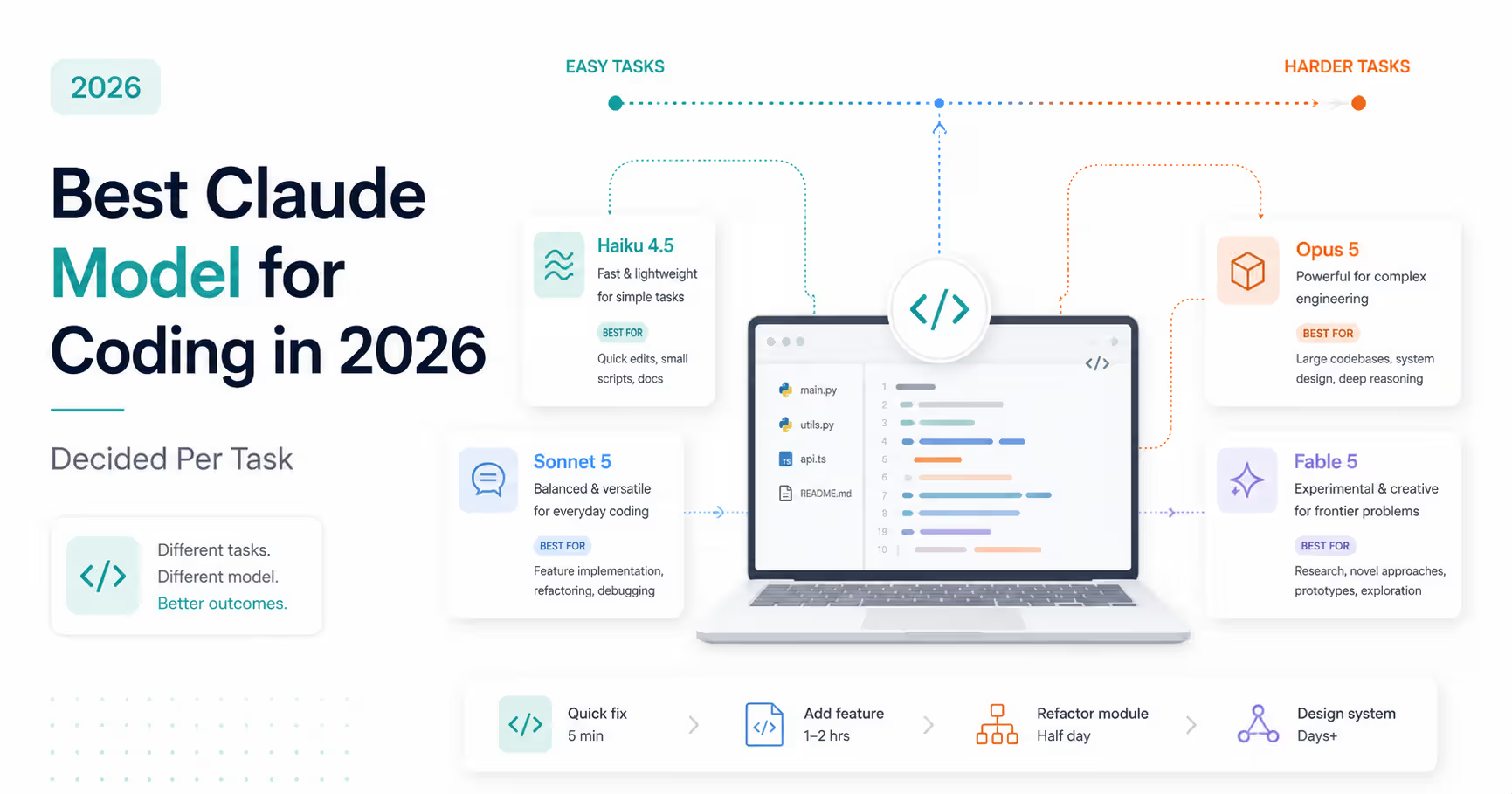
Run Claude Sonnet 5 as your default. It's the price-to-performance model in the lineup, it carries a 1M-token context window with up to 128K output tokens, and it handles the overwhelming majority of day-to-day coding: building components, wiring endpoints, writing tests, reviewing diffs, refactoring within a file or two. At $2 per million input and $10 per million output tokens through August 31, 2026, it is also the cheapest capable option you'll reach for.
Escalate to Claude Opus 5 when the task is genuinely hard: multi-file architectural changes, long autonomous agent runs, debugging that spans modules, anything where you've already re-prompted twice and are about to do it again. At $5/$25 it's roughly 2.5x Sonnet's current rate, and on the right task it is still the cheaper choice — a point the next section unpacks properly.
Drop to Claude Haiku 4.5 ($1/$5) for mechanical volume where the spec is unambiguous. Reach for Claude Fable 5 ($10/$50) only when Opus 5 has actually failed, because Opus 5 exists precisely to make that reach unnecessary for most work.
And set a reminder for September 1, when Sonnet 5 moves to standard $3/$15 pricing. It doesn't change which model is best; it changes the arithmetic of every cost model you built this summer.
The August 2026 Lineup and What Each One Actually Costs
Before the framework, the facts it rests on. These are the self-serve models available on the Claude API as of August 7, 2026, with their standard rates per million tokens.
Claude Haiku 4.5 sits at $1 input and $5 output — the volume tier, and the only model here that predates the 5-series naming.
Claude Sonnet 5 is $2 input and $10 output under introductory pricing in effect through August 31, 2026, moving to standard $3/$15 on September 1. It supports a 1M-token context window and up to 128K output tokens per synchronous request.
Claude Opus 5 is $5 input and $25 output — the same rate card Opus has carried since 4.5, so the July 24 launch raised capability without raising price. It's the default model on Max plans, supports 1M-token context and 128K output, and has a Fast Mode running at roughly 2.5x speed for double the rate ($10/$50), available on the first-party Claude API only.
Claude Fable 5 is $10 input and $50 output, positioned for frontier agentic work. Anthropic launched Fable alongside Mythos 5 on June 9, 2026, briefly suspended access on June 12 to comply with U.S. export controls, and restored it on July 1 after those controls were lifted. Mythos 5 is not a self-serve option — it's a trusted-access lane under Anthropic's Project Glasswing.
Two discounts apply across the board and matter more than most model-switching decisions. Prompt caching cuts cache hits to roughly a tenth of standard input cost — Opus 5 cached input reads at $0.50 per million instead of $5.00 — which is enormous for agentic coding, where the same codebase context gets re-read on every turn. The Batch API halves both input and output rates for work that tolerates a delay, putting Opus 5 at $2.50/$12.50.
- Haiku 4.5 — $1 / $5 per MTok. Volume and mechanical work.
- Sonnet 5 — $2 / $10 through Aug 31, 2026; $3 / $15 from Sept 1. 1M context, 128K output. The default.
- Opus 5 — $5 / $25, launched July 24, 2026, unchanged from Opus 4.8. Default model on Max. Fast Mode $10 / $50.
- Fable 5 — $10 / $50. Frontier agentic tier; ships with conservative safeguards that reroute a minority of sessions to Opus 5.
- Mythos 5 — not self-serve. Trusted-access only (Project Glasswing).
- Prompt caching ≈ 90% off cache hits; Batch API = 50% off both sides. Apply these before you consider downgrading a model.
Why Per-Token Price Is the Wrong Metric for Agentic Coding
Here's the mistake I made for my first two months of serious Claude Code use, and the one every price-comparison table quietly encourages.
Per-token pricing tells you what a successful pass costs. It tells you nothing about how many passes you'll need. And on agentic coding — where the model reads files, plans, edits across a codebase, runs commands, and reacts to what breaks — the number of passes is the entire cost story.
Work the arithmetic on a real shape of task. Say a cross-module refactor takes a capable model one pass: read context, plan, edit six files, run the test suite, fix one failure, done. Now say a cheaper model at 40% of the price takes three passes, because the first attempt missed a dependency, the second broke a type, and the third finally landed after you re-prompted with the constraint you shouldn't have had to state. Three passes at 40% each is 120% of the expensive model's cost. You paid more and you spent forty minutes supervising instead of reviewing.
That's the whole case for Opus 5 on hard work, and notably it's the case Anthropic's own positioning makes: Opus earns the gap on long agentic runs where fewer retries beat a cheaper per-token rate, while Sonnet wins on high-volume drafting and classification. It's rare that a vendor's framing and a user's experience line up this cleanly, so I'll say plainly that mine does.
The inverse is equally true and gets less attention. On tasks where the cheap model succeeds first time — and that is most tasks — every rupee spent on the expensive model is waste. Running Opus 5 to add a prop to a component is not diligence, it's a habit you haven't examined.
So the operational rule is simple: start on the cheaper model, and escalate the moment you notice you're re-prompting rather than reviewing. The second re-prompt is the signal. Not the third, not the fifth — by then you've spent the difference twice over.
The Per-Task Decision Table
This is the table taped to the inside of my head. Find your task on the left; the model is on the right.
| dimension | model | why |
|---|---|---|
| Bulk mechanical edits (renames, prop types, scaffolding, log parsing) | Haiku 4.5 | Unambiguous spec, high volume, cheap to verify. $1/$5 is the whole argument. |
| New component, endpoint, or hook from a clear spec | Sonnet 5 | First-pass success is the norm. Escalating here is spending for no reason. |
| Writing or extending a test suite | Sonnet 5 | Pattern-heavy, verifiable by running it. Failures are cheap to detect and cheap to fix. |
| Code review and diff explanation | Sonnet 5 | Reading beats writing here, and you're the check on the output anyway. |
| Refactor inside one or two files | Sonnet 5 | Scope is bounded; the model can hold the whole problem without planning across modules. |
| Cross-module refactor or architectural change | Opus 5 | Retry cost dominates. One clean multi-file pass beats three cheap partial ones. |
| Long autonomous agent run (plan → edit → test → fix, unattended) | Opus 5 | Errors compound across steps. This is precisely where fewer retries beat a lower rate. |
| Debugging that spans modules or defies reproduction | Opus 5 | The task is reasoning, not typing. Escalate immediately rather than after two failed Sonnet passes. |
| Anything you've already re-prompted twice | Opus 5 | The second re-prompt is the signal, regardless of what the task looked like at the start. |
| A task Opus 5 has genuinely failed | Fable 5 | The only honest reason to pay $10/$50. Rare enough that it should feel like an event. |
* Model availability, rate cards and plan defaults all moved twice between June and August 2026. Verify current pricing at platform.claude.com before building this table into a team process — and re-check it after September 1, when Sonnet 5's standard rates take effect.
Opus 5 vs Sonnet 5: Where the Line Actually Falls
Most of the decision collapses into this one comparison, so it deserves its own section.
The price relationship is clean: Opus 5 at $5/$25 is roughly 2.5x Sonnet 5's introductory $2/$10, narrowing to about 1.7x when Sonnet moves to $3/$15 in September. Note that second number, because it matters for anyone budgeting past August — the gap between default and escalation is about to shrink by a third, which makes escalating cheaper in relative terms than it is today.
Capability-wise, both carry 1M-token context and up to 128K output, so this is not a context-window decision. It's a reasoning-depth decision. What I notice in daily use is that Sonnet 5 is excellent at executing a plan and Opus 5 is better at making one. Give Sonnet a well-scoped instruction and it lands cleanly and fast; give it an underspecified problem across six files and it will produce something plausible that misses a constraint you didn't state. Opus is markedly better at the 'what am I actually being asked to do here' phase — which is why the most cost-effective pattern I've landed on is a split, not a choice.
The split: plan on Opus, execute on Sonnet. Use Opus 5 for the architectural pass — have it read the relevant modules and produce the plan, the file list, the sequence, the risks. Then switch to Sonnet 5 to carry out the steps. You pay the premium on the small, dense reasoning portion of the work and the cheap rate on the large, verbose execution portion. On the API this is straightforward. Inside Claude Code it's a `/model` switch between plan mode and execution, and it's the single biggest cost lever I've found that doesn't involve accepting worse output.
One migration note if you're moving from Opus 4.8: Opus 5 sits in its own rate-limit bucket. Opus 4.5 through 4.8 share a combined pool that Opus 5 does not draw from, so shifting traffic across doesn't free headroom in the old pool. There's also a behavioural change worth testing before you swap in production — on 4.8, a request omitting the thinking field ran without thinking; on Opus 5 the same request behaves differently. Run your existing prompts against it before assuming a drop-in swap.
- Price gap today: Opus 5 ≈ 2.5x Sonnet 5. From September 1: ≈ 1.7x. Escalation gets relatively cheaper.
- Not a context decision — both offer 1M in / 128K out. It's a reasoning-depth decision.
- Sonnet 5 executes plans well; Opus 5 makes better plans. Split the work along that seam.
- Best cost pattern I've found: plan on Opus 5, execute on Sonnet 5. Premium on the dense part, cheap rate on the verbose part.
- Opus 5 has its own rate-limit bucket, separate from the Opus 4.5–4.8 pool — migration does not free headroom.
- Test before swapping from 4.8: thinking-field behaviour changed between the versions.
Where Haiku 4.5 and Fable 5 Actually Fit
The two ends of the range get dismissed too quickly in most guides — one as too weak to bother with, the other as the obvious premium choice. Both dismissals are wrong.
Haiku 4.5 is the most underused model in the lineup for developers. At $1/$5 it costs half of Sonnet's introductory rate and a fifth of Opus, and for genuinely mechanical work the quality difference is invisible because the task has no room for judgement. Adding TypeScript prop types across a directory. Generating test scaffolding from a component signature. Parsing a log file into a table. Writing commit messages from a diff. Converting a JSON fixture set into another shape. These are tasks where the specification is the whole problem, and once the specification is clear, model reasoning depth stops mattering. The rule I apply: if I could write a regex for it given an hour, Haiku can do it in a second, and paying Opus rates for it is a small ongoing tax on inattention.
Where Haiku is genuinely wrong: anywhere a mistake is expensive to detect. Silent logic errors in business rules, anything touching money or permissions, anything where 'looks right' and 'is right' diverge. The cheap model's failure mode isn't refusing — it's confidently producing something plausible.
Fable 5 has the opposite problem: it's easy to reach for because it's the frontier tier, and usually unnecessary. At $10/$50 it's twice Opus 5's rate, and Anthropic's own framing for the Opus 5 launch was that it approaches Fable's performance at half the price. That's a vendor telling you not to buy the expensive thing, which is worth taking seriously. Fable also carries conservative safeguards: queries on some sensitive topics receive a response from Opus 5 instead, triggering in under 5% of sessions on average by Anthropic's account. For coding that's mostly irrelevant, but on long autonomous runs it does mean the model handling your session isn't guaranteed to be the one you selected — a wrinkle worth knowing about before you build a benchmark around it.
My honest position: I've used Fable 5 on real work and I keep struggling to construct a coding task that justifies it over Opus 5 since July 24. That may say more about my workload than the model. If yours involves genuinely frontier agentic autonomy, test it — and if you find the task where the gap is real and reproducible, I'd like to hear about it in the comments, because I haven't found mine.
Model Choice Inside Claude Code Works Differently
Everything above prices models in API terms, because that's the only place the arithmetic is visible. Inside Claude Code on a subscription, the meter is different in ways that change the decision.
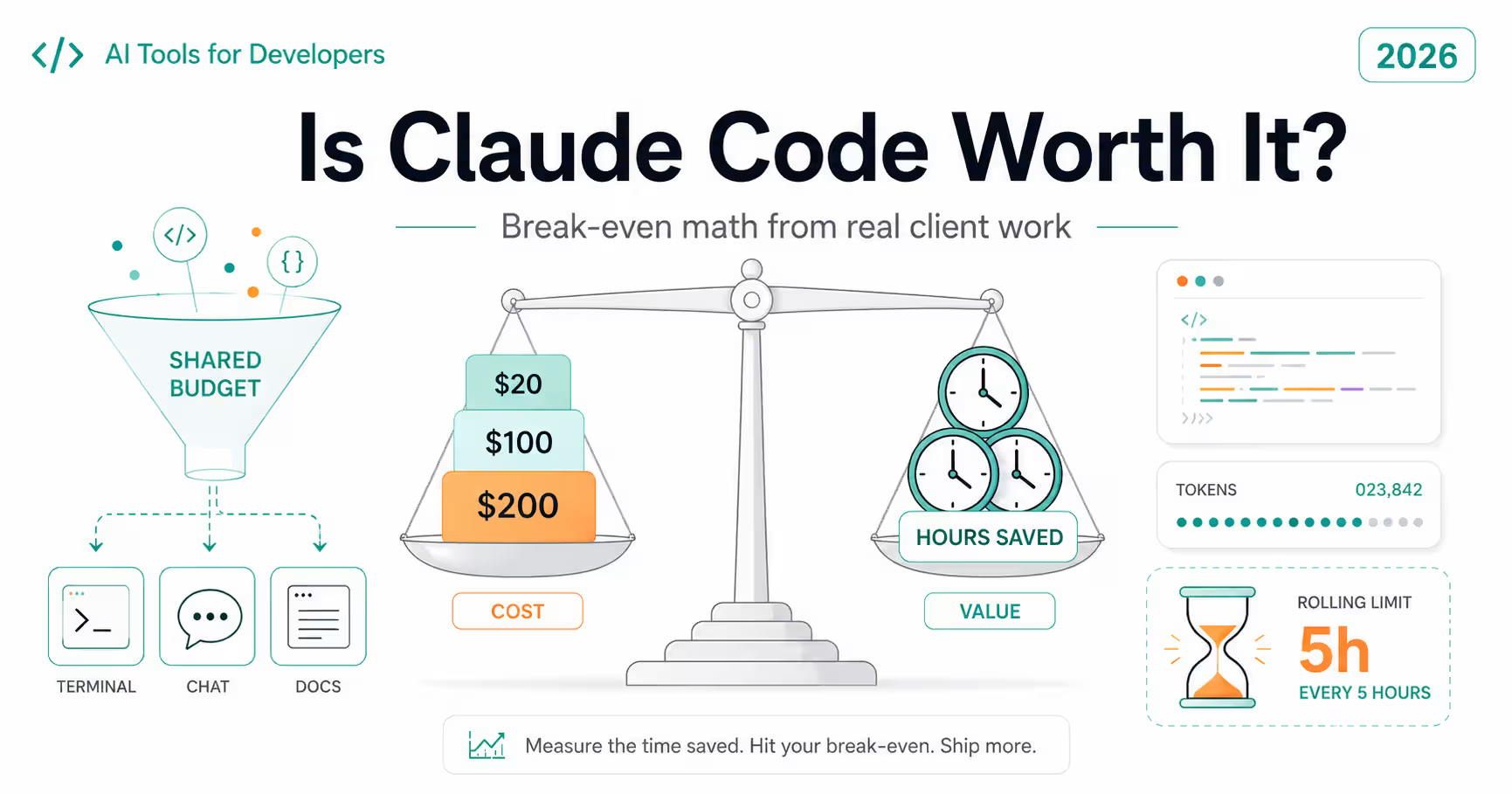
On a Pro or Max plan you are not paying per token — you're drawing against a usage budget shared across Claude Code, Claude chat and Cowork. Burn tokens in one and you lose capacity in the others. Anthropic governs that budget with two clocks: a rolling five-hour window that starts on your first message rather than on a fixed schedule, and a weekly cap on top of it. Max plans carry two weekly caps — one across all models, and a separate one for Sonnet specifically.
That last detail is the one people miss, and it inverts part of the advice above. On Max, heavy Sonnet use draws against a dedicated Sonnet allowance rather than competing with your Opus headroom. Running everything on Opus because you can doesn't just cost more capability-per-task than you need — it burns the shared pool that your harder work depends on, while a separate Sonnet budget sits unused. Opus 5 being the default model on Max makes this easy to do by accident.
Practically, inside Claude Code: switch with `/model`, plan on Opus, execute on Sonnet, and treat the five-hour window as a resource you're allocating rather than a limit you bump into. When you do hit a ceiling, every paid consumer plan now has an extra-usage toggle that continues at standard API rates with a monthly spend cap you set — which means the per-token pricing in this article stops being theoretical the moment your subscription budget runs out. That's the point where model choice becomes a direct bill again, and where the September 1 Sonnet increase will show up on your card.
- Subscription usage is a shared budget across Claude Code, Claude chat and Cowork — not a per-product allowance.
- Two clocks: a rolling 5-hour window starting from your first message, plus a weekly cap.
- Max plans have dual weekly caps — all-models and Sonnet-only. Sonnet work draws on a separate allowance.
- Opus 5 is the Max default, which makes over-escalation the path of least resistance. Switch deliberately with /model.
- The extra-usage toggle continues past your limit at standard API rates with a spend cap you control — that's when token pricing becomes your actual bill.
What I Actually Shipped, and On Which Model
Most articles in this category test models. I'm going to do something less tidy and more useful: tell you which models built a system that is currently taking real money from real customers, and where that ladder turned out to be wrong.
The build. MumsStitch is a women's fashion ecommerce site I own and operate — Next.js frontend, Express backend, PostgreSQL, deployed on DigitalOcean behind Nginx with PM2. I built the backend, a payment gateway integration, an SMTP service, S3 image storage and a shipping API integration. Separately I built a functional CRM, and I took over a client backend another developer had built.
Fable 5 handled planning, the backend, and the payment gateway. The heaviest work went to the heaviest model, at $10/$50 per million tokens. On architecture decisions and payment code specifically, a wrong answer is expensive and hard to detect, so I bought the most capable tier available at the time rather than optimising cost. The gateway has run correctly in production since launch.
Two precisions, because payment code is where readers should hold me to a higher standard. I read the code and tested every scenario I could construct, repeatedly, before go-live. And I didn't treat my own review as sufficient — the brand's CEO independently tested the payment flows before we shipped. AI-generated, developer-reviewed, client-verified. That's a different claim from 'it works in production'.
Opus 4.8 handled medium-weight work and the hardest debugging. The standout came from the client backend I inherited: built with Claude by another developer, its Swagger documentation was broken and wouldn't update even after repeated redeploys — the kind of bug that looks like a deployment problem and isn't. Opus 4.8 found it. Reasoning-shaped problem, not typing-shaped, which is exactly the profile where escalating pays. It also did the frontend analysis work: PageSpeed Insights remediation and technical SEO fixes.
That story carries the uncomfortable lesson of this article. The same tool that built my payment gateway correctly built a backend with broken documentation that shipped unnoticed. The difference wasn't the model. It was whether anyone reviewed the output.
Then Opus 5 launched, and the ladder moved. After July 24 I gave it the offer and discount logic for MumsStitch — running in its higher-reasoning mode, spanning both backend and frontend, touching pricing rules, cart behaviour and display. That is a full-stack feature of genuinely Fable-5 weight, and it landed. It's been working correctly since. I also used it for bulk product SEO metadata across the catalogue and for a vulnerability review pass.
So the finding this article exists to report: the ladder shifts down a tier. I paid $10/$50 for work that Opus 5 subsequently handled at $5/$25, because Opus 5 didn't exist when I built it. If you're standing where I was in June, you almost certainly don't need to start at the frontier tier — Anthropic's near-Fable-performance-at-half-price positioning matched my experience, which is a sentence I write rarely.
The limit on that finding, stated plainly: offer logic is not a payment integration. It's complex, full-stack and money-adjacent, but the failure mode of a mispriced discount is recoverable in a way that a broken payment flow isn't. I have not put Opus 5 on a payment gateway, so I won't tell you it's proven there. What I'll say is that on the hardest non-payment work I've given it, it did not feel like a step down from Fable 5.
Sonnet 5 did content and SEO prose, not application code. I'm flagging that deliberately: I recommend Sonnet 5 as a scoped-execution default on the strength of its positioning and my lighter use of it, not on production application code I built with it.
Limits on all of this. One developer, one stack — TypeScript, React, Node, Postgres — on codebases I know well. These are shipped outcomes, not controlled trials: I picked a model per task and lived with it rather than running the same task three ways. Treat it as one practitioner's ladder rather than a ranking.
The September 1 Price Change and Other Fine Print
Four pieces of fine print separate a working answer from a stale one.
First, and most urgently: Sonnet 5's $2/$10 rate is introductory pricing in effect through August 31, 2026. Standard pricing of $3 input and $15 output per million tokens begins September 1 — a 50% increase on both sides. If you built a cost model this summer, it is about to be wrong by half on your highest-volume model. Subscription users don't feel it directly in the monthly fee, but anyone using the extra-usage toggle past their plan limit pays API rates, and those rates are what's changing.
Second, the rate-limit bucket structure. Opus 5 does not share a pool with Opus 4.5 through 4.8. If you're running production traffic on 4.8 and planning a migration, moving requests to Opus 5 gives you fresh headroom rather than reallocating existing headroom — helpful, but it also means you can't test-migrate a slice of traffic and expect the old pool to loosen.
Third, the discounts that outperform model-switching. Prompt caching discounts cache hits to roughly 10% of standard input cost, and for agentic coding — where the same repository context is re-read on every single turn — cache reads dominate token volume. One report of heavy Claude Code usage found over 90% of tokens in large-project sessions were cache reads. Before you downgrade a model to save money, check whether you're caching. The Batch API's 50% cut applies to anything that can tolerate a delay: overnight refactors, bulk documentation passes, test generation across a repo.
Fourth, the standing caveat on all of this. Between June 9 and July 24, 2026, the lineup gained two models, briefly lost two to export controls, regained them, and then gained a new flagship. That is four material changes in seven weeks. Any article recommending a specific Claude model — including this one — has a shelf life measured in weeks, not years. The framework should outlast the names; verify the names before you act on them.
- September 1, 2026: Sonnet 5 moves from $2/$10 to $3/$15. Reprice every projection built this summer.
- Opus 5 has an independent rate-limit bucket — migrating from 4.8 adds headroom rather than moving it.
- Prompt caching (≈90% off hits) beats model downgrading for agentic work, where cache reads dominate token volume.
- Batch API halves both sides for anything that can wait overnight — Opus 5 lands at $2.50/$12.50.
- Four material lineup changes in seven weeks (June–July 2026). Treat model recommendations as perishable and verify at platform.claude.com.
Frequently Asked Questions
Strategic Summary
Final Thoughts
The honest answer to 'what's the best Claude model for coding' is that the question has the wrong shape. There's a default and there's an escalation, and knowing when to move between them is worth more than knowing which one benchmarks higher. The default is Sonnet 5, because most coding tasks are well-specified execution and it does those cleanly at $2/$10 — for another few weeks. The escalation is Opus 5, because on cross-module work and long agentic runs the retry count dominates the rate card, and one clean pass at $5/$25 beats three cheap ones every time. Haiku 4.5 handles mechanical volume better than its reputation suggests, and Fable 5 is a tier most of us can honestly skip now that Opus 5 delivers near-frontier work at half the price. If you take one operational habit from this, take the second-re-prompt rule: the moment you notice you're rewording the instruction instead of reviewing the output, switch models. It's the cheapest diagnostic in the workflow and it removes the two failure modes that cost real money — grinding a cheap model against a hard problem, and running an expensive one on work that never needed it. And put September 1 in your calendar. Sonnet 5's standard pricing arrives, the gap between default and escalation narrows by a third, and every cost model built this summer needs a second look. The framework survives that change. The numbers don't. --- Last reviewed: August 2026. Pricing, model availability, context limits and plan defaults are from Anthropic's published pricing documentation, cross-checked against independent trackers on August 7, 2026, plus my own testing in real client work. This lineup changed four times in the seven weeks before publication — verify current rates at platform.claude.com before budgeting, and treat any specific model recommendation here as perishable. Client project specifics are kept high-level to respect confidentiality. No affiliation with Anthropic; no affiliate links.
What's your escalation trigger? I switch to Opus 5 on the second re-prompt — I'd like to know whether that lines up with how you work, and especially whether anyone has found a coding task where Fable 5 clearly beat Opus 5 since the July 24 launch. Drop the task shape in the comments; I'll test it.
I write hands-on, no-hype breakdowns of Claude's moving parts — model pricing, usage limits, architecture changes — from daily use in real client work. Browse the AI Tools for Developers hub, or reach me via stacknovahq.com/contact.
Next Up
Continue your research
Is Claude Code Worth It? The Honest Cost Breakdown
Claude Sonnet 5 Tested on Real Production Code
Claude Fable 5 vs Opus 4.8: Real CRM Code Tested
Claude Fable 5 Refusals Explained: Opus Fallback
Claude Code vs Cursor on a 25-Module ERP
Best AI Tools for Developers in 2026
Sources & Research
Claude Platform Docs — Pricing (rate card for all current models; verify before publishing)
https://platform.claude.com/docs/en/about-claude/pricing
Anthropic — Product news and model announcements (Opus 5 launch, Fable 5 and Mythos 5)
https://www.anthropic.com/news
Anthropic — Fable and Mythos access statement (June–July 2026 export controls and restoration)
https://www.anthropic.com/news/fable-mythos-access
Finout — Claude Opus 5 Pricing 2026: Complete Cost Guide & Comparison (launch date, Fast Mode rates)
https://www.finout.io/blog/claude-opus-5-pricing-2026
eesel AI — Claude Opus 5 pricing in 2026 (rate-limit buckets, Max default, thinking-field change)
https://www.eesel.ai/blog/claude-opus-5-pricing
BenchLM — Claude API Pricing, August 2026 (cross-check on current rates and model IDs)
https://benchlm.ai/anthropic/api-pricing
TrueFoundry — Claude Code Rate Limits & Usage Quotas Explained (shared budget, dual weekly caps)
https://www.truefoundry.com/blog/claude-code-limits-explained