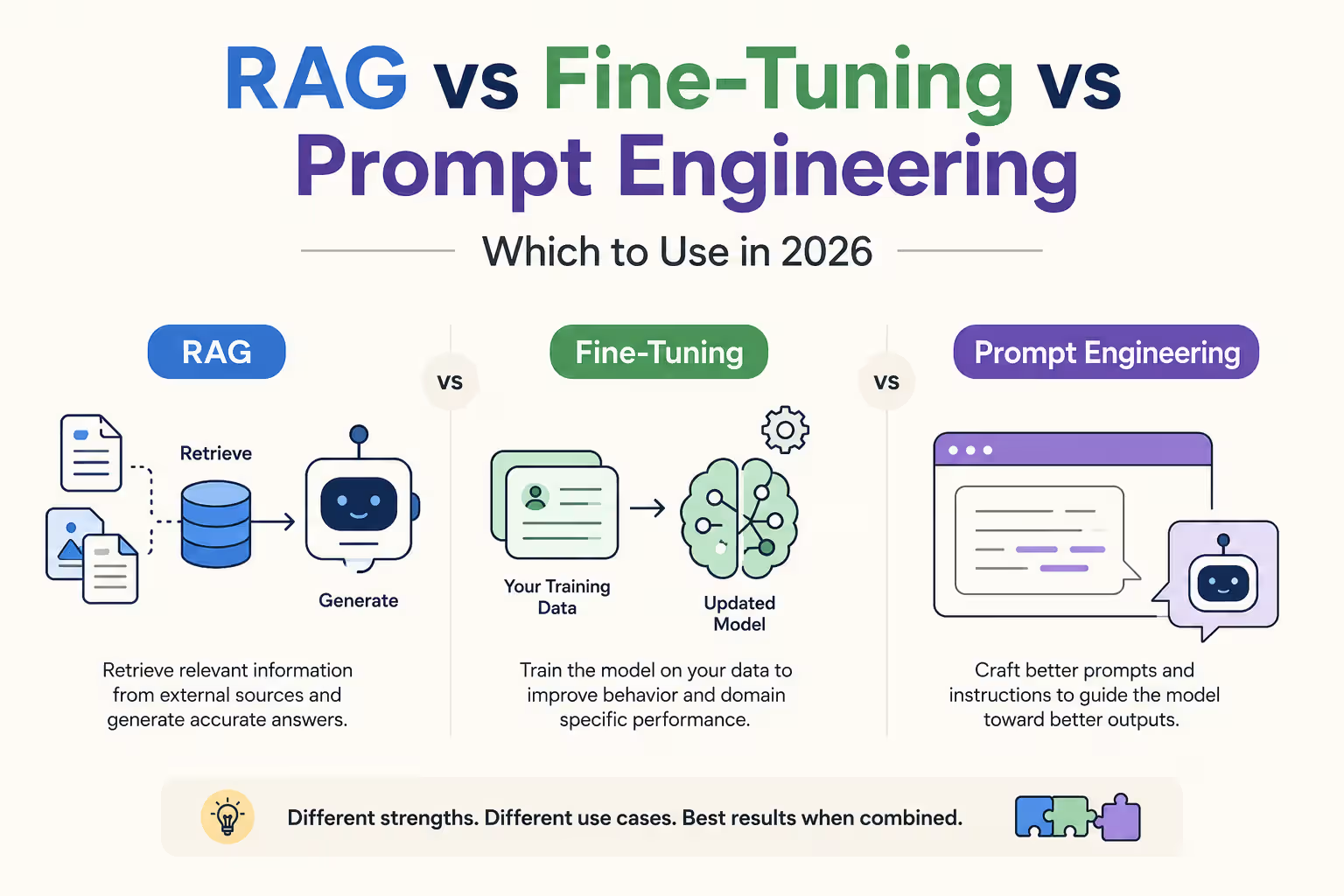
RAG vs Fine-Tuning vs Prompt Engineering (2026 Guide)

Written by
Sumit Patel
Published
May 17, 2026
Updated
May 17, 2026
Reading Level
Advanced Strategy
Investment
39 min read
TL;DR — Which Technique Should You Use
- 1Start with prompt engineering. It's free, it's fast, and it solves more than you'd expect.
- 2Add RAG when the model needs access to specific documents, recent info, or private data it wasn't trained on.
- 3Reach for fine-tuning when you need to change how the model behaves — strict output formats, brand voice, specialized reasoning — not what it knows.
- 4Use all three together for serious production systems. They work at different layers and complement each other.
- 5RAG is the right answer most of the time in 2026 because most production problems are knowledge problems, not behavior problems.
- 6Default RAG stack: LangChain or LlamaIndex for orchestration, Pinecone or Weaviate for vector storage, OpenAI or Cohere for embeddings, Claude or GPT for generation.
- 7Default fine-tuning rule: only after you've confirmed that prompting and RAG genuinely can't solve the problem. Most teams skip this check and regret it.
- 8One rule to remember: knowledge problems → RAG, behavior problems → fine-tuning, everything else → prompt engineering.
Why I'm Writing This (And What You Should Know About My Perspective)
Every article about RAG vs fine-tuning vs prompt engineering falls into one of two categories. The first is an academic explainer that defines everything carefully and refuses to commit to a recommendation, because that would require taking a position. The second is a vendor pitch — where the technique the author's tool supports happens to be the answer. Neither of those helps you when you're trying to figure out whether to build a RAG pipeline or write a better prompt, and you need an answer this week. I'm a frontend developer (React/TypeScript) who builds ERP and CRM systems professionally and spends a lot of time integrating AI features — prompt-engineered content tools, evaluating whether fine-tuning makes sense for specific use cases, and working through what a RAG architecture would look like for a given problem. I'm not a machine learning researcher, and I don't pretend to be. What I am is someone who's had to make these architectural calls under real constraints — limited time, limited budget, and clients who want a clear answer rather than 'it depends.' This article is what I'd say to a developer friend asking which technique to pick for their next AI feature. If you want deep ML theory, this isn't it. If you want a working decision framework grounded in what actually happens when you build this stuff, read on. If you came here for a definitive 'RAG or fine-tuning' answer — you'll leave with something more useful: 'it depends on whether your problem is about knowledge or behavior, and you should try prompt engineering first either way.'
There's a question I've been asked in some form by basically every developer building an AI feature in the past year or two: 'Should we use RAG, fine-tune the model, or just write better prompts?' It's the right question. It's also the one that most AI content online answers badly. The popular takes tend toward extremes. One camp insists RAG is the answer to everything — vector databases everywhere, every problem looks like a knowledge problem once you've learned about Pinecone. Another camp insists fine-tuning is 'real' AI engineering and prompt engineering is for hobbyists. A third camp says frontier models are getting so good that prompt engineering will absorb everything else eventually. None of this maps to what building AI features actually looks like in 2026. RAG, fine-tuning, and prompt engineering aren't three things fighting for the same spot in your architecture. They work at completely different layers of a system. Prompt engineering shapes how you communicate intent. RAG controls what the model knows at query time. Fine-tuning changes how the model behaves at a deeper level. Most serious production systems use all three — and treating them as either/or choices is the reason a lot of AI features ship worse than they should. This guide is the framework I use when someone asks me which technique fits their feature. It covers what each one actually does, when it's the right call, when it's the wrong one, how they combine in real systems, what each one actually costs, the mistakes developers make most often, and the tools that have become reliable defaults in 2026. By the end, you should be able to answer 'RAG, fine-tune, or prompt?' for any feature you're building — not because I handed you a flowchart, but because you'll understand the underlying problem well enough to reason about it yourself.
Key Takeaways
10 PointsWhat Each Technique Actually Does (Without the Jargon)
Before any decision framework makes sense, you need a clear mental model of what each technique actually does to a system. Most of the confusion in online discussions comes from treating them as different flavors of the same operation, when they're actually touching completely different parts of the stack.
Prompt engineering is writing the instructions and context you send to an LLM at inference time. The system prompt, the few-shot examples, the output format specification, the edge case handling — all of it. The model is unchanged. You're not modifying weights, not adding data sources. You're just getting better at communicating with the model. Everything happens inside the prompt and the response.
RAG (Retrieval-Augmented Generation) adds a step before the prompt reaches the model. When a query comes in, the system first searches an external knowledge source — usually a vector database containing chunks of embedded documents — for the most relevant pieces of information. Those chunks get inserted into the prompt as context, and the model generates its answer using both its training and the specific retrieved content. The model itself is still unchanged. What changes is what it has access to at query time. RAG is basically a way to give a model knowledge it doesn't have without modifying it.
Fine-tuning actually modifies the model. You take a base model and continue training it on a dataset of your own examples — input-output pairs showing the behavior you want. The result is a new model whose weights have been adjusted. After fine-tuning, the same prompt produces different outputs than it would have before. This is the only technique of the three that actually changes the model itself.
Notice the layering here. Prompt engineering works at the conversation interface. RAG works one layer below in context assembly. Fine-tuning works at the deepest level, inside the model weights. You can stack all three: a fine-tuned model that receives RAG-retrieved context assembled by a carefully engineered prompt is a real and common production pattern.
The practical implication: 'should I use RAG or fine-tuning?' is sometimes a false choice. The right question is which layers of the stack your problem actually lives in — and the answer is often more than one.
- Prompt engineering shapes how you communicate with the model. The model itself is unchanged.
- RAG shapes what the model has access to at query time. The model is still unchanged.
- Fine-tuning changes the model itself. After training, the same prompt produces different outputs.
- The three work at different layers — they're not mutually exclusive, they stack.
- Most serious production systems eventually use some combination of all three.
When Prompt Engineering Is Genuinely Enough (More Often Than You Think)
Here's something I've watched play out across more than a few projects: most AI features that developers initially think need RAG or fine-tuning are actually prompt engineering problems in disguise. Developers who've shipped a couple of AI features stop being surprised by this. Developers who learned about RAG before they learned to write a solid system prompt often take much longer to accept it.
Prompt engineering is the right primary approach when the task is well-covered by general knowledge already in the model, the constraints can be described clearly in natural language, and you don't need data the model wasn't trained on. That covers a lot of real AI use cases: summarizing user input, classifying support tickets, extracting structured data from messy text, generating first drafts, translating, rewriting in different tones, doing an initial pass over code or documents you paste in.
None of those need a vector database. None need a fine-tuned model. They need a prompt that clearly describes the task, a couple of good format examples, some edge case handling, and output the rest of your code can actually parse.
Good prompt engineering in practice looks a lot more like careful product writing than like coding. You start with a clear role and task definition. You add explicit constraints — what the model should and shouldn't do. You include two or three diverse examples that demonstrate the input-output relationship. You specify the output format precisely, usually as JSON with a defined schema. You handle the obvious failure modes. Then you test on real inputs, find where the model goes sideways, and iterate.
Done carefully, this takes a few hours per feature. Done sloppily, it produces a brittle prompt that works on your three test inputs and breaks in production. The difference between a prompt-engineered feature that's reliable and one that isn't is almost never the model — it's how rigorously the prompt was designed.
The places where prompt engineering hits a ceiling are specific and easy to recognize. You need RAG when the answer requires information the model doesn't have. You need fine-tuning when prompting can't reliably enforce the behavior you need. Outside those two cases, you probably don't need either.
- Most AI features that feel like RAG or fine-tuning problems are actually prompt engineering problems.
- Prompt engineering wins when general knowledge plus clear instructions plus examples is enough.
- Good prompt engineering looks like careful product writing — role, constraints, examples, output format, failure modes.
- Typical time investment: a few hours of design, iteration, and testing per feature.
- The two hard limits: missing knowledge (use RAG) and inconsistent behavior that prompts can't fix (use fine-tuning).
When RAG Is the Right Answer (And Why It Usually Is in 2026)
RAG has become the most important AI architecture pattern in 2026 because it solves the most common production problem cleanly. That problem is: the model is capable, but it doesn't know about your stuff.
'Your stuff' might be your company's internal documentation, a product knowledge base, a user's own documents, a database of legal precedents, technical specs, financial reports, research papers, support history — any body of information the base model wasn't trained on. The model can reason, write, and follow instructions just fine. It just has no idea what's in your knowledge base. RAG closes that gap without retraining anything.
The canonical RAG use cases appear across most industries: customer support assistants that answer product-specific questions, internal tools that let employees query company docs in plain language, legal assistants that need to cite specific clauses, research tools over a curated corpus, documentation chatbots for technical products, and per-user assistants where each user's documents are private. They all share the same shape: a capable model, plus specific knowledge it needs at query time.
What RAG gives you that fine-tuning can't — and this is usually the argument that settles the comparison — comes down to a few properties that matter a lot in production. Easy updates: when your docs change, you re-index them. Minutes later, the assistant knows. With fine-tuning you'd need to retrain. Citations: because the system knows which chunks it retrieved, it can show users where an answer came from. Non-negotiable for legal, medical, and enterprise use cases. Per-user isolation: each user's documents live in their own namespace. User A never gets results from User B's documents. Fine-tuning can't do this without a separate model per user, which is infeasible. Scale beyond context windows: you might have a huge corpus. RAG retrieves only what's relevant per query instead of trying to fit everything in context.
The argument against RAG that occasionally surfaces — 'just dump everything into the context window, models have huge contexts now' — doesn't hold up in production. Yes, frontier models support large context windows. No, that's not a reason to put your entire knowledge base in every prompt. Token costs explode, latency degrades, and model attention gets worse as context grows. RAG isn't a workaround for small context windows — it's how you give a model focused, relevant information instead of drowning it.
A typical RAG pipeline in 2026: documents are split into roughly paragraph-sized chunks, each chunk gets embedded into a vector, those vectors are stored in a vector database with source metadata, queries are embedded with the same model, the database returns the most similar chunks, those chunks go into a prompt with instructions to answer from the retrieved content, and the model generates an answer. There are many variations — hybrid search, reranking, query rewriting, agentic retrieval — but the core shape is consistent.
Practical recommendation: for any question-answering, search, or assistant feature built on top of a specific body of content, RAG should be your default architecture.
- RAG is the right answer when the model needs access to specific knowledge it wasn't trained on.
- Canonical use cases: customer support, internal docs, legal/medical assistants, per-user document Q&A, technical docs chatbots.
- Key advantages over fine-tuning: easy updates, citations, per-user isolation, scales to large knowledge bases.
- The 'just use a bigger context window' argument fails in production on cost, latency, and attention quality.
- Default architecture for Q&A features in 2026: chunk → embed → store in vector DB → retrieve at query time → generate from context.
When Fine-Tuning Is Genuinely Worth It (And When It Isn't)
Fine-tuning has a weird reputation problem in 2026. The discourse treats it as either 'real' AI engineering or as something frontier models have made obsolete. Neither is right, and both are responsible for wasted budget.
Fine-tuning is the right answer when your problem is about behavior, not knowledge. The clearest cases:
Strict output formats that prompts can't reliably enforce. If your downstream system needs JSON in a very specific schema with zero variation, and careful prompting gets you 95% compliance but the 5% failures break your pipeline, fine-tuning on your exact format can push that close to 100%. Whether this is worth it depends on the cost of format failures in production — for some systems it's acceptable, for others it breaks everything.
Specialized tone, voice, or writing style. When a model needs to consistently write in a specific brand voice that's hard to capture in instructions, fine-tuning on examples in that voice produces more reliable results than trying to describe the voice in a system prompt. This matters most for high-volume content generation where consistency across thousands of outputs is the point.
Domain-specific reasoning patterns. Some specialized domains — legal analysis, medical reasoning, code in specific frameworks — have conventions the base model knows about but doesn't reliably apply. Fine-tuning on high-quality examples makes the model considerably more reliable in that domain.
Cost optimization for high-volume inference. A smaller fine-tuned model can sometimes outperform a much larger general model on a narrow task, and inference is dramatically cheaper. For features that run millions of times — content moderation, classification, structured extraction — the economics can favor fine-tuning a small model over routing every query through a large one.
What fine-tuning is reliably bad at: teaching the model facts. This is still the biggest misconception in 2026. Fine-tuning a model on a body of facts gives it a vague, lossy, unreliable absorption of that information. It can't cite. It hallucinates specifics. It mixes absorbed facts with pretraining patterns. And when your information changes, you retrain. RAG does this job better in every dimension that matters.
The other common failure mode is dataset quality. Fine-tuning amplifies whatever's in your training data, including its inconsistencies and errors. Building a clean, high-quality fine-tuning dataset is more work than most teams budget for. A few hundred carefully labeled examples often outperforms tens of thousands of noisy ones. Most fine-tuning disappointments are dataset failures, not model failures.
Practical rule: fine-tune only after you've genuinely established that prompting and RAG can't solve the problem. 'We tried prompting once' doesn't count. Build a real evaluation set, test prompt variants properly, try RAG if knowledge is involved, and only when you've confirmed a ceiling that's clearly inadequate should you reach for fine-tuning.
- Fine-tuning earns its place for behavior problems: strict output formats, specialized tone, domain-specific reasoning, high-volume cost optimization.
- Fine-tuning fails when used to teach facts. That's what RAG is for.
- Dataset quality matters more than dataset size. A few hundred careful examples often beats thousands of noisy ones.
- Most disappointing fine-tuning projects are dataset failures, not model failures.
- Only reach for fine-tuning after you've confirmed that prompting and RAG genuinely can't solve the problem.
The Cost Comparison Most Articles Get Wrong
Cost comparisons between these techniques almost always get framed as 'fine-tuning costs $X to train, RAG costs $Y per query, prompt engineering is free.' That framing misses where the real costs actually sit, which is engineering time and ongoing maintenance — not compute or API fees.
Here's the actual cost shape for each:
Prompt engineering has very low direct costs. You pay only for inference calls, which are usually a small fraction of your overall AI spend. The real cost is engineering time — the hours spent iterating, building evaluation sets, and handling edge cases. For a typical feature this is measured in days, not weeks. Ongoing maintenance is also low: when the model updates, you might need to re-tune prompts, but there's no infrastructure to maintain.
RAG has moderate ongoing costs and a real upfront engineering investment. You pay for embedding documents (a one-time cost per version), running and storing the vector database (ongoing infrastructure), and inference calls similar to prompt engineering. The upfront engineering is more substantial — building the ingestion pipeline, choosing chunking strategies, configuring retrieval, handling failure modes, evaluating retrieval quality. Expect weeks of engineering, not days. Ongoing maintenance includes keeping the index current as content changes, monitoring retrieval quality, and re-indexing when you change models or chunking strategies.
Fine-tuning has the highest engineering investment and the most uncertain payoff. For commercial APIs with fine-tuning support (like OpenAI), the training run on a modest dataset is often in the low hundreds of dollars — not the dominant cost. The expensive parts are: dataset preparation (creating quality input-output examples, which can take weeks), proper evaluation infrastructure, ongoing retraining when needs evolve, and inference cost on your custom model. For open-source fine-tuning with LoRA, you avoid the training fees but absorb all the infrastructure work yourself.
The relevant comparison is never 'which technique is cheapest in isolation.' It's 'which technique fits this problem at the lowest total cost of ownership.' RAG's higher infrastructure cost than prompt engineering is worth it for knowledge problems, because trying to solve a knowledge problem with prompts alone produces a worse system with hidden costs (wrong answers, user trust issues, manual workarounds). Fine-tuning's higher engineering cost is worth it for the specific behavior problems where prompts and retrieval genuinely can't deliver — but it's almost never worth it for knowledge problems, where you'd be paying more for a worse outcome.
When comparing: don't just ask which technique is cheapest. Ask which technique fits the problem, and what's the total cost of using it right versus the cost of forcing a cheaper technique that doesn't quite fit. That second cost is invisible in upfront estimates and always turns out larger than expected.
- Prompt engineering: nearly free to run, modest engineering investment, low ongoing maintenance.
- RAG: moderate ongoing infrastructure cost, real upfront engineering, meaningful ongoing maintenance (index updates, retrieval monitoring).
- Fine-tuning: training cost rarely dominates — dataset prep, evaluation, and retraining are the real costs.
- Wrong question: 'which is cheapest in isolation.' Right question: 'which produces the lowest total cost of ownership for this specific problem.'
- Using the wrong technique cheaply ends up costing more than using the right technique properly.
How Production Systems Actually Combine All Three
The most useful thing I've internalized from working on AI features is that mature systems rarely use just one technique. The 'RAG vs fine-tuning' framing is useful for learning, but it falls apart the moment you start shipping. Real systems layer the techniques because they solve different problems.
Here's a concrete pattern that shows up across many production AI features: an internal documentation assistant for a technical product. The user asks a question, the system retrieves relevant docs, generates an answer in a specific voice, returns citations, and handles ambiguous queries. No single technique handles all of this cleanly.
RAG handles the knowledge layer. Product documentation is chunked, embedded, and stored in a vector database. Semantic search returns the most relevant chunks per query. This solves 'the model doesn't know our documentation' cleanly. Documentation updates flow through the indexing pipeline. Citations come back with answers.
Fine-tuning (or a carefully selected smaller model) shapes the behavior. The model is trained to consistently produce answers in the company's documentation voice — concise, technical, structured with code examples when relevant. It doesn't teach the model facts; it teaches the model how to respond. The same retrieved context goes through this model and comes out more consistently than it would from a general base model.
Prompt engineering ties it all together. The system prompt sets role and constraints. The user query gets rephrased if needed for better retrieval. Retrieved chunks get assembled with clear instructions for how to use them. Output format is specified. Edge cases — no results, ambiguous query, off-topic question — have explicit fallback handling.
The result is better than any single technique would produce. RAG provides knowledge. Fine-tuning provides voice. Prompt engineering provides the logic that makes the components into a usable product.
This pattern appears across most serious production systems in 2026. Customer support assistants use RAG for product knowledge, fine-tuning or careful prompting for tone, and prompt engineering for handoff logic. Coding assistants combine RAG over a codebase with fine-tuning on coding conventions. Research assistants pair RAG over a curated corpus with prompt engineering that enforces citation discipline.
The lesson: don't treat the choice as binary. Ask which layers of the stack your problem needs, and plan for each layer. A system that uses all three thoughtfully almost always beats one that relies on any single technique.
- Mature production systems rarely use just one technique — they layer all three.
- RAG handles the knowledge layer (what the model knows at query time).
- Fine-tuning shapes the behavior layer (how the model responds).
- Prompt engineering provides the orchestration and edge case handling.
- Real pattern: documentation assistant with RAG over docs, fine-tuning or a smaller model for voice, prompt engineering for orchestration.
- The right architectural question: 'which layers does this problem need' — not 'which single technique.'
The Common Mistakes Developers Make Choosing Between These Techniques
The same mistakes show up over and over. Recognizing them upfront saves real time and money.
Mistake 1: Using fine-tuning to solve knowledge problems. Most common, most expensive. A team identifies that the model doesn't know their domain and decides fine-tuning is the answer. They spend weeks producing a dataset, run the fine-tune, and the result knows about their domain unreliably — it hallucinates specifics, can't cite sources, and is painful to update. RAG would have solved this faster and cheaper. The rule: if your justification for fine-tuning contains the word 'know' — 'the model needs to know about our products' — you almost certainly want RAG.
Mistake 2: Trying to fix behavior problems with longer prompts and more retrieved context. The mirror mistake. A team needs consistent output format, so they stuff more examples into the prompt and retrieve more context. The model stays inconsistent on the cases that matter. They concluded prompt engineering doesn't work — when they actually just hit its ceiling and didn't escalate. Some problems genuinely need fine-tuning.
Mistake 3: Skipping prompt engineering entirely. I've seen teams spend weeks building a RAG pipeline for a problem that careful prompt engineering would have fixed in an afternoon. Complexity bias in AI architecture is real — RAG sounds more rigorous than 'write a better prompt,' so it gets prioritized. Almost every AI feature should start with serious prompt engineering. Only escalate after you've confirmed prompts can't solve it.
Mistake 4: Premature optimization of the wrong layer. Teams agonize over Pinecone vs Weaviate, or OpenAI vs Anthropic, before validating their architecture. The gap between a well-designed system on average tools and a sloppy system on the 'best' tools is huge. Pick reasonable defaults, ship, measure what's actually broken, then optimize that.
Mistake 5: No evaluation infrastructure. This bites fine-tuning hardest, but applies everywhere. Teams ship a fine-tuned model with no formal evaluation — they tested it on a few examples, it looked better, they deployed. Months later they find regressions on cases they didn't cover. Building a real evaluation set — fifty to a few hundred representative inputs with expected outputs — pays back in every direction. It tells you when prompt engineering is enough. It tells you whether RAG is actually improving things. It tells you whether fine-tuning is justified. Without it you're making architectural decisions on instinct.
Mistake 6: Treating the base model as static. The models you build on are improving continuously. A problem that needed fine-tuning a year ago might be solvable with prompting now. Revisit older architectural decisions periodically — some of them have become unnecessary.
- Mistake 1: Using fine-tuning for knowledge problems. If your reason contains 'know,' you want RAG.
- Mistake 2: Trying to fix behavior problems with longer prompts. Some problems genuinely need fine-tuning.
- Mistake 3: Skipping prompt engineering. Complexity bias is real — always start simple.
- Mistake 4: Optimizing tool choice before validating architecture.
- Mistake 5: No formal evaluation set. You can't make good decisions without one.
- Mistake 6: Assuming the base model is static. Models improve — revisit old architectural decisions.
The Decision Framework: A Question Tree You Can Actually Use
Here's the process I work through when trying to figure out which technique fits a feature. It's not a mechanical flowchart — it's a sequence of questions that surface what kind of problem you're actually solving.
Question 1: Have you genuinely tried prompt engineering? Not 'we asked it once and it didn't work.' Real prompt engineering: a clear role and task definition, explicit constraints, two to four solid examples, a specified output format, edge case handling, and iteration on real test inputs. If you haven't done this properly, do it before anything else. A meaningful share of problems disappear at this stage.
Question 2: Is your problem about knowledge or behavior? If the gap is 'the model needs to access specific information it doesn't have' — your docs, your data, recent information, user-specific content — this is a knowledge problem and the answer is almost certainly RAG. If the gap is 'the model knows enough but doesn't behave the way I need' — wrong format, wrong tone, inconsistent style — this is a behavior problem and the answer is either better prompt engineering or fine-tuning.
Question 3 (for knowledge problems): Does the relevant info fit reliably in context? If yes, and the knowledge is small and static, you might not need RAG — just include the documents in your prompt. If no — the corpus is large, changes often, or needs per-user isolation — build RAG.
Question 4 (for behavior problems): Is this inconsistency, or a fundamental capability gap? If the model occasionally gets the format wrong and can be improved with better examples, this is probably still a prompt engineering problem. If the model fundamentally can't produce the behavior you need despite careful prompts — wrong voice that instructions can't capture, format compliance that needs to be near-perfect — this is where fine-tuning makes sense.
Question 5: Do you have an evaluation set? Before shipping any technique, build a representative eval — fifty to a few hundred inputs with expected outputs or quality criteria. Measure the current approach, measure alternatives, decide based on data not gut feeling. If you can't articulate how you'd know whether a technique is working, you're not ready to ship it.
Question 6: Is this a hybrid problem? Most real production features end up being hybrid. A customer support assistant probably needs RAG for product knowledge, prompt engineering for orchestration and edge cases, and possibly fine-tuning for voice. A code generation feature needs prompt engineering for task spec, maybe RAG for codebase context, maybe fine-tuning for conventions. Don't force a single-technique answer onto a multi-layer problem.
This collapses to a simple sequence in most cases: prompt engineer first, add RAG if the problem is about knowledge, add fine-tuning if behavior genuinely can't be fixed with prompts, combine them whenever a feature needs more than one layer.
- Question 1: Have you actually tried prompt engineering? (Not one casual attempt.)
- Question 2: Knowledge or behavior problem? Knowledge → RAG. Behavior → better prompts or fine-tuning.
- Question 3 (knowledge): Does the info fit in context reliably? Yes → include it in the prompt. No → build RAG.
- Question 4 (behavior): Inconsistency or fundamental gap? Inconsistency → better prompts. Capability gap → fine-tuning.
- Question 5: Do you have an evaluation set? Build one before deciding.
- Question 6: Is this hybrid? Most real features are — don't force a single-technique answer.
Side-by-Side: RAG vs Fine-Tuning vs Prompt Engineering
| dimension | prompt engineering | rag | fine tuning |
|---|---|---|---|
| What it changes | How you communicate with the model | What information the model has at query time | The model itself (weights are modified) |
| Best for | General tasks the base model can handle with clear instructions | Knowledge problems — access to specific documents or data the model wasn't trained on | Behavior problems — strict formats, brand voice, specialized reasoning, high-volume inference |
| Wrong for | Problems requiring missing knowledge or strict behavior the model can't reliably deliver | Behavior problems — RAG cannot reliably enforce output format or tone | Knowledge problems — fine-tuning absorbs facts unreliably and can't update easily |
| Update speed | Instant (change the prompt) | Minutes (re-index changed documents) | Hours to days (re-run training) |
| Supports citations | No (only what the model mentions from training) | Yes (knows which chunks were retrieved) | No (model absorbed data, can't point to sources) |
| Per-user data isolation | Possible via prompt context but limited by window size | Native (separate namespaces per user) | Infeasible (would need a separate fine-tuned model per user) |
| Scales to large knowledge bases | Limited by context window | Excellent (retrieves only what's relevant per query) | Poor (model absorbs knowledge lossily) |
| Engineering investment | Hours to days per feature | Weeks for a production-quality pipeline | Weeks to months including dataset preparation |
| Ongoing cost | Inference calls only | Inference + vector DB infrastructure + embedding costs | Inference (often higher than base) + retraining costs as needs evolve |
| Maintenance burden | Low — adjust prompts as models evolve | Moderate — index updates, retrieval quality monitoring | High — dataset versioning, evaluation, periodic retraining |
| When the model improves | Often benefits immediately from better base models | Benefits from improved generation; retrieval may need re-evaluation | Requires re-evaluation — old fine-tunes can become obsolete |
| Default in 2026 for | Everything, as a starting point | Q&A features, search, assistants over specific knowledge bases | Specialized behavior that genuinely can't be solved with prompts |
The Tooling Landscape: What Developers Actually Reach For in 2026
Tool choice in this space has stabilized meaningfully since the chaotic 2023-2024 period. There are clear defaults now, and the gap between leading tools and alternatives is often smaller than the marketing suggests.
For prompt engineering, you're working directly with the model providers: OpenAI's API (GPT models), Anthropic's API (Claude), Google's API (Gemini), and open-source options via Ollama or cloud providers like Together or Replicate. The choice between these comes down to specific strengths — Claude for careful reasoning and instruction-following, GPT for broad capability and ecosystem, Gemini for multimodal depth, open-source for privacy and cost control. For evaluation and prompt management, LangSmith, Helicone, and Promptfoo have matured into genuine production tools. For most local development, calling the APIs directly is often enough — orchestration layers add complexity you may not need.
For RAG, the orchestration layer is dominated by LangChain and LlamaIndex. LangChain is more general-purpose with a larger integration ecosystem and a steeper learning curve. LlamaIndex is more focused on retrieval patterns and usually faster to get a working pipeline running. For simpler use cases, LlamaIndex is the lighter-weight choice. For complex multi-step agentic workflows, LangChain has more building blocks. Both are credible defaults and actively developed.
For vector databases: Pinecone (fully managed, easy setup, good defaults), Weaviate (open-source, strong hybrid search, good for self-hosted), Qdrant (open-source, performant, strong filtering), and pgvector (Postgres extension that keeps you in your existing database). For greenfield projects, Pinecone is the fastest path to a working system. For projects where you want everything self-hosted or you're already on Postgres, pgvector is often the pragmatic choice. The differences between these matter less than your chunking strategy, embedding choice, and retrieval configuration.
For embedding models: OpenAI's embedding API and Cohere are the mainstream managed options. For local or open-source needs, BGE-M3 and Nomic Embed are both widely used and capable choices. Embedding selection rarely makes or breaks a RAG system — chunking and retrieval configuration matter far more.
For fine-tuning, OpenAI's fine-tuning API is the most documented and accessible commercial option. For open-source fine-tuning, the ecosystem is mature: Hugging Face's transformers and TRL libraries, Unsloth for memory-efficient training, Axolotl for configuration-driven workflows, and LoRA-based approaches that reduce hardware requirements substantially. Note: not all major model providers offer public fine-tuning APIs — verify availability for whichever model you plan to use before building around it.
For evaluation: Ragas for RAG-specific evaluation, LangSmith for traces and run analysis, Promptfoo for prompt comparison. The point of evaluation tooling isn't to replace human judgment — it's to make human judgment scale. A spreadsheet of fifty real queries scored by hand is more valuable than an automated metric you don't fully understand.
The meta-point: tool choice is reversible. Don't agonize over it. Pick reasonable defaults, ship, measure what's actually broken, and adjust then.
- Orchestration: LangChain (broader, more agentic) or LlamaIndex (lighter, retrieval-focused). Both are credible.
- Vector databases: Pinecone (managed), Weaviate or Qdrant (self-hosted), pgvector (stay in Postgres). Architecture matters more than which one you pick.
- Embeddings: OpenAI or Cohere managed, BGE-M3 or Nomic Embed for open-source. Rarely the determining factor.
- Fine-tuning: OpenAI fine-tuning API for commercial simplicity; Hugging Face, Unsloth, Axolotl for open-source. Verify API availability for your chosen provider.
- Evaluation: Ragas for RAG, LangSmith for traces, Promptfoo for prompts. Manual review on real queries is often the highest-leverage tool.
- Tool choice is reversible. Architecture decisions aren't. Focus there first.
Frequently Asked Questions
Strategic Summary
Final Thoughts
If there's one thing I want this article to leave you with, it's that RAG, fine-tuning, and prompt engineering aren't competing for the same architectural slot. They work at different layers of a system, and the developers who get this right in 2026 are the ones who learn to combine them rather than treat every feature as a binary choice. The practical defaults I'd follow: start with prompt engineering on every new feature — it's free, it's fast, and it handles more than you'd expect. Add RAG when your feature needs access to specific knowledge the model wasn't trained on. Reach for fine-tuning only after you've confirmed that prompts and retrieval genuinely can't deliver the behavior you need. And for any feature that matters in production, expect to use all three together. The tooling has stabilized enough that tool choice is a smaller decision than architecture. LangChain or LlamaIndex, Pinecone or pgvector, OpenAI or Cohere — pick reasonable defaults, ship, measure what's broken, and iterate. A thoughtful architecture on average tools beats a sloppy architecture on the best tools by a lot. The one habit that pays off across everything: build a real evaluation set before you ship. Fifty representative inputs scored by hand, or a structured eval with Ragas or LangSmith. Either way, it's how you get out of vibes-based architectural decisions. It tells you when prompt engineering is enough. It tells you whether RAG is actually improving things. It tells you if fine-tuning is genuinely justified. The AI landscape will keep moving — better models, longer contexts, new patterns that blur the lines between these techniques. The specifics will shift. The underlying framework — knowledge problems vs behavior problems, prompt engineering as the foundation, the discipline of matching technique to problem layer — should stay useful even as the surface details change. --- If your team is building an AI feature and you'd rather not run all these experiments yourself, that's the kind of work I take on as a freelance developer. AI feature integration in React, Next.js, and Node.js. RAG pipeline design and implementation. Evaluating whether fine-tuning is genuinely worth pursuing for your specific case. Work With Me → stacknovahq.com/work-with-me Or reach me via Upwork, Contra, or the contact form on stacknovahq.com. I respond within 24 hours and will tell you honestly if your project is something you can handle yourself. --- This article is part of a broader series on AI tools and techniques for developers in 2026. The best AI tools for developers in 2026 guide covers which AI coding assistants pair well with these techniques. The 7 cheaper Cursor IDE alternatives and the open-source Cursor alternatives guides cover the IDE side of an AI-augmented workflow. The vibe coding deep-dive covers how the prompt-engineering habits from this article translate into AI-first development. For the self-hosted and private AI angle — running open-source models locally — the guide to building a private AI personal assistant covers the Ollama-based stack that pairs naturally with RAG over private data. The MCP install milestone analysis covers the protocol that increasingly connects RAG pipelines to external systems. And the AI debugging and clean code workflows guide covers the development practices that pair with the patterns described here. --- *Reviewed by: Sumit Patel, Frontend Developer & Technical Writer, StackNova HQ. Architectural recommendations reflect research and project work conducted late 2024 through mid 2026. Tool capabilities verified May 2026 against publicly available documentation. No affiliate relationships with any tool reviewed. Full disclosure policy.*
Start with prompt engineering on your next AI feature, no matter what your instinct says. Spend a few hours doing it properly — clear role, explicit constraints, two to four good examples, specified output format, real test inputs — before reaching for RAG or fine-tuning. A meaningful share of problems disappear at this stage.
Building a production AI feature and trying to figure out whether you need RAG, fine-tuning, or just better prompts? That's the kind of work I take on as a freelance developer — AI feature integration in React, Next.js, and Node.js, and honest evaluations of whether fine-tuning is actually worth pursuing for your specific case. Work With Me → stacknovahq.com/work-with-me Reach me via Upwork, Contra, or the contact form on stacknovahq.com. I respond within 24 hours and will tell you if your project is something you can handle yourself.
Next Up
Continue your research
best AI tools for developers in 2026
7 cheaper Cursor IDE alternatives
open-source Cursor alternatives
vibe coding deep-dive
private AI personal assistant guide
MCP install milestone analysis
AI debugging and clean code workflows
10 best AI productivity tools for 2026
Sources & Research
LangChain — Open Source Framework for LLM Applications
https://www.langchain.com/
LlamaIndex — Data Framework for LLM Applications
https://www.llamaindex.ai/
Pinecone — Managed Vector Database
https://www.pinecone.io/
Weaviate — Open Source Vector Database
https://weaviate.io/
Qdrant — Vector Search Engine
https://qdrant.tech/
pgvector — Postgres Vector Extension
https://github.com/pgvector/pgvector
OpenAI Fine-Tuning Documentation
https://platform.openai.com/docs/guides/fine-tuning
Anthropic Claude Documentation
https://docs.anthropic.com/
Hugging Face — Open Source ML Platform
https://huggingface.co/
Ragas — Evaluation Framework for RAG
https://docs.ragas.io/
LangSmith — LLM Application Observability
https://www.langchain.com/langsmith
Ollama — Local LLM Runtime
https://ollama.com/
BGE-M3 — Open Source Embedding Model
https://huggingface.co/BAAI/bge-m3