Vite 8's Biggest Architectural Change: Rolldown, Explained

Written by
Sumit Patel
Published
March 25, 2026
Updated
April 8, 2026
Reading Level
Advanced Strategy
Investment
12 min read
Quick Answer
Vite 8 went stable on March 12, 2026, replacing the split esbuild + Rollup setup with a single Rust-based bundler, Rolldown, which itself reached a locked 1.0 stable release on May 7, 2026. Production build gains are real but scale with project size — large apps see the biggest wins, small apps see modest ones.
Vite 8 is a major architectural shift, not a minor version bump — the biggest change to Vite since v2. It replaces the old split workflow, where esbuild handled development and Rollup handled production, with a single Rust-based bundler called Rolldown. Since this article was first published, two important things happened: Vite 8 has now been in production use across the ecosystem for months, and Rolldown itself reached a stable, API-locked 1.0 release in May 2026. This updated guide covers the real-world benchmark data, the concrete migration gotchas that actually break upgrades, and the trade-offs (including a memory-usage caveat most articles skip).
What Changed in Vite 8's Build Architecture?
Vite 8 replaces the dual-bundler model with one unified pipeline. Development and production now share the same core bundling system. Under the hood, the transform work esbuild used to do is now handled by Oxc (a Rust-based parser, resolver, transformer, and minifier from the same team), and Lightning CSS is the default CSS minifier. The result is a full Rust toolchain replacing the previous JavaScript-heavy stack.
The quiet win here isn't raw speed — it's dev/prod parity. Before Vite 8, code could work in dev but break in production because esbuild and Rollup resolved modules or handled edge cases differently. With one engine running both, module resolution, code splitting, and transforms are identical in dev and production. That removes an entire category of "works on my machine" bugs.
| aspect | vite 7 | vite 8 |
|---|---|---|
| Development bundler | esbuild | Rolldown (Rust) |
| Production bundler | Rollup | Rolldown (same pipeline) |
| JS/TS transforms | esbuild | Oxc (Rust) |
| CSS minification | esbuild (Lightning CSS optional) | Lightning CSS (default) |
| Build architecture | Dual system, two plugin execution paths | Unified system, one execution path |
| Node requirement | Node 18+ | Node 20.19+ or 22.12+, ESM-only package |
How Much Faster Is Vite 8 in Real Projects?
The performance gains are real, but they vary widely by project size, codebase complexity, and plugin usage. These numbers come from real production apps reported during and after the rolldown-vite preview and Vite 8 rollout — not synthetic benchmarks.
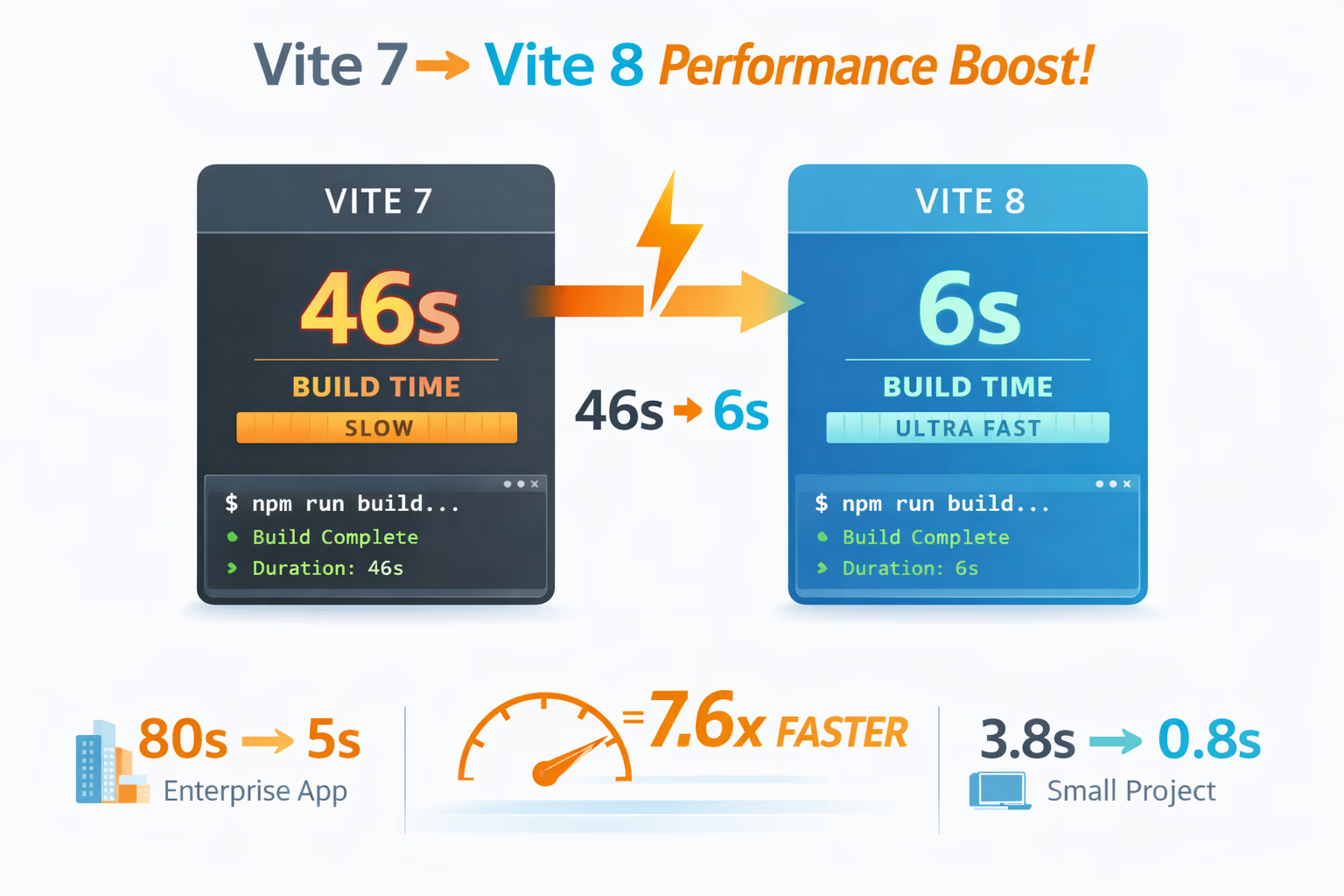
A rough rule of thumb from ecosystem reports: large codebases (500+ modules) see the biggest gains, mid-sized projects (100–500 modules) typically land in the 5–10x range on production builds, and small apps see roughly 2–5x. Note that dev-server HMR speed is largely unchanged from Vite 7 — that was already fast with esbuild. The big wins are in production build time and dependency pre-bundling.
| company | before | after | result |
|---|---|---|---|
| Linear | 46 seconds | 6 seconds | ~7.6x faster (87% reduction) |
| GitLab | 2.5 minutes (Vite 7); Webpack originally | 22 seconds | 43x faster than original Webpack setup |
| Beehiiv | Baseline | 64% faster | Significant improvement |
| Ramp | Baseline | 57% faster | Significant improvement |
| Mercedes-Benz.io | Baseline | Up to 38% faster | Moderate improvement |
Why Does Rolldown Improve Build Speed?
Why a Rust-Based Bundler Is Faster
Rolldown is written in Rust, which suits high-performance compilation work, parallel execution, and single-pass full-module-graph analysis. In the official 19,000-module benchmark, Rolldown finished in 1.61 seconds versus Rollup's 40.1 seconds — a ~25x difference at the bundler level. That's where the widely quoted 10–30x figure comes from.
How a Single Pipeline Reduces Overhead
When development and production share one bundling engine, Vite no longer bridges two separate systems. Dependency pre-bundling now shares the same module graph as the rest of the pipeline, eliminating duplicate work that the old esbuild step performed.
What Plugin Simplification Changes
Rolldown supports the same plugin API as Rollup, so most existing Vite and Rollup plugins work out of the box. Plugins no longer need to behave correctly across two distinct bundling architectures, which lowers mismatch risk.
How Internal Optimizations Help Large Apps
Rolldown enables more aggressive dead code elimination (it can analyze the full module graph in a single pass), smart constant inlining by default, module-level persistent caching, more flexible chunk splitting, and Module Federation support — capabilities that were difficult or impossible with the dual-bundler setup. Bundles often come out smaller with zero config changes.
What Are the Real-World Limits of the Performance Claims?
The biggest mistake is assuming every project will see the same improvement. Real-world results depend on codebase scale, dependency graph complexity, plugin load, and build configuration.
This is why Vite 8 should be evaluated as an architectural upgrade first and a performance upgrade second. In some projects the speedup is dramatic; in others, the real win is dev/prod consistency and fewer edge cases.
- Small projects may see only modest gains (roughly 2–5x on production builds).
- Large applications with 500+ modules benefit the most.
- Plugin-heavy setups can reduce the speedup, since JavaScript plugin code still runs at JavaScript speed.
- The 10–30x claim is a bundler-level benchmark, not a guaranteed app-wide result.
- Dev-mode memory usage is notably higher: the main Node process can use several times more RAM than Vite 7 because Rolldown keeps more module-graph data in memory. Watch this on memory-constrained CI runners and laptops.
What Breaks During Migration? The 3 Real Gotchas
Most projects upgrade cleanly thanks to a compatibility layer that auto-converts existing esbuild and rollupOptions configuration to their Rolldown and Oxc equivalents. But three issues account for most migration headaches reported by the community.
1. build.rollupOptions Is Now build.rolldownOptions
Vite 8 renamed the config key. The compatibility layer translates most existing options automatically, but tools and plugins that read or write rollupOptions directly (Storybook was one high-profile example) need updates. If your config leans on advanced Rollup-specific options, review the migration guide rather than trusting auto-conversion blindly.
2. Stricter CommonJS Interop
Rolldown handles CJS module interop more strictly than the old pipeline. If runtime errors appear when importing CommonJS packages after upgrading, the temporary escape hatch is setting legacy.inconsistentCjsInterop: true in your config. The long-term fix is migrating those imports to ESM. This usually isn't a Vite bug — it's exposing module-system inconsistencies that the old setup papered over.
3. manualChunks Is Deprecated, Plus Environment Constraints
The manualChunks configuration no longer works the old way — chunk splitting is handled through Rolldown's newer, more flexible mechanisms. Separately: Vite 8 requires Node 20.19+ or 22.12+, ships as an ESM-only package, and Yarn PnP setups have known incompatibilities. Check these before you schedule the upgrade.
What New Features Come With Vite 8?
Vite 8 adds more than build performance improvements. It also ships practical enhancements that reduce the amount of extra tooling many teams need.
- Built-in Devtools support
- Native TypeScript path alias support
- emitDecoratorMetadata support without plugins
- WASM support in SSR
- Browser console logs forwarded to the terminal
- Module Federation support via the unified Rolldown pipeline
- A searchable plugin directory at registry.vite.dev covering Vite, Rolldown, and Rollup plugins
What's Happened Since Vite 8 Went Stable?
This release wasn't the finish line — the toolchain has kept moving since March 2026, and two developments matter for anyone deciding whether to upgrade now.
- Rolldown 1.0 stable (May 7, 2026): the API is now locked under semver — option names, types, and plugin hook signatures are backward-compatible, so pinning ^1.0.0 is safe. This removes the last 'is the foundation stable?' objection.
- Full bundle mode (in development): instead of serving unbundled per-file ESM in dev, Rolldown can bundle the whole app for development just like production. Preliminary numbers show ~3x faster dev startup, ~40% faster full reloads, and ~10x fewer network requests — a big deal for very large apps with slow dev page loads.
- Lazy barrel optimization (experimental): analyzes barrel-file exports so unused modules aren't compiled, cutting both build time and output size.
- The broader VoidZero toolchain (Vite, Rolldown, Vitest, Oxc, Oxlint) now shares one parser, resolver, and interop layer, so improvements flow to Vite users automatically.
What Are the Trade-Offs of Upgrading to Vite 8?
The upgrade is not free. Vite 8 introduces a larger install, higher dev-mode memory usage, and some migration risk for complex or highly customized builds.
These trade-offs are the cost of a faster, unified build system. For teams that care more about build throughput and dev/prod parity than package size or dev memory footprint, the trade is usually worthwhile — especially when CI minutes are money on a codebase the size of a large production app, the kind of build-time math that mattered when we compared tools on a 25-module ERP codebase.
- Install size increased by roughly 15 MB: ~5 MB from the Rolldown binary (optimized for speed over size) and ~10 MB from Lightning CSS, which moved from optional peer dependency to a normal dependency.
- Dev-mode RAM usage is meaningfully higher than Vite 7 because more module-graph data is kept in memory.
- Requires Node 20.19+ or 22.12+ and is ESM-only — older environments and Yarn PnP setups are blockers.
- Edge cases can still appear in heavily customized builds, particularly around CJS interop and custom chunking.
How Should You Approach Migration to Vite 8?
Most basic projects migrate cleanly, but larger apps should use the officially recommended two-step path so problems can be isolated.
- Step 1: On Vite 7, swap the vite package for rolldown-vite. This isolates Rolldown-specific issues from everything else that changed in Vite 8. Recommended for larger or complex projects.
- Step 2: Once builds are clean, upgrade to Vite 8 stable.
- Check plugin compatibility first via registry.vite.dev — most plugins work, but obscure Rollup plugins are the risk area, the same dependency-risk category covered in <a href="https://stacknovahq.com/ai-tools-for-developers/claude-code-hallucinated-packages-slopsquatting">our breakdown of hallucinated npm packages</a>.
- If a framework (Astro, Nuxt, Vitest, etc.) pins Vite as a dependency, you may need a package-manager override to test early — or simply wait for that framework's Vite 8 support.
- Compare production output, bundle sizes, and runtime behavior between Vite 7 and Vite 8 builds before switching CI over.
FAQ
Strategic Summary
Final Thoughts
Vite 8 is more than a version update — it's a structural change that unifies development and production around Rolldown, now backed by a locked 1.0 stable API. The performance data from Linear, GitLab, Ramp, and Beehiiv is real, the migration gotchas are known and fixable, and the trade-offs (install size, dev memory, ESM-only) are documented. The key takeaway: evaluate your actual build pipeline against the two-step migration path rather than the headline speed numbers — and for large apps, the case for upgrading now is strong. If you are weighing this migration alongside other production build decisions, that is the kind of tooling audit Zethius runs for client engineering teams.
Next Up