Claude Fable 5 vs Opus 4.8: Real CRM Code Tested

Written by
Sumit Patel
Published
July 5, 2026
Updated
July 5, 2026
Reading Level
Advanced Strategy
Investment
28 min read
Fable 5 vs Opus 4.8 — the short version
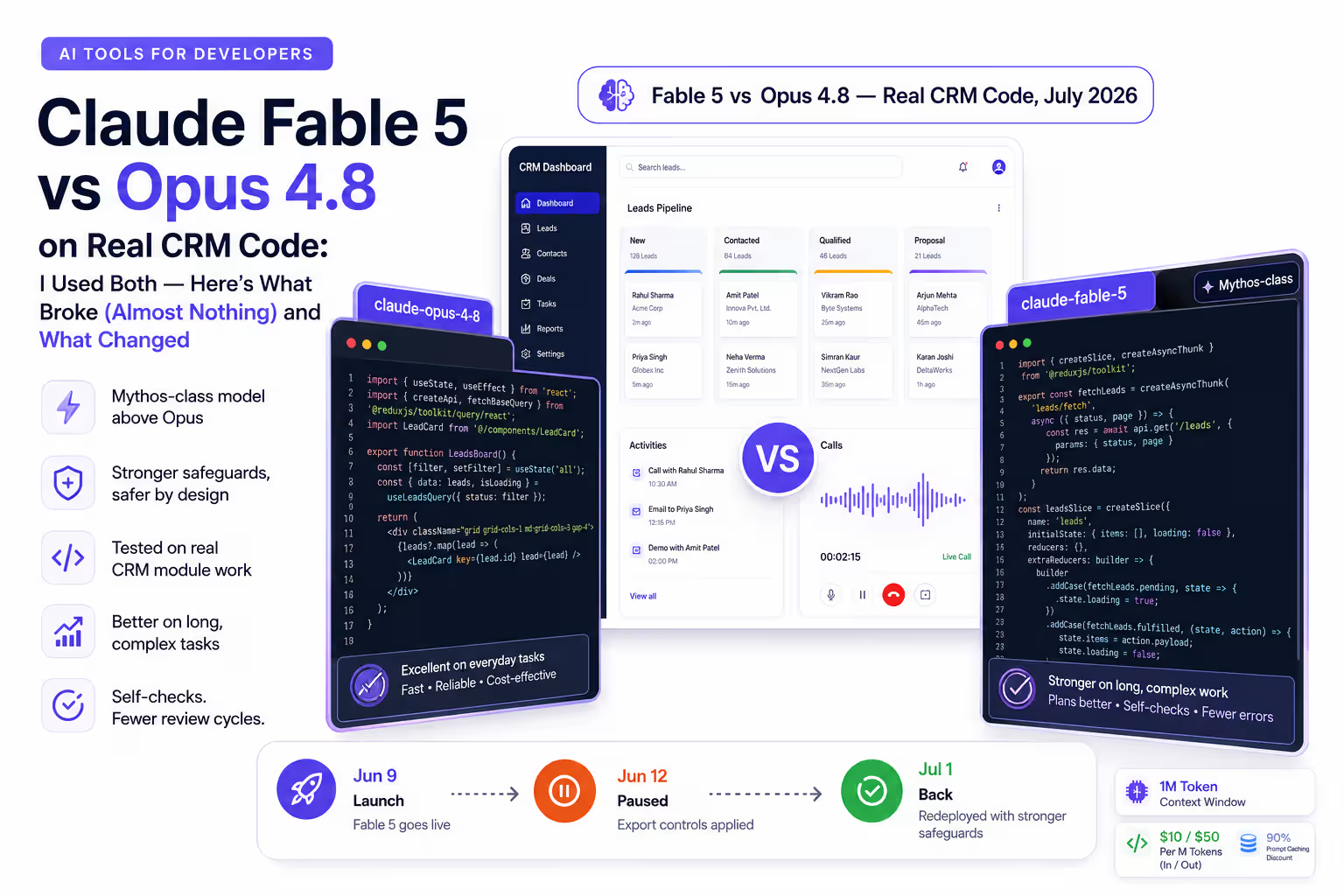
- 1What Fable 5 is → Anthropic's first generally available Mythos-class model (a tier above Opus); same underlying model as Mythos 5, plus safety classifiers.
- 2Timeline → launched Jun 9, 2026; paused Jun 12 under export controls; restored Jul 1 with enhanced safeguards.
- 3On real CRM code → both are excellent; Fable 5 pulls ahead on long, complex, multi-stage tasks and self-checks its work.
- 4Refusals in normal dev work → I saw [[FILL: number of refusal/fallback events you actually saw, likely zero]]. Classifiers target cyber/bio topics, firing in under 5% of sessions on average; flagged queries get answered by Opus 4.8 instead.
- 5API migration gotchas → stop_reason 'refusal' arrives as HTTP 200; use the fallbacks parameter (beta) or SDK middleware; 30-day retention, no ZDR.
- 6Pricing → $10/M input, $50/M output; 90% prompt-caching discount; US-only inference at 1.1x.
- 7Subscription access → Pro/Max/Team/select Enterprise; 50% of weekly limit through Jul 7, usage credits after; Anthropic aims to restore it as a standard plan feature.
- 8Verdict → keep Opus 4.8 (or Sonnet) as the everyday default; reach for Fable 5 on the genuinely hard, long-horizon problems.
Why I'm the one writing this — and why the boring finding is the honest one.
I'm a frontend developer. I build and maintain a 25-module ERP, a 100+ user membership CRM with ViciDial wired in, and a multi-tenant CRM SaaS product — all in React and TypeScript — and I use AI coding tools on that work every single day. When Fable 5 launched on June 9, I put it straight onto real CRM module work next to Opus 4.8. Then the export-control pause hit, I went back to Opus full-time for almost three weeks, and on July 1 I picked Fable back up. That accidental A/B structure — same codebase, same kind of tasks, forced switching between the two models — is the basis of this review. Most Fable 5 coverage right now is either benchmark screenshots from launch day or drama coverage of the export-control saga. Neither answers the question that matters to a working developer: when you point both models at the same real production code, what's actually different, and does anything about the new safeguards or the new billing model bite you? Fair warning about this review: my headline finding is that nothing broke. I know 'everything worked' is a boring headline. It's also the truthful one, and per the rule I set in my slopsquatting piece — a zero count is a credible result; don't inflate it — I'd rather give you the accurate boring answer plus the places where things genuinely can break, than manufacture drama. I have no affiliation with Anthropic; these are simply the tools I use.
Here's a sentence I didn't expect to write about a frontier model launch in 2026: the most dramatic thing about Claude Fable 5 wasn't the model — it was everything around the model. Fable 5 launched on June 9 as Anthropic's first Mythos-class model for general use — a new tier above Opus, sharing the same underlying model as the restricted Claude Mythos 5. Three days later it vanished under US export controls after a reported jailbreak. On July 1 it came back, with what Anthropic calls its strongest safeguards ever. In between, developers argued about whether the safety classifiers would ruin it for real work, whether the fallback-to-Opus behavior meant you were paying Mythos prices for Opus answers, and whether the whole thing was worth the usage-credit cost. I didn't have to speculate, because I'd already been using it. I ran Fable 5 on real CRM module work during its three-day launch window, spent the pause working the same codebase with Opus 4.8, and went back to Fable the day it returned. This post is my honest Claude Fable 5 vs Opus 4.8 report: what Fable 5 actually is (and how it differs from Mythos 5), what broke in real development work — spoiler: almost nothing — what genuinely changed versus Opus 4.8, whether the classifiers ever fired on normal code, the three integration changes that can silently break an API setup, and the cost reality of using a model that's currently metered in credits. If you've read my Claude Mythos Preview piece from April, this is the payoff: the Mythos-class capability finally in general hands, tested where it counts — on production client code.
Key Takeaways
7 PointsThe Honest 30-Second Verdict
If you only read one section, read this one.
Both models are legitimately excellent, and that's not hedging — it's the finding. Across all my CRM module sessions on both Fable 5 and Opus 4.8, I did not hit a single failure worth writing down. No refusals on normal development work, no degraded outputs, no fallback events, nothing that cost me time. Even the most complex tasks I threw at Fable 5 came back right with far less back-and-forth than I'm used to.
The real difference between the two shows up on task length and depth. On a scoped edit — wire a field through the module, fix a selector, adjust a component — Opus 4.8 and Fable 5 are effectively interchangeable, and Opus is the cheaper way to get the same result. On long-horizon work — a multi-file refactor with dependencies, an implementation that requires holding a plan across many stages — Fable 5 is noticeably stronger: it plans better, drifts less, and checks its own work before handing it back. That matches Anthropic's own claim that Fable's lead over other models grows with task length and complexity.
And one difference I didn't expect to care about: conversation quality. Talking to Fable 5 feels less like operating a tool and more like working with someone. Even basic communication feels natural. That sounds cosmetic; in practice it means fewer clarification loops, which is time.
So the verdict isn't 'Fable good, Opus obsolete.' It's a split: Opus 4.8 (or Sonnet) for the everyday 80%, Fable 5 for the hard 20% — especially now that Fable is metered in usage credits.
What Is Claude Fable 5? (Mythos-Class, Explained)
Claude Fable 5 is the first model in Anthropic's Claude 5 family and the first Mythos-class model made generally available. Mythos-class is a new capability tier that sits above Opus — the way Opus sits above Sonnet.
The naming needs one minute of explanation because it confuses everyone. Fable 5 and Claude Mythos 5 share the same underlying model. The difference is safeguards. Fable 5 ships with safety classifiers — smaller automated systems that detect when a request touches high-risk cybersecurity or biology territory and route it away. Mythos 5 doesn't carry those classifiers, and is available only to approved organizations (critical-infrastructure defenders and similar) through Anthropic's Project Glasswing program. Same engine, different guardrails, hence different names.
What the safeguards do in practice: when a query trips a classifier, it's answered by Claude Opus 4.8 — Anthropic's next-most-capable model — instead of Fable. Anthropic says these trigger in under 5% of sessions on average, deliberately tuned on the cautious side, and that you aren't charged Fable prices for rerouted requests. I'll cover whether any of this ever touched my actual work in the safeguards section — short answer, no.
Capability-wise, Anthropic's claim is that Fable 5 is state-of-the-art on nearly every tested benchmark — software engineering, knowledge work, vision, scientific research — with the gap over Opus growing as tasks get longer and more complex. It's built for long-horizon agentic work: run it in a harness like Claude Code and it can plan across stages, delegate to sub-agents, write its own tests, and use vision to check outputs against the goal. Specs: a 1M-token context window by default, up to 128k output tokens per request, available on the Claude API (model string claude-fable-5), Amazon Bedrock, Google Cloud, and Microsoft Foundry, and on Claude Pro, Max, Team, and select Enterprise plans.
- Mythos-class = a new tier above Opus. Fable 5 is the first Mythos-class model in general availability (launched June 9, 2026).
- Fable 5 and Mythos 5 share one underlying model; Fable adds safety classifiers, Mythos (no classifiers) is restricted to Project Glasswing partners.
- Flagged queries fall back to Opus 4.8; classifiers fire in under 5% of sessions on average, and rerouted requests aren't billed at Fable prices.
- 1M-token context window, up to 128k output tokens; API model string claude-fable-5.
- Biggest claimed strength: long-horizon, multi-stage work — plans, delegates, tests its own output.
The Three-Week Saga: Launch, Pause, Return
You can't review Fable 5 in July 2026 without covering the timeline, because it shaped how everyone — including me — actually got to use it.
June 9: Fable 5 launches globally alongside the restricted Mythos 5. June 12: the US government applies export controls to both models after Amazon researchers reported a method of bypassing Fable 5's cybersecurity safeguards — prompting it to identify software vulnerabilities, in one case producing code demonstrating an exploit. The directive barred access for foreign nationals, and since Anthropic had no reliable way to verify user nationality in real time, it suspended both models for everyone. Three days of Fable, then gone.
What followed was interesting for anyone weighing how much to trust these tools. Anthropic's review, done with the government and Amazon, found that the vulnerabilities in the report could also be identified by several less capable models — including Opus 4.8, GPT-5.5, and Kimi K2.7 — and that every model they tested could produce the same exploit demonstration. In other words, the jailbreak didn't unlock unique Mythos-level capability. On June 30 the controls were lifted, and on July 1 Fable 5 returned worldwide — with enhanced cybersecurity safeguards tuned to trigger more readily, a new HackerOne program for researchers to report Fable jailbreaks, and deeper pre-release collaboration with the US government going forward.
For this review, the saga had one useful side effect: it forced a clean A/B structure. Three days of Fable on my CRM work, nearly three weeks back on Opus 4.8 on the same codebase, then Fable again from July 1. Same project, same kind of tasks, switching between the two models — which is a better comparison setup than any deliberate benchmark I'd have designed.
How I Tested It (Real CRM Work, Two Windows)
No synthetic benchmark, same as always on this site. I used both models inside my actual job, on real deadlines, on real client code.
The testbed was CRM module work: the kind of production React/TypeScript development I do daily on the membership CRM and the multi-tenant CRM SaaS — components, Redux/RTK Query data flows, API integration logic, refactors that cross multiple files, and the occasional genuinely hard architectural problem. Over the launch window (June 9–12) I ran Fable 5 on whatever came up. During the pause (June 12–30) the same stream of work went through Opus 4.8. From July 1, back to Fable — [[FILL: number of real work sessions on Fable 5 across both windows]] Fable sessions in total across both windows.
What I paid attention to, for both models: first-pass correctness (did the output work without a correction round), behavior on long multi-stage tasks (did it hold the plan or drift), refusal/fallback events (did a classifier ever fire on normal dev work), and the soft stuff — how much explaining and re-explaining each model needed before it understood the task.
A fairness note, same as my Antigravity review: I used my normal prompting style, not prompts tuned to flatter either model. And this is one developer's workload — CRM and frontend-heavy. If your work is systems programming, security, or biotech-adjacent, your safeguard experience in particular will differ from mine.
What Broke: Honestly, Almost Nothing
This is the section the title promised, so let me deliver it straight: in my real work, nothing broke.
Not one refusal on normal development tasks. Not one fallback event I could detect. Not one output that was structurally wrong in a way that cost me real time — from either model. I went into the launch window half-expecting the story of this post to be classifier friction, weird refusals on innocuous code, or Fable stumbling where Opus didn't. Across [[FILL: number of real work sessions on Fable 5 across both windows]] sessions, the count of issues worth writing down was [[FILL: number of refusal/fallback events you actually saw, likely zero]].
I want to be careful about what that does and doesn't mean. It doesn't mean Fable 5 is flawless — it means that for CRM and frontend development, the failure modes people speculated about at launch simply didn't materialize in my usage. Even the most complex things I handed it came back right with surprisingly little friction. One example that stuck with me: [[FILL: one concrete complex task Fable 5 handled in one pass, described high-level]]. On previous models that's a multi-round conversation; on Fable it was closer to a handoff.
Per the standard I set in the slopsquatting post — where I argued that a zero-issue count is a credible, publishable result and more interesting than a fabricated scary number — I'm reporting the boring truth: for this class of work, both models just work.
But 'nothing broke in the product' is not the same claim as 'nothing changes for your setup.' There are three places where switching to Fable 5 genuinely can break things — they're just in your integration code and your billing, not in the model's output. That's the API migration section below, and if you call Claude programmatically it's the most important part of this article.
- Zero refusals, zero detectable fallbacks, zero time-costing failures across all sessions of real CRM/frontend work — on both models.
- The launch-week fear — classifiers ruining normal dev work — did not materialize for this class of work.
- Complex, multi-stage tasks were where Fable most exceeded expectations: correct on the first pass far more often.
- Honest scope: this is a CRM/frontend workload. Security and biology-adjacent work will meet the classifiers far more often.
- The real 'what can break' lives in your API integration, not the model output — covered below.
What Actually Changed: Claude Fable 5 vs Opus 4.8 on Real Tasks
So if nothing broke, what did I actually get for the Mythos-class price tag? Three things, in order of how much they mattered to me.
First — and biggest — long-horizon reliability. On short scoped tasks the two models are close enough that I couldn't reliably tell their outputs apart. The separation appears as tasks get longer. Hand Opus 4.8 a large multi-stage refactor and it does well, but I stay in the loop — checking intermediate steps, nudging it back on course. Hand the same task to Fable 5 and it behaves more like a senior dev who took notes in the kickoff meeting: it holds the plan, sequences the work sensibly, and — this is the part that changes the workflow — verifies its own output before presenting it. The head-to-head that convinced me: [[FILL: one concrete task where you compared Opus 4.8 and Fable 5 head-to-head]]. Anthropic's claim that Fable's lead grows with task length matched my experience exactly.
Second, self-checking. Fable 5 is noticeably more proactive about testing its own work — writing checks, tracing its changes through the code, catching its own inconsistencies before I do. With Opus, review is my job; with Fable, review starts to feel like a second pass rather than the first line of defense. I still review everything (see my AI code review post for why), but the defect rate arriving at my review dropped.
Third, the conversational feel — and I hesitated to include this because it sounds like fluff, but it has a real productivity effect. Communication with Fable 5 feels natural in a way that's hard to convey in a benchmark: it gets the intent of a loosely worded request the first time, asks the right clarifying question when one is genuinely needed, and doesn't need the careful prompt-engineering scaffolding I habitually build. Fewer clarification loops per task is a measurable time saving even if 'it feels real to talk to' isn't a measurable metric.
What did NOT change: short tasks aren't meaningfully better, and Opus 4.8 remains an outstanding model — three weeks of pause-era work on it reminded me it's nobody's consolation prize.
| dimension | opus 4 8 | fable 5 |
|---|---|---|
| Short, scoped edits | Excellent — effectively interchangeable with Fable | Excellent — no meaningful advantage here |
| Long, multi-stage tasks | Good, but needs supervision at intermediate steps | Noticeably stronger — holds the plan, drifts less |
| Self-checking | On request | Proactive — tests and verifies its own work by default |
| Conversation / intent-reading | Very good | Feels natural — fewer clarification loops |
| Refusals on normal dev work | None seen | None seen — classifiers target cyber/bio, not CRM code |
| API price (per M tokens) | Lower — standard Opus pricing | $10 input / $50 output |
| Subscription access | Standard plan usage | 50% of weekly limit to Jul 7, then usage credits |
| I reach for it when | Everyday work — the routine 80% | The hardest 20% — long, complex, architecturally heavy |
* Pricing and access rules for both models are changing rapidly — Fable's subscription policy has already changed twice within a month of launch. Figures here reflect Anthropic's published pages at the time of writing; verify current pricing at anthropic.com before committing budget.
The Safeguards Question: Did the Classifiers Ever Fire?
This was the question every developer asked at launch, and asked louder after July 1's 'extraordinarily strong' safeguards language: will the classifiers get in the way of normal work?
My answer, from real usage on both sides of the pause: no. Not once. Across every Fable 5 session on CRM modules, React components, Redux state, API integration code, and database-adjacent logic, I never saw a refusal, never saw a response that read like it had been rerouted, and never hit friction I could attribute to a safety system. The classifiers are aimed at a specific territory — offensive cybersecurity and biology/chemistry — and everyday product development doesn't go anywhere near it. Anthropic's own number is that safeguards trigger in under 5% of sessions on average, and my experience suggests that for a frontend/CRM workload the effective rate rounds to zero.
Two honest caveats. First, the fallback design means a triggered classifier doesn't refuse you outright in most cases — it answers via Opus 4.8 instead, and you aren't charged Fable prices for the rerouted request. So some fraction of 'Fable' answers across all users are actually Opus answers, which cynics have summarized as 'Fable might just be Opus in a mask.' For flagged topics, that's structurally true; for everything else — which is everything I do — it demonstrably isn't, because the long-horizon behavior gap I described above is real and consistent.
Second, biology and chemistry queries currently fall back to Opus 4.8 on most requests — Anthropic has said openly that these safeguards are tuned more broadly than ideal and that it intends to narrow them, with a trusted-access program coming for biomedical researchers. If you're in that field, Fable 5 today is not for you yet, and no review by a frontend developer should convince you otherwise.
The takeaway for working developers: judge the safeguards by your domain, not by the discourse. For product development, they're invisible.
- Zero classifier events across all my sessions — CRM/frontend work never approaches the flagged categories.
- Flagged queries are answered by Opus 4.8 rather than hard-refused, and rerouted requests aren't billed at Fable prices.
- Post-July-1 cybersecurity safeguards are deliberately stricter — security researchers should expect real friction.
- Most biology/chemistry requests currently fall back to Opus 4.8; Anthropic says it plans to narrow this and add a trusted-access program.
- Rule of thumb: for normal product development the safeguards are invisible; for dual-use domains, they're the whole story.
The 3 Integration Changes That CAN Break Your Setup
Here's where 'what broke' gets a real answer — not in the model, but in the migration. If you call Claude through the API and you swap your model string to claude-fable-5, three things change, and two of them will break naive code silently.
First, refusals are HTTP 200. When Fable 5's classifiers decline a request, the Messages API returns stop_reason: "refusal" as a successful response — not an error status. The response also reports which classifier declined. If your integration only checks HTTP status codes and then blindly consumes the content, a refusal will flow through your pipeline looking like a normal answer. Every Fable integration needs an explicit stop_reason check.
Second, you need a fallback strategy. A request Fable refuses can usually be served by another Claude model, and Anthropic gives you three routes: a server-side fallbacks parameter (in beta on the Claude API and Claude Platform on AWS) that retries for you, client-side SDK middleware (TypeScript, Python, Go, Java, C#), or rolling your own retry against claude-opus-4-8. For anything user-facing, pick one before you ship — a refusal with no fallback is a dead end your users will see.
Third, billing and data rules differ. Fable 5 is $10 per million input tokens and $50 per million output — with the standard 90% prompt-caching discount on input, which matters enormously for agentic workloads that resend large contexts. US-only inference is available at 1.1x pricing. And a compliance detail that will matter to some client projects: Fable 5 (and Mythos 5) carry 30-day data retention and are not available under zero data retention — they're designated Covered Models. If a client contract requires ZDR, Fable 5 is off the table for that project today, full stop.
None of this is hard. All of it is the kind of thing that breaks quietly if you treat a model swap as a one-line change.
- Check stop_reason on every Fable 5 response — "refusal" comes back as a successful HTTP 200, not an error.
- Pick a fallback route before shipping: server-side fallbacks parameter (beta), SDK middleware, or a manual retry on claude-opus-4-8.
- Budget on $10/M input, $50/M output — and lean on the 90% prompt-caching discount for agentic workloads.
- Compliance check: 30-day data retention, no zero-data-retention option. If a client requires ZDR, Fable 5 is currently excluded.
- Test the refusal path deliberately in staging — in normal dev work you may never trigger it organically, which means it ships untested.
Cost & Usage Reality (Credits, Limits, and When to Reach for Fable)
The practical constraint on Fable 5 right now isn't capability or safeguards — it's metering.
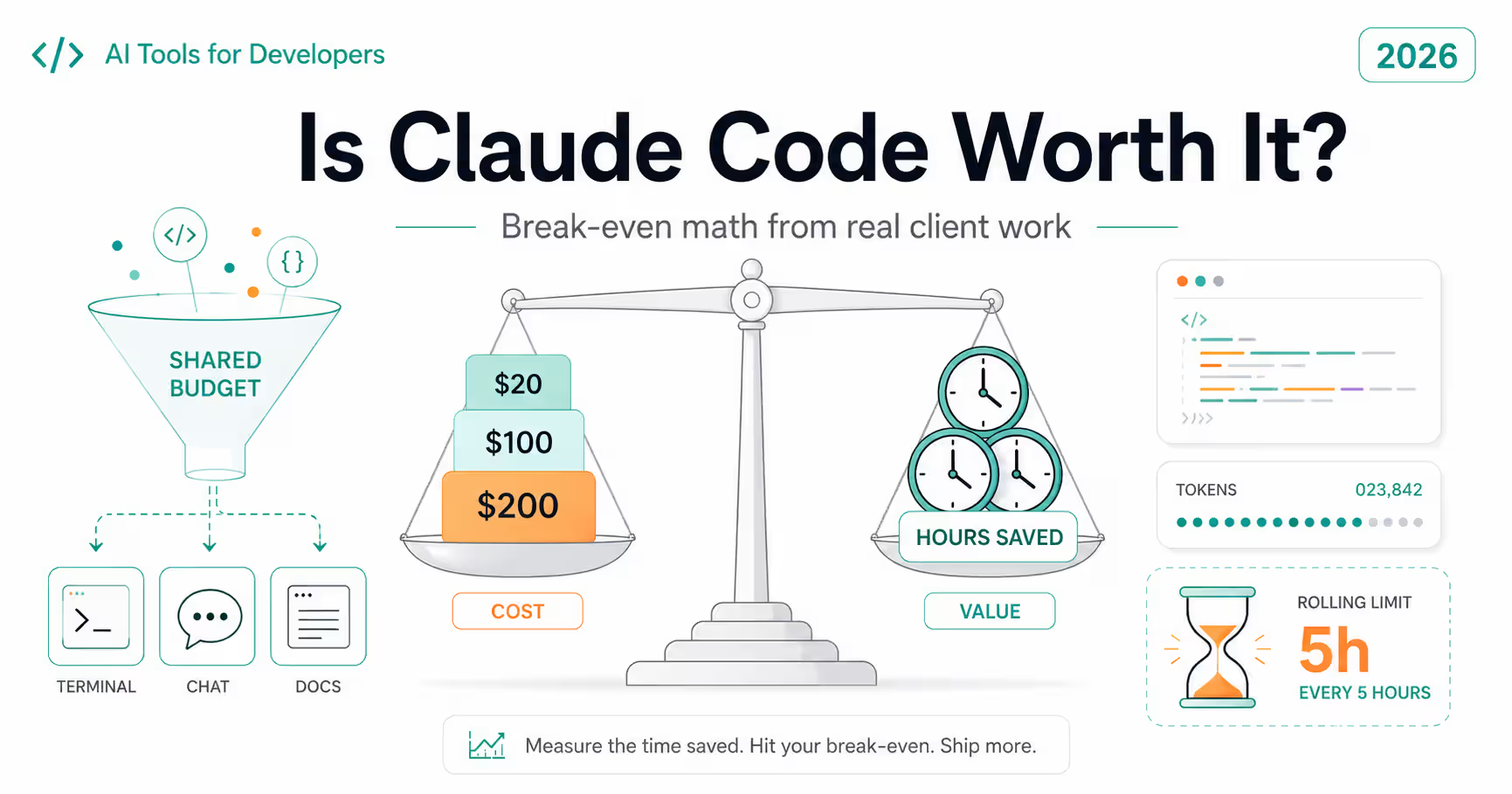
On subscriptions, the July 1 return came with a temporary structure: eligible Pro, Max, Team, and select Enterprise users could put up to 50% of their plan's weekly usage limit toward Fable 5 through July 7, after which Fable use runs on usage credits. Anthropic has said it aims to restore Fable as a standard part of subscription plans once capacity allows, and that it will communicate changes ahead of time — but as of this writing, credits are the operative model. Fable also consumes tracked usage meaningfully faster than other models, so a Fable-heavy day eats your allowance in a way an Opus-heavy day doesn't. In my own usage it ran to roughly [[FILL: rough share of your weekly usage limit Fable consumed, if you tracked it]] of my weekly limit.
On the API, the math is simpler: $10/M input, $50/M output, with prompt caching cutting cached input by 90% — which is the difference between viable and not for long agentic sessions that resend a big codebase context every turn.
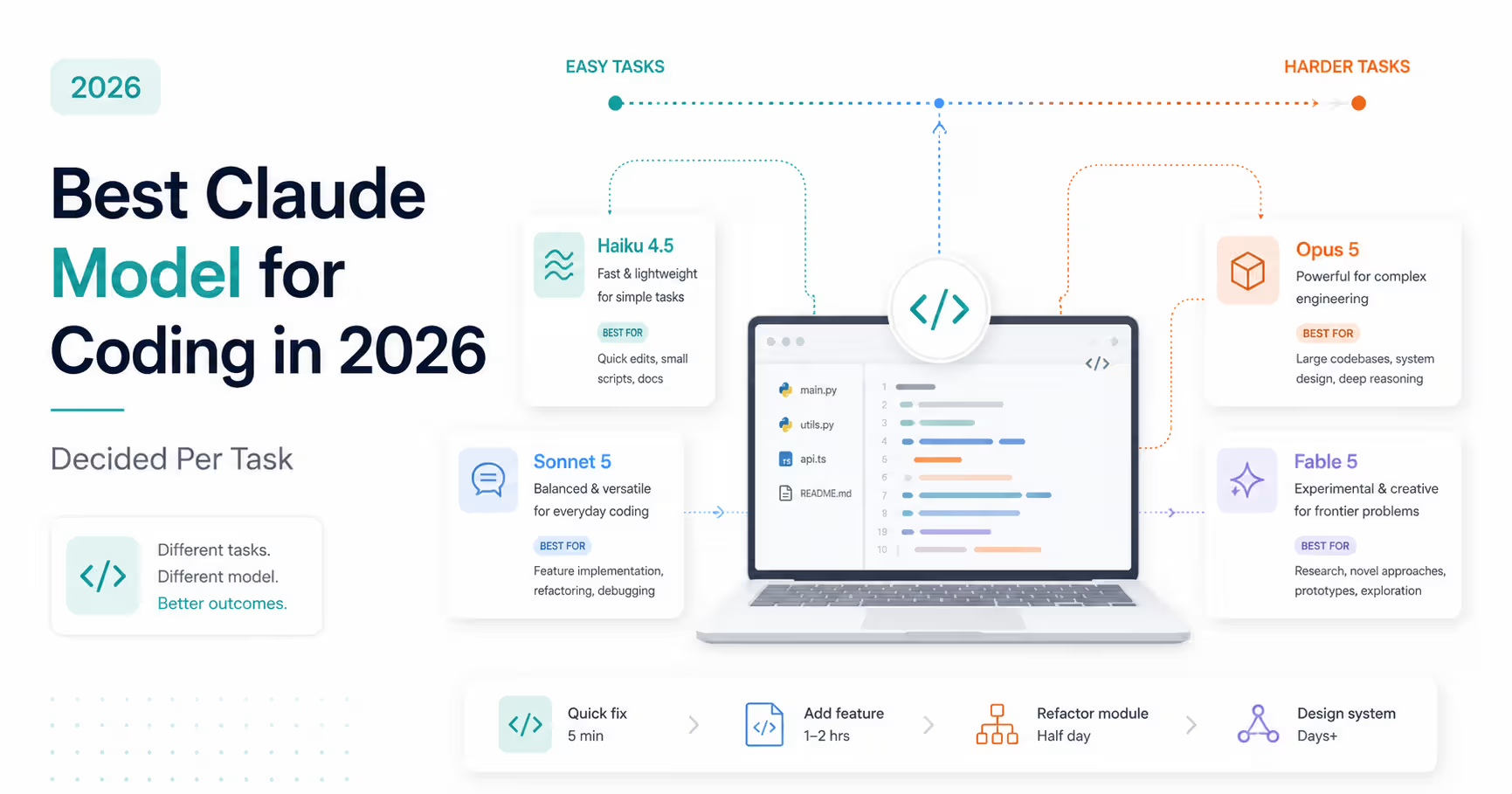
All of this points to the same usage pattern, and it's the one I've settled into: don't make Fable 5 your default. Make it your escalation path. Sonnet or Opus 4.8 for the routine work where they're already excellent and near-indistinguishable from Fable; Fable 5 for the tasks where its long-horizon advantage actually cashes out — the gnarly refactor, the multi-day implementation, the problem you'd otherwise spend an afternoon supervising. That's also, not coincidentally, exactly the usage pattern the pricing structure is nudging everyone toward.
Should You Switch? My Honest Verdict
Use both. That's not a cop-out — it's the same conclusion every honest comparison on this site reaches, because it's how this work actually gets done.
If you're on a Claude subscription and you do genuinely hard, long-running work — big refactors, complex implementations, tasks you currently babysit — Fable 5 is worth its credit cost for exactly those tasks. The long-horizon reliability and self-checking are real, the conversational quality is a genuine (if unquantifiable) upgrade, and for normal product development the safeguards never enter the picture. My experience across both availability windows was, honestly, issue-free — and I don't say that about many tools on this site.
If your work is mostly short, scoped tasks, don't feel behind for staying on Opus 4.8 or Sonnet. Three weeks of pause-era work reminded me that Opus 4.8 is a superb model in its own right; on everyday tasks you will not feel the difference, and you'll feel the credit meter.
If you run API integrations, the migration is the real work: handle stop_reason "refusal", wire a fallback, re-check the retention rules against your client contracts, and test the refusal path on purpose — because in normal work you'll never hit it by accident.
And if your domain is security research or biology — wait, or apply for the trusted-access routes. The current safeguards are deliberately broad in exactly your territory, and Anthropic has said so itself.
The bigger picture: Mythos-class capability in general availability is the most significant model release of 2026 so far, and after the export-control detour, the version we got back is the cautious one. On real CRM code, cautious turned out to be plenty.
Frequently Asked Questions
Strategic Summary
Final Thoughts
The honest summary of a month with Fable 5: the drama was all off-stage. On stage — on real CRM module code — both Fable 5 and Opus 4.8 were close to flawless, and the interesting story isn't what broke, because nothing did. It's what quietly changed: Fable's grip on long, multi-stage work, its habit of checking itself before handing work back, and a conversational quality that removed the prompt-scaffolding ritual I didn't realize I'd been performing. The things that CAN break are all in the migration, not the model: refusals arriving as HTTP 200s, integrations without a fallback path, ZDR-bound client contracts, and a credit meter that punishes using a Mythos-class model for Sonnet-class tasks. Handle those four and the switch is uneventful — which, after a launch that involved federal export controls, is a strange kind of compliment. My setup going forward: Opus 4.8 and Sonnet stay as the daily drivers, Fable 5 is the escalation path for the problems that used to eat an afternoon of supervision. The same lesson every tool review on this site lands on — match the model to the task — just with a genuinely stronger option at the top of the stack now. And the standing caveat, bigger than usual this time: everything about Fable 5's access, pricing, and safeguards has changed twice in a month and will change again. Test it on your own work, in your own domain, before you take my word — or anyone's. --- Last reviewed: July 5, 2026. Model details, timeline, pricing, and usage policy are from Anthropic's announcements, platform documentation, and press coverage at the time of writing, all linked below — they are changing rapidly, so verify directly before relying on them. Experience described reflects my own real usage on production CRM and client code; project specifics are kept high-level to respect client confidentiality. No affiliation with Anthropic or any tool named.
Have you used Fable 5 since the July 1 return? Tell me in the comments what domain you work in and whether the classifiers ever fired on you — I'm collecting real-world data on how the safeguards behave across different kinds of work, because my CRM-heavy experience is one data point, not the whole picture.
If you found this useful, I write hands-on, no-hype reviews of AI models and coding tools from daily client work — Claude, Antigravity, Codex, Cursor and more. Browse the AI Tools for Developers hub, or reach me via stacknovahq.com/contact.
Next Up
Continue your research
Claude Mythos Preview: Anthropic's Power AI Model (2026)
Claude Code vs Cursor on a 25-Module ERP: An Honest Comparison
Custom CRM vs Ready-Made for Indian SMBs (2026)
AI Code Review: What It Catches, What It Misses, and What Only You Can Find
Google Antigravity 2.0 CLI: I Tested It on a Real Project
Sources & Research
Anthropic — Claude Fable 5 and Claude Mythos 5 (launch announcement, June 9, 2026)
https://www.anthropic.com/news/claude-fable-5-mythos-5
Anthropic — Redeploying Claude Fable 5 (July 2026)
https://www.anthropic.com/news/redeploying-fable-5
Claude Platform Docs — Introducing Claude Fable 5 and Claude Mythos 5 (API changes, refusals, pricing)
https://platform.claude.com/docs/en/about-claude/models/introducing-claude-fable-5-and-claude-mythos-5
Anthropic — Claude Fable product page (pricing, availability)
https://www.anthropic.com/claude/fable
The Hacker News — Anthropic Restores Claude Fable 5 After U.S. Lifts Export Controls
https://thehackernews.com/2026/07/anthropic-restores-claude-fable-5-after.html
MacRumors — Fable 5 available again; usage limit and credits details
https://www.macrumors.com/2026/07/01/anthropic-fable-5-relaunch/
9to5Google — Fable 5's return with enhanced safeguards
https://9to5google.com/2026/07/01/anthropic-fable-5-returns-to-claude/