Claude Fable 5 Refusals Explained: Opus 4.8 Fallback

Written by
Sumit Patel
Published
July 8, 2026
Updated
July 8, 2026
Reading Level
Advanced Strategy
Investment
21 min read
Fable 5 refusals — the short version
- 1What happened → a safety classifier flagged your request; Opus 4.8 answered it instead, with a notification.
- 2Billing → rerouted requests are NOT charged at Fable prices.
- 3Trigger domains → offensive cybersecurity and biology/chemistry. Normal dev work doesn't come near either.
- 4Frequency → under 5% of sessions on average; effectively 0% for product development (my real count: zero).
- 5Post-July-1 → cybersecurity classifiers are stricter than at launch; false positives skew toward security-adjacent topics.
- 6API shape → HTTP 200 + stop_reason 'refusal' + which classifier fired. Status-code-only error handling misses it completely.
- 7Fixes → server-side fallbacks parameter (beta), SDK middleware, or manual retry on claude-opus-4-8.
- 8False positive → rephrase, take the Opus answer, report via thumbs-down. HackerOne is for jailbreaks, not over-blocking.
Why I'm the one writing this — including the part where the problem never happened to me.
I'm a frontend developer building production ERP and CRM systems in React and TypeScript, and I've used Fable 5 on that work through both of its availability windows — the three-day June launch and the post-July-1 return — alongside daily Opus 4.8 use. So I'm writing about the refusal system from an unusual position: I understand it in detail and I have personally never triggered it. My reroute count across all real production sessions is zero. That's not a gap in this article; it's the most useful data point in it. The refusal discourse online is dominated by two groups — security researchers who hit the classifiers constantly (by design) and people repeating launch-week fears who haven't used the model at all. What's missing is the middle: what the safeguards actually mean for a normal developer doing normal work, and what an API integrator has to handle regardless of whether refusals ever fire. That's this post. Facts here come from Anthropic's launch and redeployment announcements and platform documentation, all linked below. No affiliation with Anthropic — these are simply the tools I use and pay for.
You picked Fable 5 from the model picker, asked your question, and got a notification that your answer came from Opus 4.8 instead. Or your API integration started returning responses with stop_reason set to 'refusal' — as HTTP 200s, which your error handling cheerfully ignored. Either way, you've just met the most misunderstood part of Anthropic's most capable model: Claude Fable 5 refusals. Here's the context in one breath: Fable 5 is a Mythos-class model — the new tier above Opus — and it shares its underlying model with Claude Mythos 5, which is restricted to vetted critical-infrastructure defenders. The only thing standing between 'general availability' and 'approved organizations only' is a set of safeguards, and the most visible of them is a classifier system that watches for high-risk cybersecurity and biology requests and routes flagged ones to Opus 4.8. After a reported jailbreak triggered a three-week government suspension in June, those classifiers came back stricter than ever on July 1. So the refusal system isn't a bug or an afterthought — it is literally the reason you're allowed to use this model at all. This post explains how it actually behaves: what happens when a request is flagged (and what it costs you — spoiler: not Fable prices), which topics trigger it and which never will, an honest answer to the 'Fable is just Opus in a mask' meme, the HTTP-200 refusal trap that silently breaks naive API code, the three fallback strategies Anthropic gives you, and the right way to deal with false positives. For the capability side — whether Fable is worth using at all — see my full Fable 5 vs Opus 4.8 review on real CRM code. This is the troubleshooting companion, same as my Antigravity 'high traffic' error post: the thing you search when the tool does something unexpected.
Key Takeaways
7 PointsThe 60-Second Answer: Claude Fable 5 Refusals Explained
If Fable 5 rerouted or refused your request, here's the whole picture, fast.
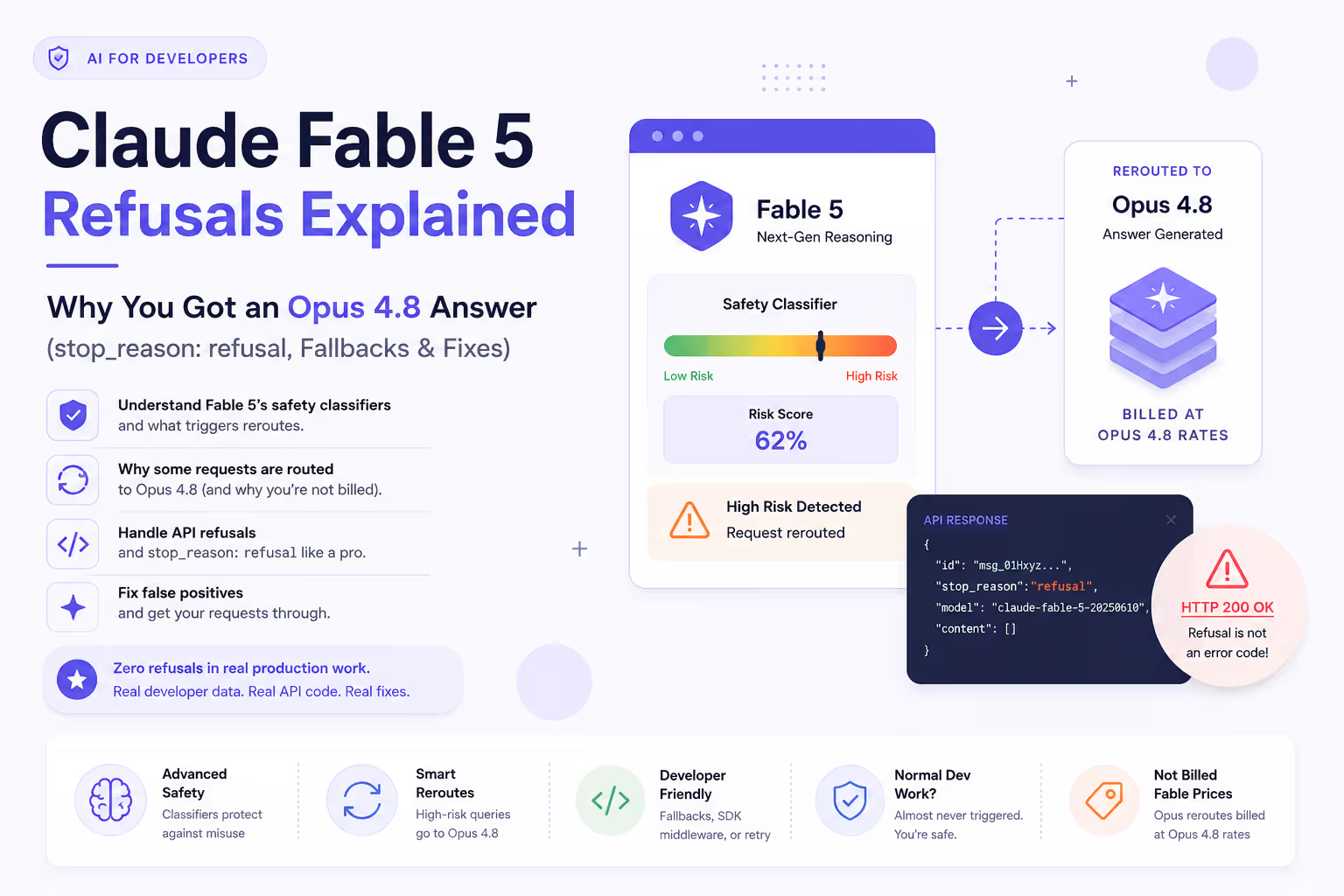
Fable 5 runs with safety classifiers — smaller automated AI systems that monitor each interaction for potentially harmful requests in two domains: offensive cybersecurity and biology/chemistry. When a classifier flags your request, it isn't answered by Fable; it's answered by Claude Opus 4.8, Anthropic's next-most-capable model, and you get a notification saying so. You are not charged Fable prices for the rerouted answer. Anthropic's published figure is that safeguards trigger in under 5% of sessions on average, tuned deliberately to the cautious side — meaning false positives on benign requests are an accepted cost, not an accident.
On the API, the same event surfaces differently: the Messages API returns a successful HTTP 200 with stop_reason set to 'refusal', and the response reports which classifier declined. Anthropic provides three recovery routes — a server-side fallbacks parameter (in beta), SDK middleware, or your own retry against claude-opus-4-8.
Two timing notes that explain why you might be seeing this now. The July 1 redeployment shipped stricter cybersecurity classifiers than the June 9 launch version — Anthropic says the new classifier blocks the reported jailbreak in over 99% of attempts — so security-adjacent work meets more friction than before, not less. And biology/chemistry requests currently fall back to Opus 4.8 on most queries by design, while Anthropic works on narrowing the safeguards and opening a trusted-access program for biomedical researchers.
If your work is ordinary software development, none of this will ever touch you — the rest of this post explains why, and what to build anyway.
Why Fable 5 Has Classifiers at All (Fable vs Mythos)
The classifiers make sense the moment you understand the naming.
Fable 5 and Claude Mythos 5 share the same underlying model — Anthropic has said this plainly. Mythos-class capability crossed a threshold where, without safeguards, abilities in areas like cybersecurity could cause serious damage; a precursor Mythos model reportedly found and exploited zero-day vulnerabilities across major operating systems on command. So Anthropic split the release: Mythos 5, without classifiers, goes only to vetted organizations defending critical infrastructure through Project Glasswing. Fable 5, with classifiers, goes to everyone. The safeguards are the entire difference between the two models — it's why they have different names.
The classifier layer sits inside a broader approach Anthropic calls defense in depth: the model itself is trained to decline dangerous requests, usage patterns are analyzed retroactively for misuse, and the classifiers act as real-time monitors during each interaction. No single layer is perfect; stacked, they're meant to make misuse very difficult.
June proved the stakes weren't theoretical. Amazon researchers found a prompt method that bypassed Fable's safeguards — getting it to identify software vulnerabilities and, in one case, produce exploit-demonstration code. The US government responded with export controls that took Fable offline for nearly three weeks. Anthropic's subsequent review found the specific vulnerabilities could also be identified by less capable models including Opus 4.8 and GPT-5.5 — the jailbreak hadn't unlocked unique Mythos-level capability — and the controls were lifted June 30. But Fable returned with a hardened classifier (blocking that bypass in over 99% of attempts, per Anthropic), a HackerOne program for researchers to report new jailbreaks, and an explicit acknowledgment that the tuning errs toward over-blocking.
The practical takeaway: the refusal system is the price of general availability for a model this capable. Anthropic has been unusually candid that the current tuning is stricter than ideal and that it intends to narrow the safeguards over time. Until then, understanding the behavior beats resenting it.
- Fable 5 = Mythos 5 + safety classifiers. The safeguards are the entire difference — and the reason general users get access at all.
- Defense in depth: trained refusals + retroactive misuse analysis + real-time classifiers, stacked.
- The June jailbreak → export controls → June 30 lift → July 1 return with a hardened classifier and a HackerOne jailbreak-reporting program.
- Anthropic's own review: the jailbreak's outputs were reproducible on less capable models — no unique Mythos capability was exposed.
- Anthropic openly says current tuning over-blocks and will be narrowed. Expect the behavior described here to loosen over time.
What Actually Happens When a Request Is Flagged
Walk through the flagged-request path, because it's gentler than the word 'refusal' suggests.
In the Claude app or Claude Code: you send a request on Fable 5, a classifier flags it, and instead of a hard refusal you get an answer generated by Opus 4.8, with a notification telling you the reroute happened. For most flagged-but-benign requests this is close to a non-event — Opus 4.8 is an excellent model, and on short or moderate tasks its answers are nearly indistinguishable from Fable's (that's one of the findings of my head-to-head review). You lose Fable's edge only where it actually exists: very long, complex, multi-stage work.
On billing, the rule is clean and worth repeating because people assume the worst: you are not charged Fable prices for rerouted requests. If you're inside a subscription, a rerouted answer isn't drawing your allowance at Fable's accelerated rate; on the API, you shouldn't see Fable-rate line items for classifier-declined calls. For anyone building cost dashboards or doing usage accounting, log reroutes as Opus-priced events.
On the API, the flagged path is more abrupt and more dangerous to naive code: rather than silently substituting Opus, the Messages API returns the refusal itself — stop_reason 'refusal', HTTP 200, with the responsible classifier identified — and leaves recovery to you. That's deliberate: an integrator may want to fall back to a different model, surface a message, or route to a human, and the API doesn't presume which. The full handling pattern is two sections down.
One special case to know: biology and chemistry. For now, most requests in those domains fall back to Opus 4.8 — not because each one is judged dangerous, but because Anthropic chose broad safeguards over delayed release. It has said the false positives frustrate it too, that narrowing is a priority, and that a trusted-access program for biomedical researchers and companies is rolling out. If that's your field, Fable-grade answers in your domain are a 'coming soon,' not a 'now.'
What Triggers It — and What Never Does
The most useful thing I can give you here is a calibrated sense of where the tripwires actually are, because the online discourse makes them sound like they're everywhere.
What the classifiers watch for: requests that read as offensive-security work — vulnerability discovery, exploit development, attack tooling — and biology/chemistry requests that could touch dangerous synthesis or dual-use territory. Post-July-1, the cybersecurity side is tuned aggressively: the hardening that blocks the reported jailbreak in over 99% of attempts inevitably catches more adjacent-but-legitimate work too. If you're a security professional doing defensive research, pen-testing under authorization, or CTF-style learning, you will meet the classifiers, and the honest guidance is: expect friction, use the Opus fallback, and watch for Anthropic's trusted-access channels — that's the population Project Glasswing and Mythos 5 exist for.
What doesn't trigger them, in my direct experience and by design: everything that constitutes ordinary software development. Building React components, TypeScript, Redux state, CRM and ERP business logic, REST and GraphQL APIs, SQL and Prisma schemas, debugging, refactoring, code review, DevOps configuration, even routine security hygiene like 'sanitize this input' or 'is this query injection-safe' — none of it reads as offensive-security work. My personal classifier count across every production Fable session on real client code, spanning both availability windows: zero. Anthropic's under-5%-of-sessions average is dominated by the domains the classifiers exist for; for a product-development workload the effective rate rounds to zero.
The gray zone worth naming: work that discusses vulnerabilities without doing offensive work — writing about a CVE, explaining an attack class in documentation, teaching secure coding. This is where post-July-1 false positives are most likely to land. If you live in that zone, the false-positive playbook below is for you.
The 'Fable Is Just Opus in a Mask' Question, Answered Honestly
The meme showed up within days of the July 1 return: if flagged requests get Opus answers, and the classifiers are strict, isn't Fable 5 just Opus 4.8 with a premium badge?
Honest answer: it's structurally true for the flagged slice and empirically false for everything else — and which of those describes your experience depends entirely on your domain.
The structurally-true part: when a classifier fires, the answer you receive genuinely comes from Opus 4.8. If your work lives in the flagged domains — offensive security, biology/chemistry — a large fraction of your 'Fable' interactions really are Opus interactions, and for you the meme has teeth. That's not a scandal; it's the design working as documented, and you're not billed Fable rates for those answers. But it does mean Fable 5, today, is not the tool for those fields — Mythos 5 via trusted access is, or waiting for the safeguards to narrow.
The empirically-false part: for everyone else, the reroute rate is effectively zero, which means your Fable answers are Fable's — and the difference is measurable. In my head-to-head on real CRM code, the models are near-interchangeable on short tasks but separate clearly on long-horizon work: Fable holds a plan across many stages, drifts less, and proactively verifies its own output in a way Opus doesn't. That behavioral gap showed up consistently across sessions, which is not what 'Opus in a mask' would produce. Anthropic's own claim — that Fable's lead grows with task length and complexity — matched what I saw, and it's the entire reason to pay Fable's premium.
So the fair one-line verdict: Fable 5 is Opus in a mask for under 5% of sessions concentrated in two domains, and something genuinely beyond Opus for the rest. Judge it by your domain, not by the meme.
Handling Refusals in the API: The HTTP 200 Trap
If you integrate claude-fable-5 programmatically, this section is the one that prevents a silent production bug.
The trap: when Fable 5 declines a request, the Messages API returns it as a successful HTTP 200 response with stop_reason set to 'refusal' — not as a 4xx or 5xx error. The response also identifies which classifier declined. This is a reasonable design (a refusal isn't a transport failure), but it means every error-handling pattern built purely on HTTP status codes will wave refusals through as if they were normal completions. In a pipeline — summarization jobs, agent steps, anything that consumes the content downstream — a refusal that isn't caught becomes an empty or wrong link in the chain with no alarm attached.
Anthropic gives you three recovery routes, in rough order of how little work they are. Server-side: pass the fallbacks parameter on the request and the API retries on another Claude model for you — currently in beta on the Claude API and the Claude Platform on AWS; check the docs for current syntax and platform coverage before relying on it. Client-side: Anthropic ships SDK middleware for TypeScript, Python, Go, Java, and C# that catches refusals and retries from your side — this works on any platform, including ones where the server-side beta isn't available. Manual: catch stop_reason 'refusal' yourself and re-issue against claude-opus-4-8, which gives you the most control (logging, alerting, custom routing) at the cost of writing it.
Whichever you pick, two disciplines. First, log every refusal event with the reported classifier — it's your audit trail for both cost accounting (reroutes bill as Opus, not Fable) and for spotting if a workload has drifted into flagged territory. Second, test the refusal path deliberately in staging. This is the unusual part: for a normal product workload you may never trigger a refusal organically — I never have — which means the code path ships permanently untested unless you force it. An unexercised fallback is a fallback you don't have.
- Refusals arrive as HTTP 200 + stop_reason 'refusal' + the responsible classifier — never as an error status.
- Three recovery routes: fallbacks parameter (server-side, beta), SDK middleware (client-side, five languages), or manual retry on claude-opus-4-8.
- Log every refusal with its classifier — for cost accounting (reroutes are Opus-priced) and workload-drift detection.
- Force-test the refusal path in staging; normal workloads may never trigger it organically, so it ships untested by default.
- Compliance sidebar: Fable 5 carries 30-day retention with no ZDR option — a separate migration check covered in the main review.
False Positives: What to Do When a Harmless Request Gets Flagged
Anthropic has said, in its own announcements, that the safeguards are tuned more conservatively than ideal and will sometimes catch harmless requests. So when it happens to you, you're not fighting the system — you're in a documented, acknowledged failure mode with a playbook.
Step one: rephrase. Classifiers key on surface patterns, and false positives usually mean your phrasing pattern-matched offensive work even though your intent didn't. Restate the request with the benign context explicit — what you're building, why, in what role. In the gray zone (documentation about vulnerabilities, secure-coding education, defensive analysis), leading with the defensive framing rather than burying it typically clears the flag. Don't escalate into elaborate workarounds designed to slip past the classifier: beyond being against the terms, adversarial prompting is exactly the pattern the system is built to catch, and it converts a false positive into a legitimate one.
Step two: take the Opus answer. For most flagged-but-benign requests, the Opus 4.8 fallback answer is genuinely good — the capability gap only matters on long-horizon complexity — and you're not paying Fable rates for it. Often the pragmatic move is to accept the reroute and move on.
Step three: report it. Use the thumbs-down feedback on the response in the app — that's the channel Anthropic's teams watch for over-blocking, and given the company's stated intent to narrow the classifiers, false-positive reports are the data that narrowing runs on. One distinction worth being precise about: the HackerOne program Anthropic launched with the July 1 return is for reporting jailbreaks — ways to bypass the safeguards — not for reporting over-blocking. Under-blocking goes to HackerOne; over-blocking goes to in-product feedback.
And if you're in biology, chemistry, or security research and hitting fallbacks constantly: that's not a false-positive problem, that's the current design. The routes forward are Anthropic's trusted-access programs (biomedical access is rolling out; Glasswing covers cyber defenders) or waiting for the promised narrowing — not prompt gymnastics.
Frequently Asked Questions
Strategic Summary
Final Thoughts
The honest summary: Fable 5's refusal system is simultaneously the most discussed and least encountered part of the model. It exists because Fable shares its engine with a restricted-access Mythos-class model, and the classifiers are the entire reason the rest of us get to use it. In practice, they're a domain tax: heavy on offensive security and biology, effectively zero on ordinary development — my own count across every production session remains zero, which matches Anthropic's under-5% average once you notice what that average is made of. What actually deserves your attention is the integration surface, not the discourse: refusals as HTTP 200s with stop_reason 'refusal', a fallback route chosen and force-tested before anything ships, reroutes logged as Opus-priced events, and the false-positive playbook (rephrase, accept, report) for the rare gray-zone hit. Do that and the safeguards become what they are for me — invisible. This post is one of a three-part cluster: the full Fable 5 vs Opus 4.8 review covers whether the model is worth using at all (yes, for the right tasks), and the usage-limits and credits explainer covers what it costs you. Between the three, you have the complete honest picture of Anthropic's strangest, strongest launch of 2026. --- Last reviewed: July 8, 2026 (originally published July 6, 2026). Classifier behavior, fallback mechanics, and API details are from Anthropic's launch and redeployment announcements and platform documentation at the time of writing, linked below. Anthropic has stated the safeguards will be narrowed over time, so treat this as a snapshot and verify against official docs before building on it. Refusal-count observations reflect my own real production usage on CRM/ERP work; other domains — especially security research and biology — will have a very different experience, as the article explains.
Have you actually hit a Fable 5 refusal or reroute? Drop the domain you work in and (roughly) what kind of request triggered it in the comments — I'm collecting real-world classifier data across fields, because my zero-count from CRM work is one data point and the security/bio experience is clearly different.
If you found this useful, I write hands-on, no-hype breakdowns of AI models and coding tools from daily client work — Claude, Antigravity, Codex, Cursor and more. Browse the AI Tools for Developers hub, or reach me via stacknovahq.com/contact.
Next Up
Continue your research
Claude Fable 5 vs Opus 4.8 on Real CRM Code: I Used Both
Claude Fable 5 Usage Limits & Credits Explained (July 2026)
Claude Mythos Preview: Anthropic's Power AI Model (2026)
Google Antigravity "High Traffic" Error: Cause, Workarounds & Status
Sources & Research
Anthropic — Claude Fable 5 and Claude Mythos 5 (launch announcement — safeguards, classifier rates, bio/chem fallback)
https://www.anthropic.com/news/claude-fable-5-mythos-5
Anthropic — Redeploying Claude Fable 5 (defense in depth, hardened classifier, HackerOne program)
https://www.anthropic.com/news/redeploying-fable-5
Claude Platform Docs — Introducing Claude Fable 5 and Claude Mythos 5 (stop_reason refusal, fallbacks parameter, SDK middleware)
https://platform.claude.com/docs/en/about-claude/models/introducing-claude-fable-5-and-claude-mythos-5
Anthropic — Claude Fable product page (fallback experience, reroute billing)
https://www.anthropic.com/claude/fable
The Hacker News — Anthropic restores Fable 5 after export controls lifted (jailbreak timeline, 99% classifier claim)
https://thehackernews.com/2026/07/anthropic-restores-claude-fable-5-after.html
9to5Google — Fable 5's return with enhanced safeguards ('Opus in a mask' discourse)
https://9to5google.com/2026/07/01/anthropic-fable-5-returns-to-claude/