Claude Fable 5 Usage Limits & Credits Explained (2026)

Written by
Sumit Patel
Published
July 5, 2026
Updated
July 8, 2026
Reading Level
Advanced Strategy
Investment
26 min read
Fable 5 limits & credits — the short version (updated July 8)
- 1EXTENDED → Anthropic moved the cutoff from July 7 to July 12 (11:59:59 PM PT), announced hours before the original deadline. Applies automatically; nothing else changed.
- 2Now through July 12 → Fable 5 included on Pro/Max/Team/select Enterprise, capped at 50% of weekly usage limits.
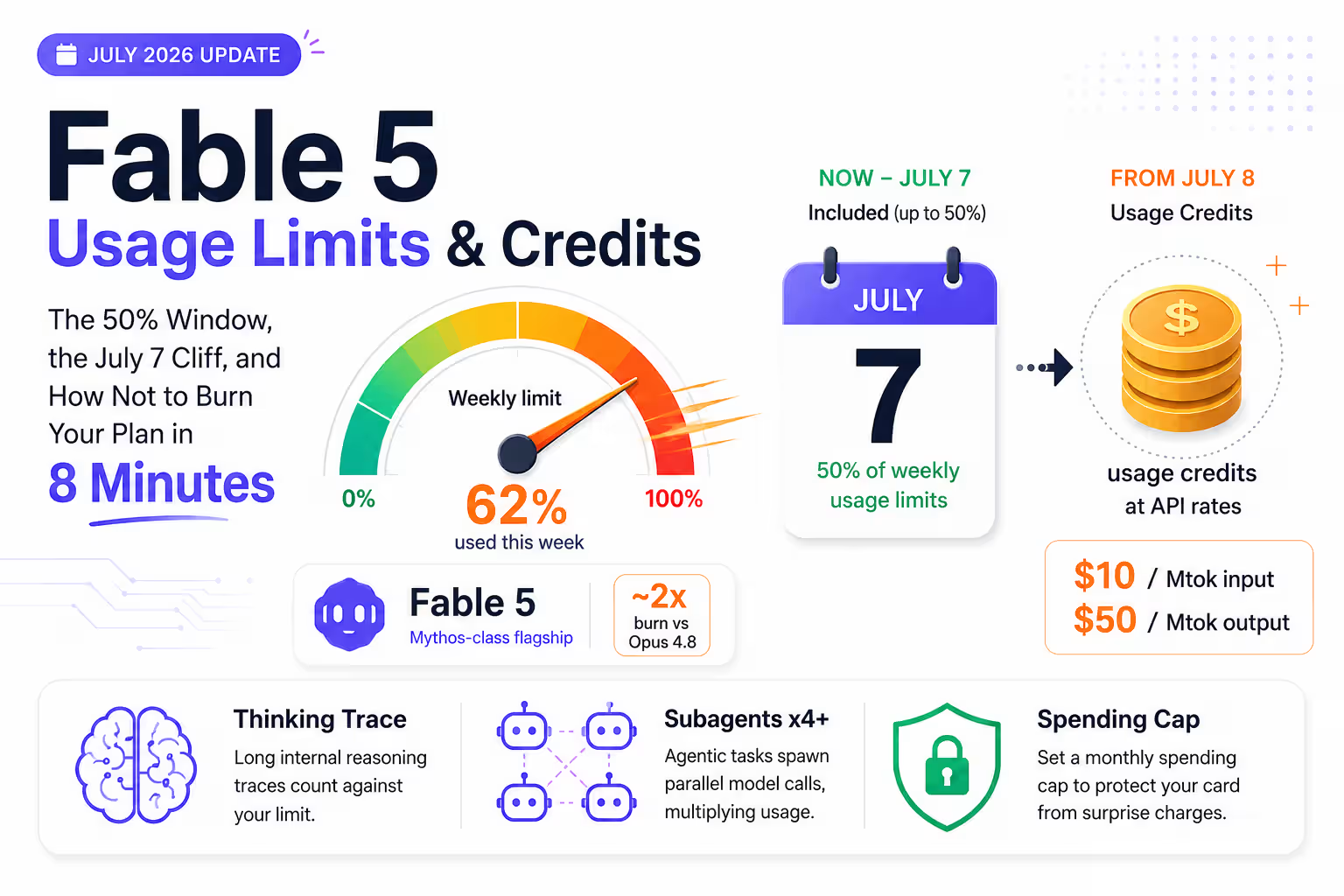
- 3From July 13 → usage credits only, billed at API rates ($10/M in, $50/M out), separate from your subscription.
- 4Standard Enterprise seats → no included window (extension doesn't apply to them either); credits must be enabled or Fable won't run.
- 5Burn rate → roughly 2x Opus per the in-app guidance; extended thinking and subagents multiply it further.
- 6'50% of weekly limits' in tokens/dollars → not published by Anthropic. Check your own usage dashboard; ignore anyone quoting exact numbers.
- 7Protect yourself → Settings > Usage: enable credits deliberately, set a monthly spending cap, turn on alerts.
- 8API route → pricing unchanged; prompt caching (~$1/M cache hits) makes it the cheap option for repeatable context-heavy work.
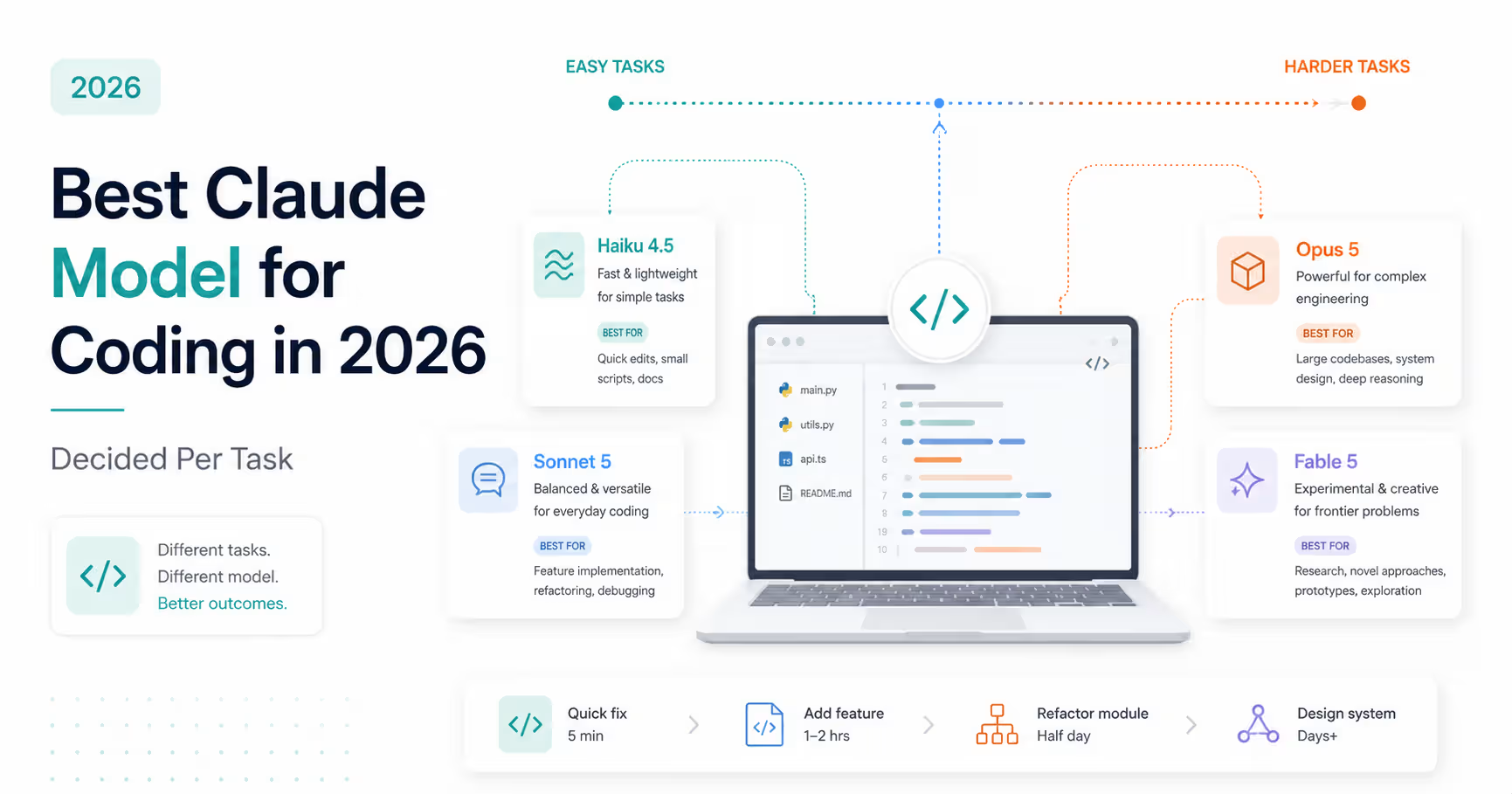
- 9Strategy → route by task: Haiku/Sonnet for bulk, Opus 4.8 for daily dev, Fable for the genuinely hard 20%.
Why I'm the one writing this — and the honest gap in every pricing post you've read.
I'm a frontend developer building production ERP and CRM systems in React and TypeScript, and I run Claude models — in the app and in Claude Code — against that work every single day. Which means I don't read about Fable 5's burn rate; I watch it happen on my own usage meter. I used Fable in its three-day launch window, went back to Opus 4.8 during the export-control pause, and have been using Fable again since the July 1 return — the full experience of both billing regimes. And when Anthropic extended the deadline hours before the July 7 cutoff, this post got updated the same day, because a pricing guide with a stale deadline is worse than no guide. Here's the honest gap this post won't pretend around, because most of the pricing coverage does: Anthropic publishes API per-token prices to the cent, but it has not published what '50% of your weekly usage limits' equals in tokens, messages, or dollars — for any plan. There's no official percentage-to-token conversion and no published per-plan credit allotment. Every article quoting you an exact 'X Fable messages per week' figure is extrapolating from Reddit threads. I'll give you everything that is confirmed, clearly flag what isn't, and show you how to measure your own number — which is the only one that matters. No affiliation with Anthropic. These are the tools I pay for and use.
Update, July 8, 2026: this post on Claude Fable 5 usage limits was written for the July 7 cliff — and then, hours before that cliff arrived, Anthropic extended the window. Fable 5 now stays included in paid plans through July 12, 2026 (11:59:59 PM PT), announced on Anthropic's official X account after days of subscriber backlash. Everything else — the 50% cap, the plan coverage, the credit pricing after the window — is unchanged, and the extension applies automatically. This article has been updated throughout to reflect the new date. Now, the original problem, which the extension does not solve: there's a specific kind of panic in opening Claude Code, running one Fable 5 task, and watching your usage meter drop like a fuel gauge with a hole in the tank. If that's why you're here: you're not imagining it, it's not a bug, and there are real numbers and real settings behind it. Fable 5 — Anthropic's Mythos-class flagship — came back on July 1 after its export-control suspension, but it came back metered. Through July 12 (extended from July 7), paid plans include it for up to half of your weekly usage limits. From July 13, every Fable token draws from prepaid usage credits at API rates. And independent of all that, Fable simply consumes allowance faster than any model Anthropic has shipped — roughly twice Opus's rate before extended thinking and subagents enter the picture, at which point the community horror stories (a full session window gone in eight minutes) start making arithmetic sense. This post is the complete, honest map: the timeline that got us here (including the last-minute extension), exactly how the 50% window works, the three multipliers that drain your limit, how to set up usage credits without exposing your card to an uncapped meter, the plan-vs-API decision, and the routing strategy that keeps Fable affordable — use it where it wins, not by default. If you want the capability side — whether Fable 5 is actually worth this hassle on real code — that's my full Fable 5 vs Opus 4.8 review. Short version: yes, for the right tasks. This post is about making sure 'the right tasks' is a budget decision you make, not one your usage meter makes for you.
Key Takeaways
8 PointsThe 60-Second Answer: Claude Fable 5 Usage Limits Explained
Here's the whole situation, compressed — updated for the extension.
Fable 5 returned to general availability on July 1, 2026 across Claude.ai, the Claude Platform, Claude Code, and Claude Cowork. On subscriptions — Pro, Max, Team, and select Enterprise — it's included through July 12 (originally July 7; Anthropic extended it hours before the cutoff), capped at up to 50% of your plan's weekly usage limits. The extension applies automatically; there is nothing to enable. From July 13, Fable is no longer part of any subscription allowance: using it draws from usage credits, prepaid and billed at standard API rates of $10 per million input tokens and $50 per million output tokens — exactly double Opus 4.8's rate and the most expensive model Anthropic prices for general use. Standard Enterprise seats never get the included window (the extension doesn't change that); for them it's credits from day one, and Fable won't run at all unless credits are enabled for the org.
Separately from billing, Fable consumes allowance fast: Claude Code's own guidance puts it at roughly 2x Opus's drawdown, and extended thinking plus parallel subagents can multiply a single task into several concurrent Fable-priced runs.
Two more things worth knowing up front. Anthropic has said the credits arrangement is capacity-driven and that it aims to restore Fable as a standard plan feature, communicating changes ahead of time — and the extension itself, announced on X rather than a blog post, is evidence the dates are soft. And the one number everyone wants — what '50% of weekly limits' means in tokens or rupees or dollars — has not been published. Your usage dashboard is the only source of truth for your account. Everything below unpacks these pieces properly.
The Timeline: How We Got to the July 12 Cliff (Twice)
The current limits only make sense against the month that produced them, because this is the second time Fable's billing has flipped and the second time the deadline itself has moved — and most subscribers never experienced the first flip.
June 9: Fable 5 launches. The original arrangement included it in Pro, Max, Team, and seat-based Enterprise plans for two weeks — through June 22/23 — inside normal plan limits, though even then it drew down allowance at roughly double Opus's rate. After the window, credits were the plan.
June 12: three days in, US export controls hit (a reported jailbreak triggered the directive — I covered the full saga in the main review), and Anthropic suspended Fable for everyone. Subscribers who were promised two weeks got about three days.
June 30 – July 1: controls lifted; Fable returns globally — but with revised terms. The new included window runs only through July 7, and it's capped at 50% of weekly limits rather than full allowance. That double reduction — fewer days AND half capacity — is what lit up Reddit, with subscribers pointing out they'd received roughly three of the promised fourteen days and were now getting one more week at half throttle. The frustration made it into press coverage within a day.
July 7–8: the extension. Hours before the cutoff was due to bite, Anthropic announced — via its official X account, with no formal blog post — that included access continues through July 12, 2026 at 11:59:59 PM PT. Five extra days, same 50% cap, same plan coverage, same post-window pricing, applied automatically. Press coverage credits the subscriber backlash; whether it was damage control or planned goodwill, the practical effect is the same: the cliff moved.
July 13 onward (currently): usage credits only, at API rates. Anthropic's stated position: this is about capacity, it's intended to be temporary, and Fable should return to standard plan inclusion when infrastructure allows — with advance notice of changes.
Why the history matters practically: this policy has now changed three times in under thirty days, including the deadline itself moving once. Treat every figure in this post as 'accurate at this update, verify before budgeting' — including the July 12 date itself, which is exactly as movable as July 7 turned out to be.
- Jun 9: launch — included in paid plans for a planned two weeks (at ~2x Opus drawdown).
- Jun 12: export-control suspension — subscribers got ~3 of the promised 14 days.
- Jul 1: return — new window through Jul 7 only, capped at 50% of weekly limits.
- Jul 7–8: last-minute extension to Jul 12 (11:59:59 PM PT), announced on X after backlash — same cap, same pricing, automatic.
- Jul 13: usage credits at API rates ($10/$50 per M tokens); standard Enterprise seats are credits-only throughout.
- Anthropic's framing: capacity-driven, temporary, plan inclusion to be restored when possible — and the moving deadline says hold all dates loosely.
How the 50% Window Actually Works (and What Nobody Knows)
The mechanics of the included window are simple to state and impossible to fully quantify — and being straight about that split is the point of this section.
What's confirmed: through July 12 (extended from July 7), if you're on Pro, Max, Team, or a select (premium) Enterprise seat, you can put up to half of your plan's weekly usage limit toward Fable 5. Your weekly limit is the same pooled allowance everything else draws from — Fable doesn't get a separate bucket; it gets a ceiling on how much of the shared bucket it may consume. Use Fable heavily and you're spending the same allowance your Opus and Sonnet work needs, at Fable's accelerated drawdown. The remaining 50%+ of your limit is protected for other models, which is arguably the cap's real purpose: stopping Fable from silently eating your entire week.
What's NOT published, anywhere, by Anthropic: what a weekly limit equals in tokens or dollars for any plan; how the in-app percentage meter converts to tokens; an official fixed multiplier for Fable's drawdown ('uses limits ~2x faster than Opus' is in-app guidance, a direction rather than a precise rate); and the credit allotments or conversion rates for the post-July-12 regime beyond 'standard API rates.' Community estimates exist — a widely-cited approximation pegs a plan's notional monthly allowance near its dollar price in API-equivalent spend — but that's forum arithmetic, not documentation.
So here's the only honest methodology: run your typical Fable session during the included window and watch your usage dashboard before and after. In my case, on a Team plan, one research-heavy Claude Code turn — a handful of web lookups, file reads across a Next.js repo, one edit — consumed 13% of my session limit and 2% of my weekly Fable allowance in a single prompt, about 85,000 tokens for one turn. The dashboard itself tells the story: Fable gets its own weekly meter alongside the all-models bar, and mine runs consistently ahead of it (36% versus 30% this week) even though Fable handles a minority of my prompts. Your workload will differ — extended thinking settings and agentic complexity swing the number enormously — which is exactly why measuring your own burn beats trusting anyone else's. The five bonus days are, if nothing else, five more days of free measurement.
Why Fable Burns Your Limit So Fast: The 3 Multipliers
The stories are dramatic — a Max subscriber burning through nearly a hundred dollars of token-equivalent usage in a single short agentic session, full five-hour windows exhausted in eight minutes — but the mechanics behind them are boring and predictable. Three multipliers stack.
Multiplier 1: the base weighting. Fable 5 draws down subscription allowance at roughly twice Opus 4.8's rate — that's Claude Code's own in-app guidance. Before you do anything exotic, the same task costs about double just for choosing Fable from the picker.
Multiplier 2: extended thinking. Fable is built for deep reasoning, and with thinking enabled at high effort it generates a large internal reasoning trace before the answer you actually see. Every token of that invisible trace counts against your limit. On a hard problem, the thinking can dwarf the visible response — which is precisely when you've chosen Fable in the first place. This is the multiplier that most surprises people, because the cost is literally unreadable.
Multiplier 3: subagents. Agentic tasks in Claude Code routinely spawn parallel subagents to divide work — and each subagent is its own model call with its own context. A single 'refactor this module' instruction can quietly branch into four to six concurrent Fable-priced, thinking-enabled runs. Stack all three multipliers and the eight-minute window drain stops being mysterious: 2x base weight × long thinking traces × 5 parallel agents is a very big number arriving very fast.
None of this is a defect — it's what buying maximum capability costs. The defect is running it by default. Practical mitigations, in order of impact: reserve Fable for tasks that genuinely need it (the routing section below); be deliberate about thinking effort rather than maxing it reflexively; know when your workflow spawns subagents and consider pointing those workflows at Opus or Sonnet; and keep the usage dashboard open during your first few Fable sessions until you've internalized your own burn rate.
- Base weighting: ~2x Opus drawdown, per Claude Code's own in-app text — the floor, not the ceiling.
- Extended thinking: internal reasoning traces count against your limit even though you never read them.
- Subagents: one agentic task can become 4–6 concurrent Fable calls, each with its own context.
- The viral horror stories are these three multipliers stacked — predictable arithmetic, not a bug.
- Mitigate by routing deliberately, managing thinking effort, and watching the dashboard until you know your own numbers.
Usage Credits: Setup, Spending Caps, and the Guardrails
From July 13 (post-extension), credits are how anyone on a subscription reaches Fable 5, so set them up on your terms before the meter does it on its terms. The extension bought you five extra days to do this calmly — use them.
What credits are: a prepaid, metered layer that sits on top of your subscription. Work covered by your plan allowance stays covered; work that isn't — Fable 5 after the cliff, or anything past your plan limits — draws from your credit balance at standard API rates, billed separately from the subscription. Stick to Opus and Sonnet within your plan and credits sit untouched.
Where it lives: your Claude account, under Settings > Usage. The flow: enable usage credits, attach a payment method, and configure the controls. Per Anthropic's help documentation, the system notifies you and asks for confirmation before usage switches over to credits, so the transition isn't silent — but the controls you set in advance are what actually protect you.
The controls, in order of importance. First, the monthly spending cap: configurable, and you can also leave it unlimited — don't. Set a number you'd be comfortable seeing on a statement; this single setting is the difference between 'Fable cost me a planned amount this month' and the surprise-invoice genre of Reddit post. Second, usage alerts as you approach the cap. Third, auto-reload: optional top-ups when your balance crosses a threshold — convenient for teams with a budget, dangerous for individuals who set a cap precisely to feel the friction. There's also a daily redemption limit (in the region of $2,000) as a system-level guardrail, which tells you the scale Anthropic thinks heavy users might hit.
My own setup, for what it's worth: I'm on a Team plan, and the enable-credits option doesn't appear in my seat's settings at all — on Team, credits are handled at the workspace level, so the pre-July-13 conversation you need is with your workspace admin, not your settings page. If I were on Pro or Max, I'd enable credits today with a modest cap and auto-reload off. The principle either way: make Fable a deliberate purchase, never an ambient one.
Plan vs API: Which Way Should You Pay for Fable?
After July 12 the per-token price is the same on both rails, so this stops being a price question and becomes a workflow question.
First, the fact that surprises people: nothing changes for the API at the cliff — and nothing changed when the cliff moved from July 7 to July 12, either. It was never free there — Fable has billed at $10/M input and $50/M output since day one, with the model string claude-fable-5, a 1M-token context window, and 128k max output. The July cliff is purely about how subscriptions account for Fable.
The API's structural advantage is prompt caching: the standard 90% input discount brings cache hits to roughly $1 per million tokens. For agentic coding sessions that resend a large codebase context on every turn, caching is not a minor optimization — it's the difference between viable and absurd economics. If your Fable workload is repeatable, high-volume, and context-heavy (CI-integrated agents, batch analysis, long-running Claude Code sessions against the same repo), the API route with disciplined caching will almost certainly cost less per unit of work.
The subscription-plus-credits route wins for the opposite shape: sporadic, interactive, exploratory use. No integration work, no key management, and the crucial property that you only pay Fable rates in the exact moments you choose Fable from the picker — your subscription still covers everything you do on Opus and Sonnet. For a freelancer or a small team whose Fable use is 'the two hard problems a week,' credits with a firm cap is the simpler and probably cheaper arrangement.
One compliance note that applies to both rails, relevant if you build for clients: Fable 5 carries 30-day data retention and is not available under zero data retention. If a client contract requires ZDR, no billing route changes that — Fable is excluded from that project. Details in the migration section of the main review.
| dimension | subscription credits | api direct |
|---|---|---|
| Per-token price | $10/M in, $50/M out (API rates via credits) | $10/M in, $50/M out — unchanged by the July 12 cliff |
| Prompt caching | Not under your control in the app | 90% discount — cache hits ~$1/M; huge for agentic work |
| Best-fit workload | Sporadic, interactive, exploratory sessions | High-volume, repeatable, context-heavy pipelines |
| Setup overhead | None — enable credits, set a cap | Integration work, key management, refusal handling |
| Cost control | Monthly spending cap + alerts in Settings > Usage | Rate limits + your own monitoring/budgeting |
| Everything-else work | Still covered by your plan (Opus/Sonnet untouched) | Every model billed per token |
* All figures reflect Anthropic's published pricing, the July 1 redeployment announcement, and the July 7–8 extension announcement at the time of this update. Subscription mechanics have changed three times in under a month — including the deadline itself moving from July 7 to July 12 — and Anthropic has said the current arrangement is temporary. Verify against anthropic.com and support.claude.com before committing budget.
The Routing Strategy: Stop Paying Fable Prices for Sonnet Work
Here's the reframe that makes everything above manageable: the July 12 switch isn't really an access problem ('do I still get the good model?'). It's a budgeting discipline you were going to need anyway. Capability just stopped being a free default in a dropdown and became a line item — and the developers who'll be fine are the ones who route by task instead of by habit. The five-day extension changes the date, not the discipline.
The exercise takes twenty minutes. List your recurring AI tasks — actually write them down. Tag each with the cheapest model that clears your quality bar. For my workload the tiers land like this: bulk and mechanical work (extraction, classification, boilerplate, simple transforms) goes to Haiku or Sonnet; the daily development core (scoped edits, components, ordinary debugging, code review passes) goes to Opus 4.8 or Sonnet, where — as I found in the Sonnet 5 head-to-head — Fable's advantage on short tasks is negligible anyway; and Fable 5 is reserved for the work where its long-horizon lead actually cashes out: the multi-file architectural refactor, the implementation you'd otherwise supervise for an afternoon, the genuinely hard problem. One recent example of deliberate downgrading from my own week: wiring up web push notifications for our web app — service worker, subscription flow, notifications landing on the phone — which I ran entirely on Opus 4.8. It's a well-documented, pattern-following feature; Fable would have done it too, and that's exactly why it shouldn't have.
The test for 'does this deserve Fable' is simple: would being right in one pass save me more than the premium costs? Strategy-level synthesis, hard architecture, long autonomous runs — yes. Anything you'd describe as routine — no, and routing it upward is pure waste since the output won't be detectably better.
What falls out of the exercise isn't a Fable decision; it's a cost model for your entire AI workflow — the same match-the-tool-to-the-task conclusion every honest comparison on this site reaches, now with a billing meter enforcing it. If the credit era ends and Fable returns to plan inclusion, keep the routing map anyway. It was always the right way to work; the cliff — whichever date it finally lands on — just made it mandatory.
Frequently Asked Questions
Strategic Summary
Final Thoughts
The honest summary: the cliff — now July 12, after the last-minute extension — looks like bad news and mostly isn't. It's a forcing function. Fable 5 is the most capable model you can rent, it burns allowance like it, and from July 13 you'll pay for it by the token. The subscribers who'll hate this are the ones running Fable as their everything-model; the ones who'll barely notice are the ones with a routing map — Haiku and Sonnet for the bulk, Opus 4.8 for the daily core, Fable for the handful of problems a week where one-pass correctness on a hard task pays for the premium. The three settings that matter before the cliff: know your own burn rate (dashboard open during a typical Fable session — Anthropic hasn't published the conversion, so your measurement is the only real number; the extension bought you five more free days of measuring), set a monthly spending cap in Settings > Usage before your first credit session, and leave auto-reload off until you've seen a month of known spend. And hold everything here loosely: the access rules have changed three times in under thirty days, the deadline itself has already moved once, Anthropic says the credits era is temporary, and I'll update this post as the policy moves — as I did the day the extension landed. For whether Fable is worth reaching for at all — the capability side of this equation — the full Fable 5 vs Opus 4.8 review on real CRM code is the companion piece. Spoiler: it is, for the right tasks. This post exists so 'the right tasks' stays your decision. --- Last reviewed: July 8, 2026 (updated for the July 12 extension; originally published July 5, 2026). Usage-limit mechanics, credit controls, and pricing are from Anthropic's July 1 redeployment announcement, the July 7–8 extension announcement on Anthropic's official X account, platform documentation, support documentation, and press coverage at the time of this update — all linked below. These policies are changing week to week; verify against Anthropic's official pages before making budget decisions. Burn-rate observations reflect my own real usage; the '50% of weekly limits' conversion remains unpublished by Anthropic, and this article deliberately does not invent one.
What does your own Fable burn rate look like? Drop your plan tier and roughly how fast a typical Fable session moved your usage meter in the comments — Anthropic hasn't published the conversion, so real-world data points from readers are genuinely the best public dataset we'll get. You've got until July 12 to measure for free.
If you found this useful, I write hands-on, no-hype breakdowns of AI models and coding tools from daily client work — Claude, Antigravity, Codex, Cursor and more. Browse the AI Tools for Developers hub, or reach me via stacknovahq.com/contact.
Next Up
Continue your research
Sources & Research
Anthropic — Redeploying Claude Fable 5 (July 1, 2026 — includes the original 50%/July 7 terms)
https://www.anthropic.com/news/redeploying-fable-5
Android Authority — Claude Fable 5 promotion extended after backlash over early cutoff (July 12 extension details, exact cutoff time)
https://www.androidauthority.com/claude-fable-5-free-extension-3685103/
The New Stack — Anthropic gives Claude subscribers five more days with Fable 5
https://thenewstack.io/anthropic-extends-fable-5/
TechTimes — Claude Fable 5 free window extended to July 12: what subscribers should do now (confirms nothing else changed; X-only announcement)
https://www.techtimes.com/articles/319875/20260707/claude-fable-5-free-window-extended-july-12-what-subscribers-should-do-now.htm
Anthropic — Claude Fable product page (pricing, plan availability)
https://www.anthropic.com/claude/fable
Claude Platform Docs — Introducing Claude Fable 5 and Claude Mythos 5 (specs, API pricing, billing rules)
https://platform.claude.com/docs/en/about-claude/models/introducing-claude-fable-5-and-claude-mythos-5
PCWorld — Claude subscribers are furious over Fable's new restrictions
https://www.pcworld.com/article/3181897/claude-subscribers-are-furious-over-fables-new-restrictions.html
Search Engine Journal — Fable 5 is back with new usage limits and safeguards
https://www.searchenginejournal.com/anthropics-claude-fable-5-is-back-with-new-usage-limits-and-safeguards/581231/
MacRumors — Fable 5 available again; 50% window and credits details
https://www.macrumors.com/2026/07/01/anthropic-fable-5-relaunch/
Developers Digest — How Claude's usage limits work with Fable 5 (burn-rate mechanics, community reports)
https://www.developersdigest.tech/blog/claude-usage-limits-fable-5-explained
Apidog — Fable 5 usage credits and the July switch (plan vs API breakdown)
https://apidog.com/blog/fable-5-usage-credits-july-7/