Claude Sonnet 5 Tested on Real Production Code (2026)

Written by
Sumit Patel
Published
July 13, 2026
Updated
July 13, 2026
Reading Level
Advanced Strategy
Investment
21 min read
Claude Sonnet 5 — the short version
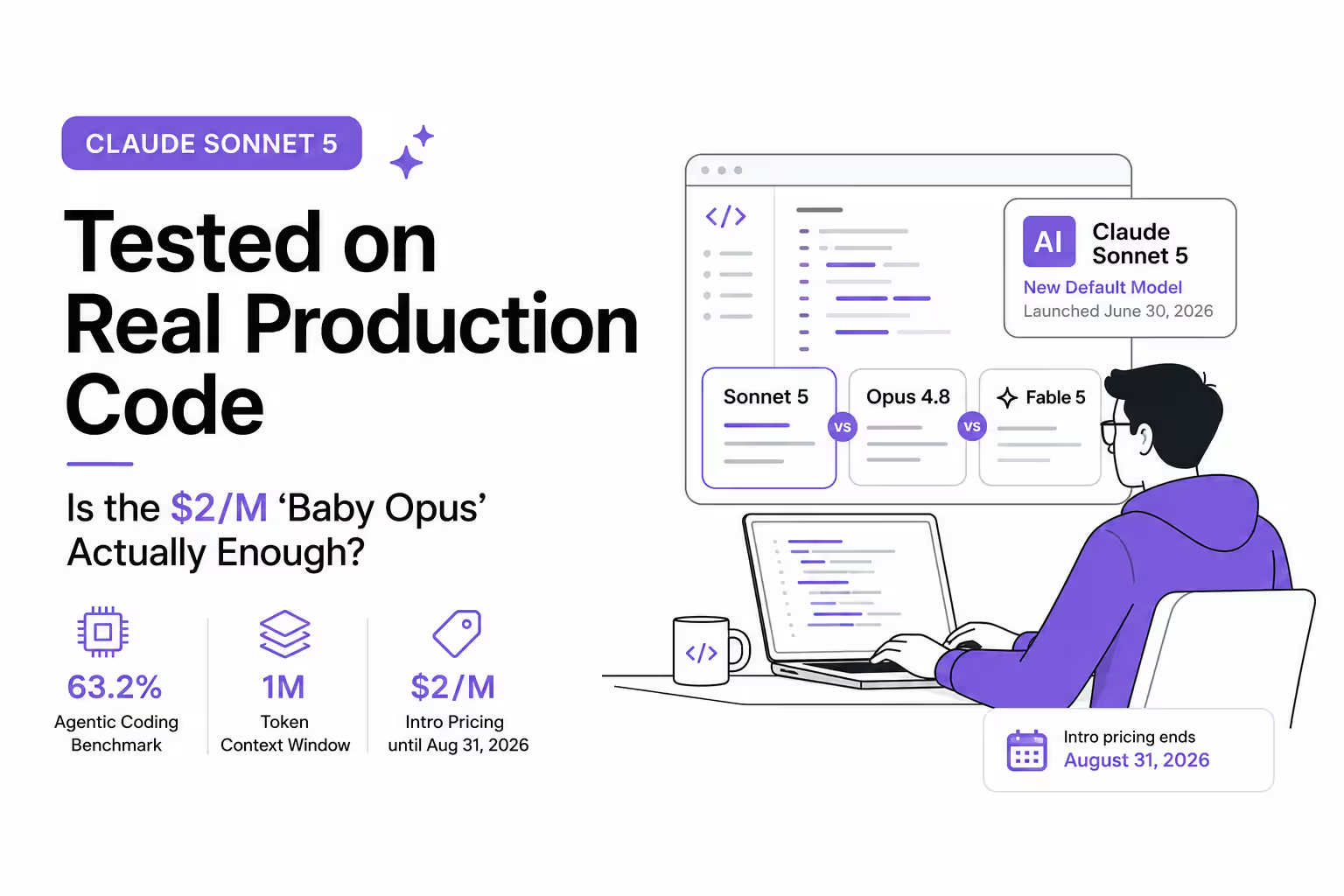
- 1What it is → Anthropic's new mid-tier model (June 30, 2026), the most capable Sonnet yet, approaching Opus 4.8 performance.
- 2Pricing → $2/M input, $10/M output introductory through August 31, 2026. Included as the default model on all Claude plans.
- 3Benchmarks → 63.2% agentic coding vs Sonnet 4.6's 58.1%; 1M token context window.
- 4Best at → daily coding, agentic tool-use sessions, long-context work — the 80% of real development tasks.
- 5Still reach for Opus 4.8 / Fable 5 → hardest multi-file architectural reasoning and frontier problems, especially now that Fable 5 bills as usage credits after July 12.
- 6Availability → Claude API, Amazon Bedrock, Google Vertex AI, Azure; default in Claude.ai, Claude Code, and the rest of the product surface.
- 7Action item → API users: run your evaluation before August 31 while intro pricing is live.
- 8Verdict → the new sensible default. Escalate by task, not by loyalty.
Why I'm the one writing this — and why it's not a launch recap.
I'm a frontend developer. I build and maintain a 25-module ERP plus client CRM projects in React and TypeScript, and AI coding agents do a large share of that work every single day — Claude models through Claude Code, plus Codex and Antigravity. When Fable 5 shipped, I tested it against Opus 4.8 on real CRM module code and published exactly what broke and what didn't. This article does the same thing for Sonnet 5, on the same class of code, so the results are comparable across posts. Most of what ranks for 'Claude Sonnet 5' right now is launch-day coverage: the benchmark table, the pricing line, the availability list. Useful, but it doesn't answer the question a working developer actually has in July 2026 — especially a developer who just watched Fable 5 move to usage-credit billing on July 12. That question is: can the free-included default model carry my daily workload, and when do I still need to pay up for the frontier tier? The honest answer has nuance, and I'll give you both halves. No affiliation with Anthropic, no affiliate links; pricing figures are from Anthropic's published information at the time of writing and change often — verify before you budget around them.
Here's the thing that makes Claude Sonnet 5 more interesting than a normal mid-tier release: it landed at exactly the moment the economics of using Claude changed. On June 30, 2026, Anthropic shipped Sonnet 5 — the most capable Sonnet yet, approaching Opus 4.8 performance, priced at $2 per million input tokens on an introductory rate that runs through August 31. It immediately became the default model for every Claude plan, Free included. Twelve days later, the Fable 5 included-usage window closed, and heavy Fable 5 use on paid plans started billing as usage credits at API rates. Put those two events together and the practical question for every developer changed overnight. It's no longer 'is the frontier model worth it?' It's 'how much of my daily work can the included default actually handle — and how much am I willing to pay in credits for the rest?' I've been running Sonnet 5 on real production ERP and CRM code since launch, next to Opus 4.8 and what remains of my Fable 5 budget. This article is the working answer: what Sonnet 5 actually is, the pricing window you need to act inside, how it performed on my real tasks, a straight three-way comparison against Opus 4.8 and Fable 5, and the cost math that decides which model earns which job. If you read my Fable 5 usage-limits breakdown, this is the sequel: that post explained the cliff — this one tells you what to run after it.
Key Takeaways
7 PointsThe Honest 30-Second Verdict
If you only read one section, read this one.
Claude Sonnet 5 is the new sensible default, and I mean that as strong praise. For the scoped, well-defined tasks that make up most real development days — building components against existing patterns, wiring API hooks, writing and fixing tests, mid-size refactors, long agentic sessions in Claude Code — it delivers output close enough to Opus-class quality that, most of the time, I stopped noticing which model was driving. The 63.2% agentic coding score (up from Sonnet 4.6's 58.1%) matches what I felt in practice: it holds long tool-using sessions together noticeably better than its predecessor.
Where the gap still shows is the hardest 20%: multi-file architectural reasoning, gnarly cross-module state logic, the problems where one wrong assumption quietly breaks something upstream. There, Opus 4.8 and Fable 5 still earn their tier — [[FILL: which tasks it fell short on]] is where Sonnet 5 needed more iterations or a model escalation in my testing.
So the verdict isn't 'Sonnet 5 replaces the big models.' It's directional and economic: Sonnet 5 is the daily driver, the frontier tier is the specialist you now pay for by the problem. Given that it's the included default on every plan and $2/M on the API until August 31, the cost of finding out where that line sits for your own work has never been lower.
What Is Claude Sonnet 5? (The Quick Definition)
Claude Sonnet 5 is Anthropic's mid-tier model, launched on June 30, 2026. Anthropic's positioning is unambiguous: the most capable Sonnet ever shipped, approaching the performance of Opus 4.8 — the model that until recently sat a full tier above it — at a fraction of the price.
The numbers behind that claim: 63.2% on Anthropic's agentic coding benchmark, versus 58.1% for Sonnet 4.6. That five-point jump matters more than it looks, because agentic benchmarks measure exactly the failure mode that hurts in real work — a model losing the plot halfway through a long, tool-using session. Sonnet 5 also ships with a 1M token context window, which for the Sonnet tier is the headline architectural change: entire mid-size codebases, long documents, and extended agent sessions now fit without the constant chunk-and-summarize dance.
Distribution is the other half of the story. Sonnet 5 became the default model for all Claude plans on June 30 — Free, Pro, and up — which means most Claude users are already on it whether they noticed or not. On the API side it's available directly from Anthropic plus Amazon Bedrock, Google Vertex AI, and Azure, at an introductory $2 per million input tokens and $10 per million output tokens through August 31, 2026. And because it's the default, it's also what Claude Code, Claude Cowork, and the rest of the product surface run unless you deliberately select a different model.
One framing note before the testing: 'approaching Opus performance' is Anthropic's claim, and vendor claims are marketing until verified. The rest of this article is me verifying it on code that pays my invoices.
- Launched June 30, 2026; immediately the default model for all Claude plans, including Free and Pro.
- 63.2% agentic coding benchmark vs Sonnet 4.6's 58.1% — the biggest Sonnet-to-Sonnet jump in the line's history.
- 1M token context window — the hard chunking ceiling for mid-size codebases is effectively gone.
- Intro API pricing: $2/M input, $10/M output, through August 31, 2026. Post-intro rate unpublished at time of writing — verify on docs.claude.com.
- Available on the Claude API, Amazon Bedrock, Google Vertex AI, and Azure.
The August 31 Pricing Window — Why the Deadline Matters
The introductory pricing isn't a footnote; it's the reason to run your evaluation now rather than in September.
Here's the situation as it stands: $2/M input and $10/M output are explicitly introductory rates valid through August 31, 2026. Anthropic had not published the standard post-intro pricing at the time I wrote this. That creates a specific, time-boxed opportunity for API users — roughly seven weeks in which you can benchmark Sonnet 5 against your current model on your real workload at a rate that may be the cheapest it will ever be.
The evaluation math is friendly. At intro rates, a genuinely heavy agentic coding day — the kind that chews through tens of millions of input tokens across long Claude Code sessions — costs single-digit to low-double-digit dollars in input spend. In my own usage, a typical heavy day landed around [[FILL: approximate token spend for a typical heavy day on Sonnet 5 at intro pricing]]. Compare that to what the same day costs on an Opus-class model and the incentive to find out exactly which of your tasks Sonnet 5 can absorb becomes obvious.
Two cautions so this stays honest. First, don't architect long-term budgets around the intro rate — it has an expiry date printed on it, and July 2026 has already taught everyone that model access and pricing can change on short notice (the Fable 5 pause and credit cliff being exhibits A and B). Second, if you're a Claude.ai plan user rather than an API user, this section mostly doesn't apply to you: Sonnet 5 is included in your plan as the default, and your real decision is the escalation question covered in the next sections.
How I Tested It (My Real Setup, Not a Benchmark)
Same methodology as my Fable 5 vs Opus 4.8 post, deliberately, so the results are comparable across articles.
No synthetic benchmark. I used Sonnet 5 inside my actual job across [[FILL: number of real work-sessions you ran Sonnet 5 in]] real work sessions since launch — feature work on the 25-module ERP, two client CRM repos, and StackNova tooling — driven primarily through Claude Code with Sonnet 5 selected, alongside comparison passes on Opus 4.8 and (sparingly, given the credit billing) Fable 5 on the same tasks.
The task mix covered the categories that decide whether a model earns a daily slot: scoped component and hook work against existing patterns; Redux slice changes in a store with 80+ slices and inconsistent naming (the exact environment where weaker models hallucinate selector paths); a couple of deliberately hard multi-file logic problems of the kind that broke tools in my earlier comparisons; long agentic sessions to test whether the 1M context and the improved agentic score hold up over an hour of continuous tool use; and speed, subjectively — because a model you wait on is a model you stop using. On that last point, versus Sonnet 4.6 and Opus 4.8, Sonnet 5 felt [[FILL: your subjective speed comparison vs Sonnet 4.6 and Opus 4.8]].
The single result that stuck with me most: [[FILL: one concrete example where Sonnet 5 output surprised you (good or bad)]].
As always: this is one developer's stack — React, TypeScript, Redux Toolkit, ERP/CRM logic. Your domain may land differently, which is exactly why the intro-pricing window is the right time to run this test on your own code rather than trusting mine.
Sonnet 5 vs Opus 4.8 vs Fable 5: The Three-Way Decision
This is the comparison the launch coverage skips, because it only matters if you actually pay for and depend on these models. Three tiers, three different economics, three different jobs.
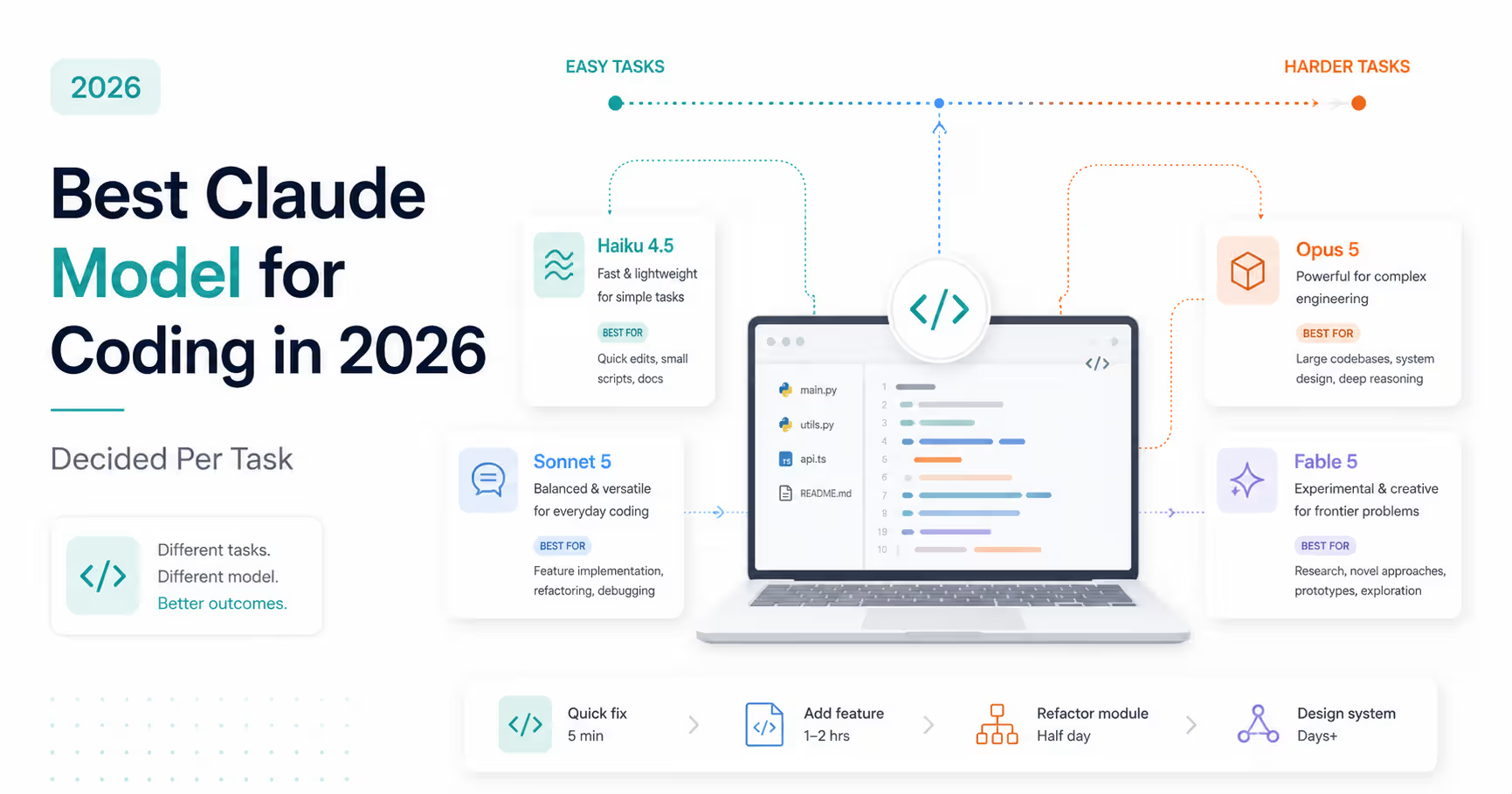
My working split after two weeks: Sonnet 5 gets everything by default. Opus 4.8 gets the tasks where I already know from experience that mid-tier models wobble — heavy multi-file reasoning, architecture decisions, the cross-module state problems I documented in the Claude Code vs Cursor post. Fable 5 gets rationed: it's the strongest model I have access to, but post-July-12 it bills as usage credits at API rates on my plan, so it only comes out for problems where frontier reasoning plausibly saves me more than the credits cost.
| dimension | sonnet 5 | opus 4 8 | fable 5 |
|---|---|---|---|
| Tier & positioning | Mid-tier; 'approaching Opus 4.8 performance' | Flagship Opus tier | Mythos-class frontier — strongest available |
| Cost reality (July 2026) | Included default on all plans; $2/$10 per M intro API pricing to Aug 31 | Standard Opus-tier API pricing; plan usage limits apply | Usage credits at API rates on paid plans after July 12 |
| Agentic coding benchmark | 63.2% (vs Sonnet 4.6's 58.1%) | Higher tier — the bar Sonnet 5 'approaches' | Frontier-class; see my Fable 5 vs Opus 4.8 post for real-code results |
| Context window | 1M tokens | Large, tier-standard | Frontier-class |
| Best at (my testing) | Daily scoped work, long agentic sessions, [[FILL: which tasks it matched Opus 4.8 / Fable 5 on]] | Hard multi-file reasoning, architectural judgment | The genuinely frontier problems; hardest reasoning |
| Weak spot (my testing) | [[FILL: which tasks it fell short on]] | Cost per task vs Sonnet 5 on work Sonnet 5 can now do | Credit burn; access risk (see the July pause) |
| I reach for it when | Always, by default | Known-hard task categories | Frontier problems worth the credits |
* Model pricing, plan inclusion rules, and default-model status change frequently in 2026 — the Fable 5 window itself was extended with hours to spare in July. Every figure in this table was taken from published information at the time of writing. Verify current pricing and plan terms on anthropic.com and docs.claude.com before making budget decisions.
Life After the Fable 5 Credit Cliff: Where Sonnet 5 Actually Fits
If you followed my Fable 5 usage-limits post, you know the timeline: the included 50% weekly window, the extension to July 12, and then the cliff — heavy Fable 5 use on paid plans billing as usage credits at API rates. A lot of readers asked the same follow-up question: 'so what do I actually run now?'
Sonnet 5 is Anthropic's answer, and honestly, the timing is too clean to be a coincidence. Ship a near-Opus default model on June 30, make it free-included on every plan, then close the frontier model's included window twelve days later. Whatever you think of the sequencing, the resulting economics are clear: the default tier got dramatically better at the exact moment the frontier tier got a meter attached.
For a working developer, that produces a concrete playbook. One: let Sonnet 5 absorb everything it can — which, per the testing above, is most of a normal week. Two: keep a short, explicit list of task categories where you've verified Sonnet 5 underperforms for your stack, and route those to Opus 4.8 within your plan limits. Three: treat Fable 5 credits like a specialist consultant's hours — spent deliberately on problems where frontier reasoning plausibly changes the outcome, not burned on tasks the default model handles. Four: re-run this calibration whenever the lineup changes, because it will; three major Claude models have shipped or changed terms in the last four months alone.
The uncomfortable meta-lesson from July 2026 — the Fable 5 export-control pause, the credit cliff, the intro pricing windows — is that model access is now a planning variable, not a constant. A stack built around one model at one price is fragile. Sonnet 5's real value isn't just its benchmark score; it's that a genuinely capable model is now the floor you fall back to when the tier above gets expensive, rationed, or paused.
The Cost Math for Developers (And the Competition Closing In)
Sonnet 5 didn't launch into a vacuum. The mid-tier is where the 2026 model price war is actually being fought, and the context makes Anthropic's pricing move legible.
OpenAI's GPT-5.6 preview line splits into three tiers — Sol at the top, Terra positioned as GPT-5.5-competitive performance at roughly half the cost, and Luna as the fast/cheap option. Terra is aimed at exactly the same buyer as Sonnet 5: the developer who wants near-flagship output without flagship invoices. Meanwhile GitHub Copilot added Kimi K2.7 Code, its first open-weight coding model, giving cost-conscious teams a usage-billed route that undercuts both. The pattern across all three vendors is identical: frontier models are getting gated and metered, while the tier just below them races toward 'good enough for almost everything' at commodity prices.
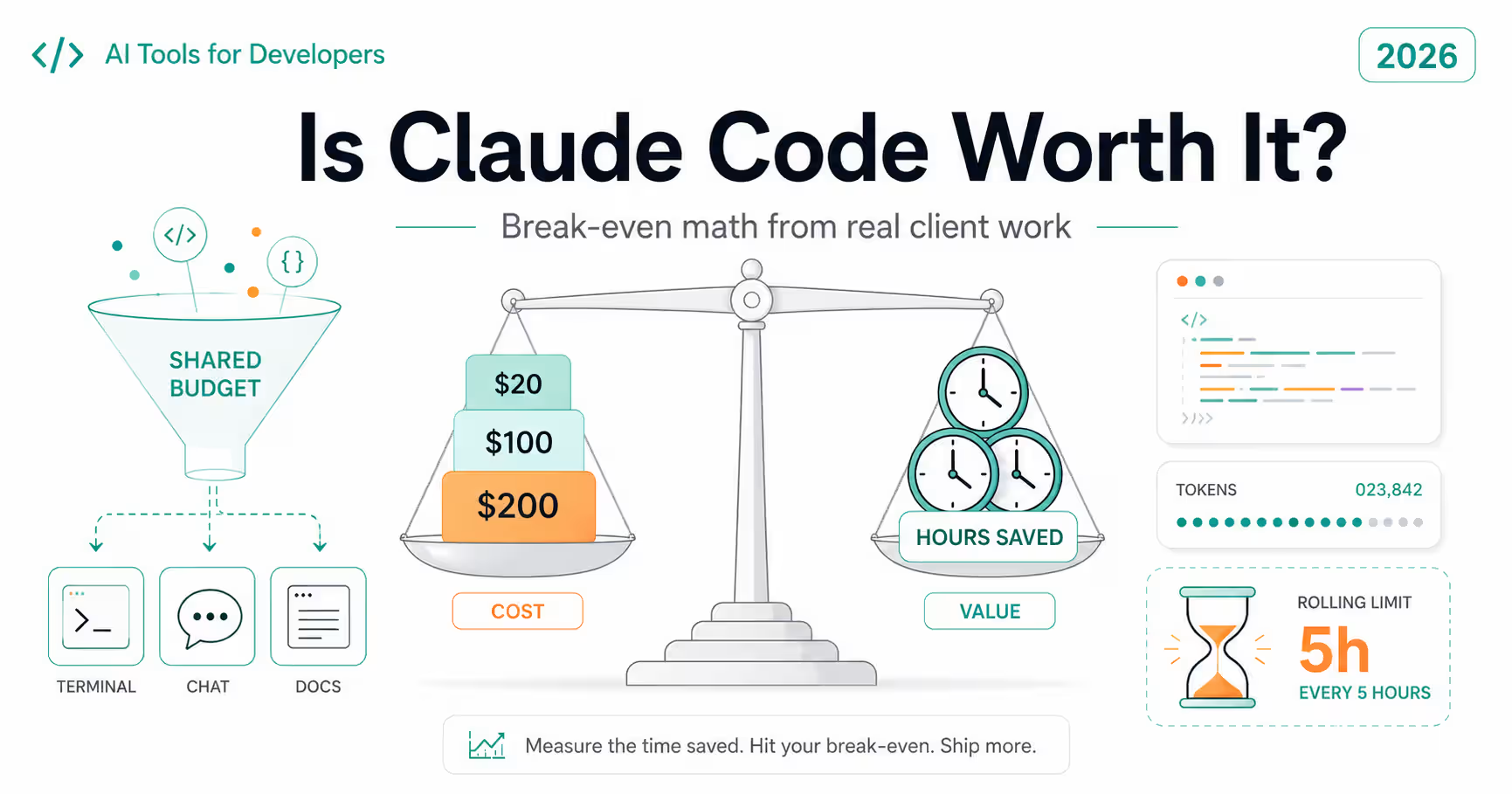
For your own math, the framework matters more than any single number, because the numbers keep moving. Cost per task = tokens consumed × rate × (1 + rework factor) — and the rework factor is where cheap models get expensive. A model that costs half as much per token but needs two extra debugging iterations on complex logic isn't cheaper; I documented that dynamic in the Claude Code vs Cursor comparison, where the 'faster' tool lost on total time once debugging was counted. Sonnet 5's pitch is that it compresses the rework factor toward Opus levels while keeping mid-tier token rates. On my scoped daily tasks, that pitch held up; on the hardest problems, the rework factor is exactly where the remaining Opus/Fable gap lives.
So the honest cost guidance: measure tokens-per-completed-task on your real work during the intro window, not price-per-million in a vacuum. That single metric — captured now, at $2/M, across your five most common task types — is worth more than every comparison table on the internet, including this one.
- Sonnet 5 intro pricing: $2/M input, $10/M output through August 31, 2026 — the mid-tier benchmark price right now.
- GPT-5.6 Terra: GPT-5.5-competitive performance at roughly half the cost — the direct competitor for the same buyer.
- Kimi K2.7 Code in GitHub Copilot: first open-weight coding model in Copilot, usage-based billing — the budget flank.
- The metric that matters: tokens per completed task including rework, not sticker price per million tokens.
- Cheap models with high rework factors are expensive models in disguise — measure on your own code.
Should You Switch? My Honest Verdict
For most developers, 'switch' is the wrong frame — you've already been switched. Sonnet 5 became the default on every Claude plan on June 30. The real questions are whether to fight that default, and how to structure the tiers above it.
Don't fight the default. On the evidence — benchmark and hands-on — Sonnet 5 is the strongest included model Anthropic has ever shipped, and for the scoped work that fills most development days it delivers output I previously associated with the Opus tier. If your workflows were tuned around Sonnet 4.6's weaknesses, retire those workarounds; the 63.2% agentic score and the 1M context window are real improvements you'll feel, not spec-sheet decoration.
Do structure your escalation deliberately. Keep Opus 4.8 for your verified-hard task categories, and treat Fable 5 credits as precision spend for frontier problems. And if you're an API builder, run your evaluation before August 31 — not because the intro pricing makes Sonnet 5 good (it's good at any plausible price), but because seven weeks of cheap, real-workload data is a gift for whatever pricing comes next.
The one prediction I'll commit to: the tiered-model workflow — capable default for volume, frontier for exceptions — isn't a temporary adjustment to July's pricing news. It's the shape of working with AI models from here on, across every vendor. Sonnet 5 just made Anthropic's version of that workflow dramatically better at the bottom tier, which, day to day, is the tier you live in.
Frequently Asked Questions
Strategic Summary
Final Thoughts
The honest summary of two weeks with Claude Sonnet 5: the most important thing about it isn't the benchmark — it's the timing. Anthropic shipped a near-Opus model as the free-included default on June 30, then closed Fable 5's included window on July 12. Read together, that's not two news items; it's a new operating model. The capable tier is now the floor everyone stands on, and the frontier tier is metered spend you allocate like any other budget line. Sonnet 5 makes that floor genuinely high — high enough that on my real ERP and CRM work, most tasks stopped needing anything above it, and the ones that did were predictable categories I can route deliberately. What I'd do in your position: if you're on a Claude plan, you're already running Sonnet 5 — spend a week consciously noticing which tasks it handles and which ones you escalate, and turn that into an explicit routing rule. If you build on the API, get your evaluation done before August 31 while the $2/M window is open, and measure tokens-per-completed-task rather than sticker price. And either way, hold your model stack loosely — July 2026 alone brought a launch, a pause, a cliff, and a pricing deadline, and there's no reason to believe August will be quieter. Run it on your own code. Then tell me where your line between Sonnet 5 and the frontier tier landed — that's the data point I'm collecting next. --- Last reviewed: July 2026. Model details (launch date, benchmarks, context window, pricing, plan defaults) are taken from Anthropic's announcements and published documentation at the time of writing and change frequently — verify directly on anthropic.com/news and docs.claude.com before relying on them. Testing described reflects my own real usage on production ERP/CRM code; project specifics are kept high-level to respect client confidentiality. No affiliation with Anthropic or any tool named.
Have you run Sonnet 5 on your own production code yet? Drop your split in the comments — which tasks it handles for you, and which ones still force you up to Opus 4.8 or Fable 5. I'm collecting real routing rules across stacks, and the Sonnet-vs-frontier line is the data point that matters most right now.
If you found this useful, I write hands-on, no-hype breakdowns of Claude models and AI coding tools from daily client work — Fable 5, Opus 4.8, Claude Code, Codex, Antigravity, Cursor and more. Browse the AI Tools for Developers hub, or reach me via stacknovahq.com/contact.
Next Up
Continue your research
Claude Fable 5 Usage Limits & Credits Explained (July 2026): The 50% Window, the New July 12 Cliff
Claude Fable 5 vs Opus 4.8 on Real CRM Code: I Used Both
Claude Fable 5 Refusals Explained: Why You Got an Opus 4.8 Answer
Claude Code vs Cursor on a 25-Module ERP: An Honest Comparison
Best AI Tools for Developers 2026: 6 Tested on Real Client Code
Sources & Research
Anthropic — Product News (official announcements)
https://www.anthropic.com/news
Anthropic — Claude API Documentation (models & pricing)
https://docs.claude.com/en/api/overview
AIToolsRecap — AI News July 2026 (Sonnet 5 launch coverage, benchmarks, pricing)
https://aitoolsrecap.com/Blog/AINewsJuly2026.aspx
AIapps — Top AI News July 2026 (mid-tier model pricing landscape, GPT-5.6 tiers, Kimi K2.7 in Copilot)
https://www.aiapps.com/blog/top-ai-news-july-breakthroughs-launches-trends/
FutureTools — AI News (Fable 5 access window extension coverage)
https://futuretools.io/news