Custom ERP Cost India (2026): ₹1.5L vs Tally & SAP

The Brief
Custom ERP cost India runs ₹1.5L–₹15L+. Real breakdown from a 220-user furniture ERP and 100+ user CRM — see exactly when Tally or SAP beats building custom.
Two numbers before we get into anything else. I'm currently building a 220-user ERP for a furniture manufacturer — 56 roles across sales, design, production, MRP, purchase, warehouse, QC, finance, and more, 25+ modules, replacing a combination of SAP, Tally, and Excel that were running simultaneously (the same 25-module build covered from the code side in my Claude Code vs Cursor comparison). And a 100+ user CRM for a membership services company, built from scratch because no off-the-shelf tool could model their business. Those are the two projects this article is based on. Not benchmarks, not demos — production systems with real deadlines and real clients. If you search 'custom ERP cost India' you get two types of results: agency pages that say 'contact us for pricing,' and generic listicles written by people who haven't built anything. This is neither. You'll get real cost ranges, what drives them up or down, an honest comparison of where Tally, SAP, and Excel actually fail — and two situations where custom development is the wrong call.
Key Takeaways
7 PointsCustom ERP Cost India (2026) — Real Ranges by Scope
The cost of a custom ERP depends entirely on scope — but 'it depends' is not useful. Here are realistic ranges based on what actually gets built.
These are build costs only. Hosting, ongoing maintenance, and post-delivery changes are separate.
| Scope | Examples | Typical Cost | Modules | Users | Notes |
|---|---|---|---|---|---|
| Internal Business Tool | Leave tracker, single-department workflow, basic reporting dashboard | ₹50k – ₹1L | 2–4 | 5–20 | Not really ERP — no cross-department logic, no complex integrations. Useful for a single department problem. |
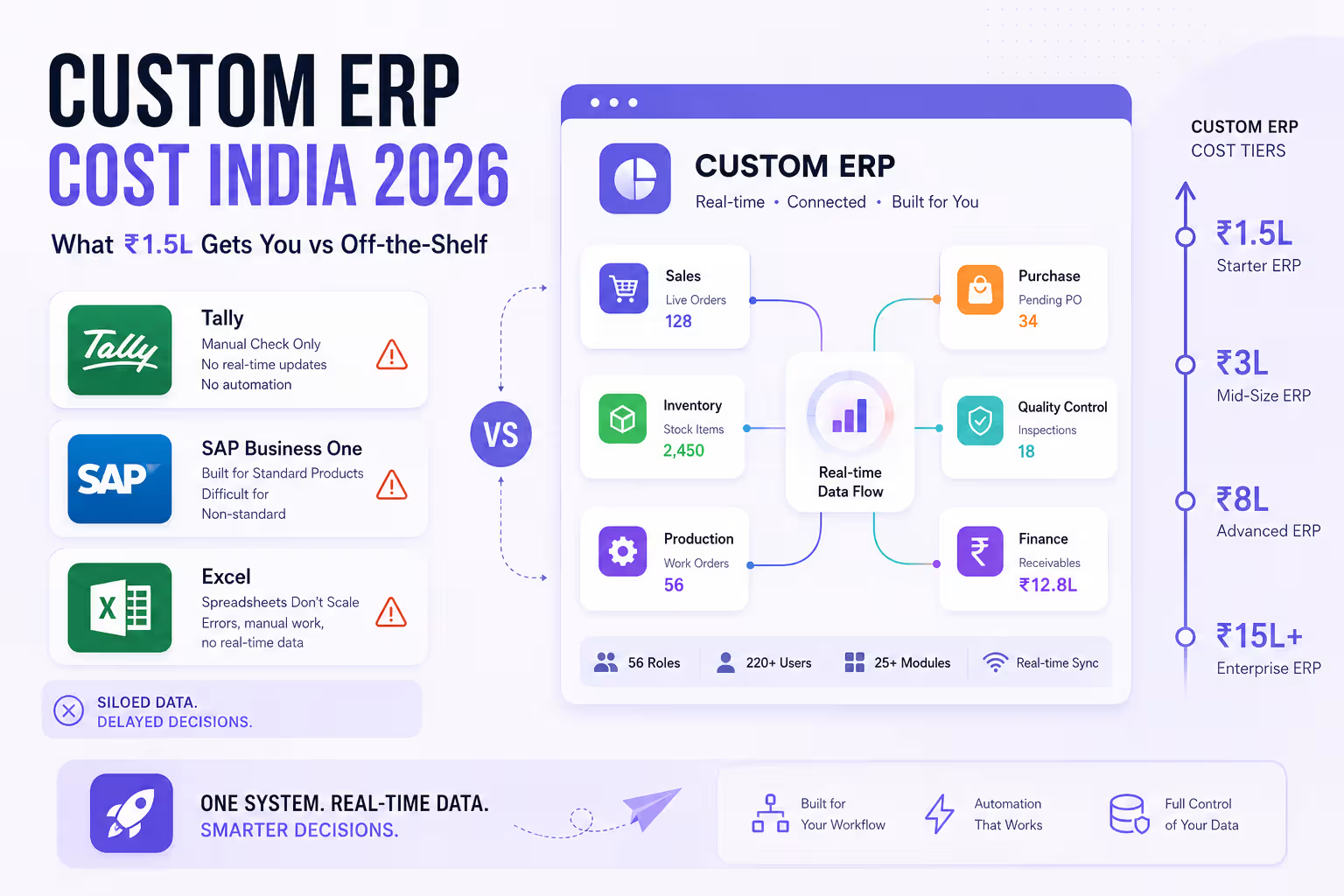
| Custom ERP — Starter | Sales + inventory + invoicing, or CRM + lead management | ₹1.5L – ₹3L | 5–8 | 20–50 | The realistic starting point for real ERP. Requires stable, documented requirements and limited integrations. |
| Mid-Size Business ERP | Multi-department ops — sales, purchase, warehouse, basic production | ₹3L – ₹8L | 10–18 | 50–150 | Real-time sync across departments, role-based access, multiple third-party integrations. |
| Manufacturing ERP | BOM, MRP, production planning, procurement, QC, dispatch | ₹5L – ₹15L | 20–30+ | 100–300 | Complex business logic, WebSocket sync, 100+ API integrations. The furniture manufacturer ERP falls here. |
| Multi-Plant / Enterprise ERP | Multiple locations, complex approval chains, BI dashboards | ₹15L+ | 30+ | 300+ | Usually structured as a monthly engagement, not a fixed project quote. |
Internal Business Tool
₹50k – ₹1LNotes: Not really ERP — no cross-department logic, no complex integrations. Useful for a single department problem.
Custom ERP — Starter
₹1.5L – ₹3LNotes: The realistic starting point for real ERP. Requires stable, documented requirements and limited integrations.
Mid-Size Business ERP
₹3L – ₹8LNotes: Real-time sync across departments, role-based access, multiple third-party integrations.
Manufacturing ERP
₹5L – ₹15LNotes: Complex business logic, WebSocket sync, 100+ API integrations. The furniture manufacturer ERP falls here.
Multi-Plant / Enterprise ERP
₹15L+Notes: Usually structured as a monthly engagement, not a fixed project quote.
What Actually Drives the Cost Up
Number of modules
Each module adds design, development, and testing time. Complex modules like MRP take disproportionately longer than simple ones like notifications — 5 modules vs 25 is not a 5x cost difference.
User count and role complexity
More users means more complex role-based access control and more UAT time. The furniture ERP has 56 distinct roles — each with different views, permissions, and workflow access.
Third-party integrations
Each integration (payment gateway, GST API, calling platform, logistics partner) adds real scope. Integrating ViciDial for call center functionality is meaningfully more work than a standard form submission.
Real-time sync requirements
Real-time data across departments via WebSocket is significantly harder to build and test than standard REST APIs that refresh on page load. This is one of the biggest cost multipliers.
Non-standard business logic
Standard CRUD is fast. Custom constraint logic — MRP allocation rules, automated purchase requisition generation, membership renewal workflows — takes much longer and is where most fixed-price estimates go wrong.
Mobile app requirement
Web-only is one codebase. A mobile app is a second platform — separate design, development, and maintenance. Not always necessary; many ERP users work at desks.
What Off-the-Shelf Software Actually Does Well
Tally is genuinely reliable for accounting. GST compliance, ledger management, voucher entries, financial reports — it handles standard Indian accounting workflows well. At roughly ₹18,000–54,000 for a license (per Tally's published pricing), it's hard to beat for pure accounting.
SAP Business One is serious enterprise software. For businesses with standardized products, standardized part codes, and workflows that match SAP's predefined module structure, it works. It carries decades of manufacturing and supply chain logic.
Zoho One gives a connected suite — CRM, inventory, books, HR — for roughly ₹1,800–2,200 per user per month based on current published pricing. For a team with standard workflows, this is reasonable cost for not building anything.
The pattern: off-the-shelf works when your business is standard. Most growing Indian businesses are not.
| dimension | tally | sap b1 | zoho one | custom erp |
|---|---|---|---|---|
| Best for | Accounting, GST, ledger | Standardized manufacturing / supply chain | SMB with standard sales + ops workflows | Non-standard products, complex cross-dept workflows |
| Approx. cost (indicative) | ₹18k–54k/year (published license pricing) | ₹3–5L+/year est. license; implementation varies significantly by partner | ₹1,800–2,200/user/month (published India pricing) | ₹1.5L–15L+ (one-time build cost) |
| Real-time data visibility | No — manual check only | Yes, within SAP modules | Yes, within Zoho suite | Yes — built to your workflow |
| Non-standard products/SKUs | Limited | Difficult without expensive customization | Limited | Full freedom |
| Cross-department automation | No | Yes, within standard modules | Partial | Yes — to your actual process |
| Timeline to go live | Days | 3–12 months (implementation) | Weeks | 3–6 months (stable requirements) |
* SAP Business One pricing varies significantly by partner, user count, and modules licensed. Figures above are indicative market estimates — verify directly with an SAP partner for your specific situation. Zoho pricing is from their published India pricing page at the time of writing.
3 Situations Where Custom ERP Wins — From Real Projects
Situation 1: Your products are non-standard and off-the-shelf can't model them.
SAP Business One assumes a standardized product catalogue — fixed SKUs, fixed part codes, fixed attributes. That works for businesses selling the same products year after year.
The furniture manufacturer I work with makes fully customized furniture. Every order has different dimensions, materials, and finishes. A color change creates a new product code. Because of this, SAP couldn't serve as their single system — they were creating BOM and drawing data in Excel first, then uploading it to SAP manually. Two systems. Manual transfer at every step.
The custom ERP replaced that entire flow. BOM creation, drawing management, version control — all native, built around their actual product logic. No Excel export. No manual upload.
Situation 2: You're running 3 separate systems and none of them talk to each other.
The same manufacturer ran: SAP (BOM and some production data), Tally (accounting), and Excel (sales orders, dispatch coordination, proforma invoices). Three systems, no real-time data flow between them.
This is Tally's core operational limitation — it doesn't push data anywhere. It doesn't notify anyone. It doesn't automate the next step. Every department opens it manually and checks. In a business with 10+ departments, every decision runs on delayed information.
After the custom ERP: sales, design, SE, PDM, PED, planning, MRP, purchase, warehouse, QC, production, finance — 56 roles — working in one system. Sales order created → flows to production planning automatically. MRP runs against live inventory. Purchase requisitions generate from MRP output. No manual transfer between systems.
Situation 3: Your business model doesn't fit any standard software category.
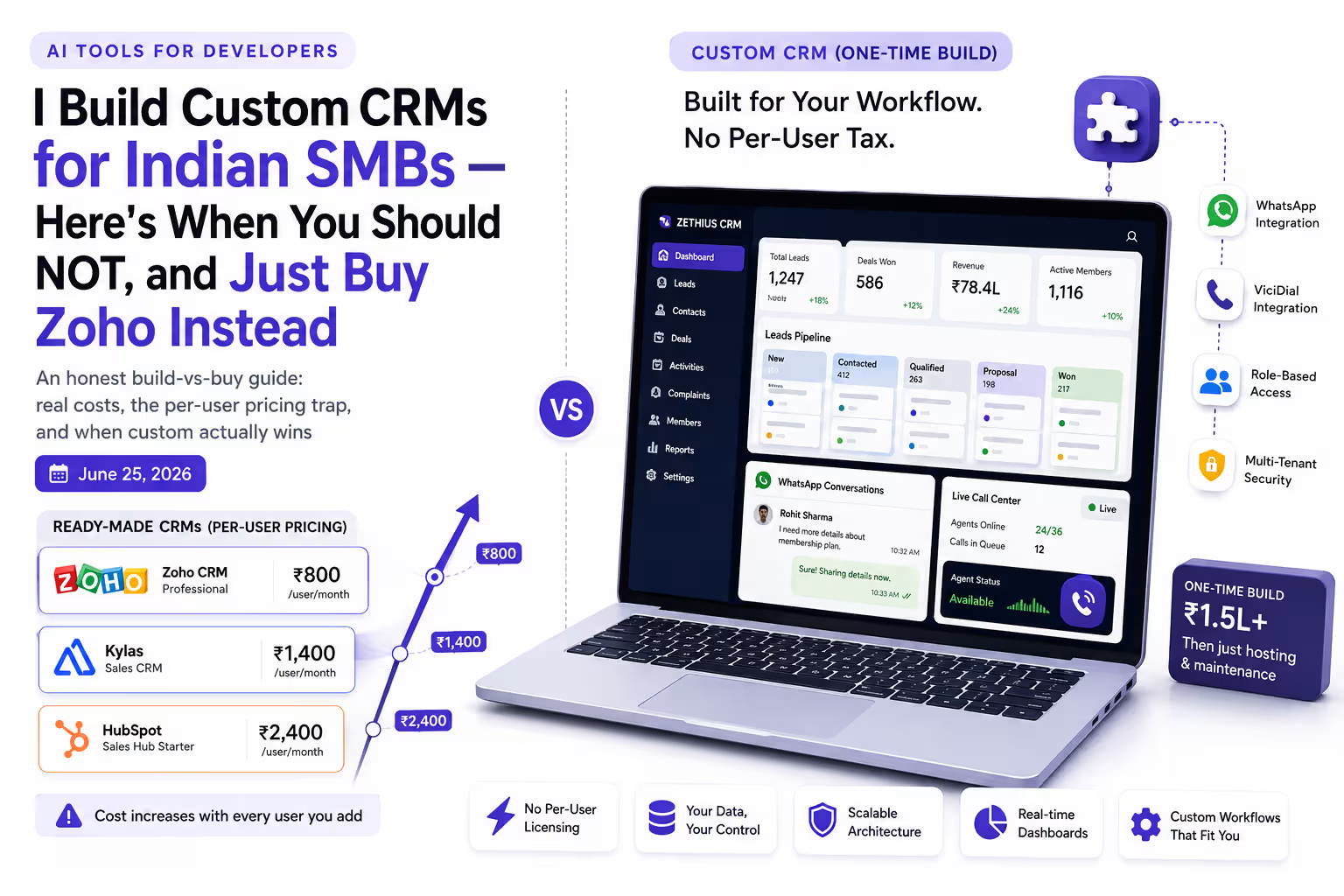
The membership services company I work with has a model no standard CRM handles cleanly: sell membership cards, provide roadside assistance, manage B2B partnerships, capture leads from Meta ads and website forms, run a call center, handle complaint dispatch to mechanics, manage renewals — all one workflow.
Before the custom CRM, agents used a separate calling platform and a separate screen for lead details. Two systems open simultaneously for every single call. The B2B team managed all leads in Excel — no pipeline, no automated follow-up reminders.
After the custom CRM: ViciDial is integrated directly into the interface. Agents dial from inside the CRM — one screen, full context. Agent breaks are tracked in the system: when an agent marks themselves unavailable, calls stop routing to them automatically. No manual coordination, no missed calls because someone forgot to update a status in a separate tool. Call history, lead details, and follow-up notes are all in the same place.
A standard CRM could handle the lead pipeline. It cannot handle complaint dispatch, membership lifecycle, call center break management, and B2B leads in the same system without heavy customization — at which point you're building custom inside someone else's platform and paying per-user fees on top — the same build-vs-buy math I cover in the custom CRM vs ready-made CRM comparison.
2 Situations Where Off-the-Shelf Is the Right Call
Situation 1: Under 20 people with standard workflows.
If your products are standard, your workflows fit inside Zoho or SAP's predefined modules, and your team is small enough that manual coordination still works — off-the-shelf is faster and cheaper. Build only when your workarounds cost more in people-hours per month than the software costs in rupees. Below that threshold, buy.
Situation 2: You need it running in 4 weeks, or your requirements aren't stable yet.
Custom ERP with clear requirements takes 3–6 months minimum. If your timeline is urgent, off-the-shelf gets you running immediately.
The second part matters more: if your business logic isn't fully defined and documented, don't start a custom build. The most expensive thing in custom development is not the developer rate — it's changing requirements mid-build. A system that could have shipped in 6 months with stable requirements can run 2+ years when logic keeps changing after development starts. Get your processes documented and stable first.
Hidden Costs Nobody Puts in the Headline
Off-the-shelf hidden costs:
*Per-user pricing compounds as you grow.* Zoho One at ₹2,000/user/month is manageable at 10 users. At 100 users, that's ₹2,40,000/month — ₹28.8L/year. The per-user model actively works against you at scale.
*The Excel layer that never goes away.* Most businesses maintain Excel alongside off-the-shelf ERP for the workflows the software doesn't cover. The furniture manufacturer had SAP and still ran sales and dispatch in Excel. You're paying for the software and the person managing the spreadsheets.
*SAP implementation is not SAP licensing.* Based on market discussions with implementation partners, SAP Business One implementation — configuration, data migration, training, customization — is a significant additional cost on top of the license fee. Verify this directly with an SAP partner; it varies considerably by company size and scope.
Custom ERP hidden costs:
*Changing requirements after development starts.* Every business logic change mid-build costs time and money. Document what was agreed, what changed, what it costs. Without clear scope control, projects bleed.
*Your team's time during UAT.* User acceptance testing requires actual department heads and users — not the developer — to test and sign off. Budget for this time explicitly.
*Scope creep.* Custom software is infinitely extensible, which means 'just one more feature' requests are constant. Without locked scope, ₹1.5L projects become ₹3L projects not because of overcharging, but because requirements grew after the quote.
The Decision Framework
Two questions that usually decide it:
1. How many separate systems does your team use to complete one business workflow — from order or lead to invoice?
Count them. If that number is 3 or more, the monthly cost of maintaining those systems — licenses, human coordination, error correction — is your comparison baseline against a custom build.
2. Are your products or processes genuinely non-standard?
If every order has custom specifications, if part codes aren't from a fixed catalogue, if approval chains don't match a standard flow — no off-the-shelf tool fits without significant workarounds. At that point you're paying for someone else's platform plus customization work. Custom development is usually cheaper and gives you something actually built for how you work.
If both answers point toward standard — standard products, standard workflows, small team — buy the off-the-shelf tool.
Frequently Asked Questions
Strategic Summary
Final Thoughts
The biggest sign you need a custom ERP isn't your company size or your budget. It's when your employees spend more time moving information between systems than actually using the systems. Export from Tally, paste into Excel, upload to SAP. Check one system for inventory, another for orders, a third for dispatch status. Call a colleague to ask what the current stock figure is because you can't see it from your screen. That's the real cost — not software licenses, not implementation fees. It's the daily friction of running a business on systems that weren't built for how your business actually works. The furniture manufacturer I work with had SAP, Tally, and Excel running simultaneously. Today that's one system: 220 users, 56 roles, real-time data across every department. The membership services company had agents on two screens for every call, B2B leads in Excel, complaint dispatch managed separately. Today that's one system — calling, leads, complaints, memberships, all connected. If you're evaluating whether custom development makes sense for your business, I'll give you a straight answer — whether that answer is 'build' or 'just use Zoho.' Reach me at zethius.com or [stacknovahq.com/contact](https://stacknovahq.com/contact). --- Related: How I used AI coding tools to build a 25-module ERP — what Cursor and Claude Code got right and wrong
If you're evaluating custom ERP for your business, drop your situation in the comments — how many systems you're running, team size, what workflows are breaking. I'll give you an honest read on whether custom makes sense.
Need a direct conversation? Reach me at zethius.com or stacknovahq.com/contact. I'll tell you honestly if your situation warrants custom development or if off-the-shelf will serve you better.
Next Up
Continue your research
Sources & Research
Tally Prime Pricing — Tally Solutions India
https://tallysolutions.com/tally-prime/
Zoho One Pricing — India
https://www.zoho.com/one/pricing.html
SAP Business One — India Overview
https://www.sap.com/india/products/erp/business-one.html
ViciDial Open Source Call Center
https://www.vicidial.org/