Vite 8 Explained with Real Data: Rolldown, 46s → 6s Builds, and What Actually Changed
Author
Sumit Patel
Published
March 25, 2026
Read Time
8 min read
Vite 8 is not just a version upgrade. It replaces the core bundling architecture that Vite has used since its early versions. Earlier, Vite relied on two different tools: esbuild for development speed and Rollup for production builds. Vite 8 removes this split and introduces a single Rust-based bundler called Rolldown. This change directly affects performance, consistency, and maintainability.
The Core Change: From Dual Bundlers to One
Before Vite 8, two different systems handled development and production. This caused inconsistencies and required additional glue code to keep both pipelines aligned.
| aspect | vite 7 | vite 8 |
|---|---|---|
| Development | esbuild | Rolldown (Rust) |
| Production Build | Rollup | Rolldown (same pipeline) |
| Pipeline | Dual system | Unified system |
Real Performance Data (From Official Release)
Vite 8 performance improvements are real but vary depending on project size and complexity. The following numbers are directly reported from real production usage.
| company | vite 7 | vite 8 | result |
|---|---|---|---|
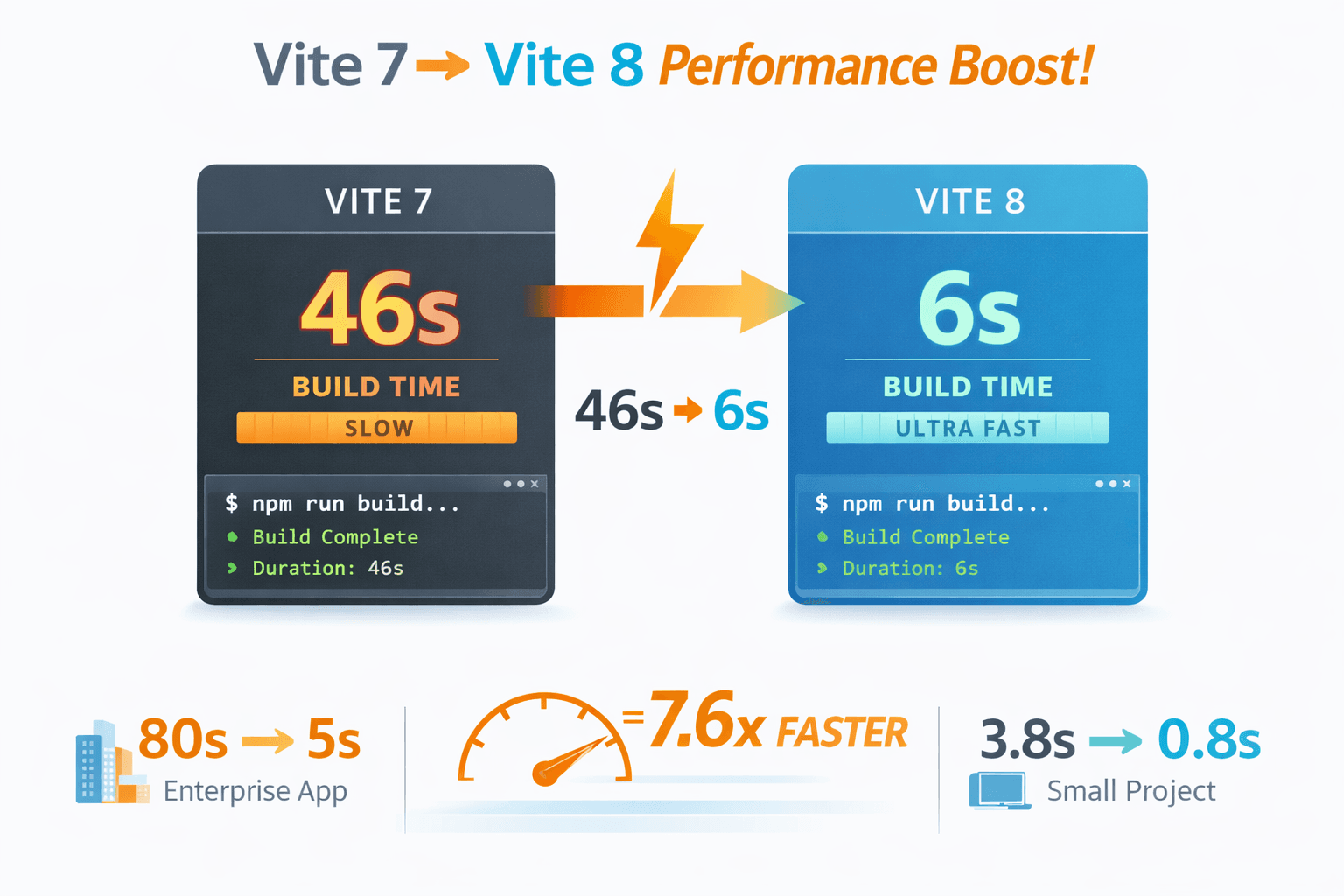
| Linear | 46 seconds | 6 seconds | ~7.6x faster |
| Ramp | Baseline | 57% faster | Moderate improvement |
| Mercedes-Benz.io | Baseline | Up to 38% faster | Moderate improvement |
| Beehiiv | Baseline | 64% faster | Significant improvement |
Why These Improvements Happen
Rust-Based Execution
Rolldown is written in Rust, which allows faster execution and better parallel processing compared to JavaScript-based tools like Rollup.
Single Pipeline
Using one bundler removes duplication between development and production, reducing transformation overhead.
Reduced Plugin Overhead
Previously, plugins had to work across two systems. Now a single API reduces inconsistencies and improves execution flow.
Better Internal Optimization
Rolldown enables features like persistent caching and improved chunk splitting, which directly impact build time.
Important Reality Check
Performance gains depend heavily on project size and configuration.
- Small projects may see limited improvement
- Large projects benefit the most
- Plugin-heavy setups can reduce gains
- The 10–30x claim refers to bundler-level benchmarks, not always full app builds
Additional Features in Vite 8
Beyond performance, Vite 8 includes several practical improvements.
- Built-in Devtools support
- Native TypeScript path alias support
- emitDecoratorMetadata support without plugins
- WASM support in SSR
- Browser console logs forwarded to terminal
Trade-offs (Not Discussed Enough)
The upgrade is not purely positive; there are trade-offs.
- Install size increased (~15 MB larger)
- Rolldown binary contributes ~5 MB
- LightningCSS adds ~10 MB
- Some edge cases may still exist during migration
Migration Reality
Most projects will work without major changes, but not all.
- Basic projects: usually zero config changes
- Complex builds: may require debugging
- Recommended path: test with rolldown-vite first
- Plugin compatibility is high but not guaranteed in edge cases
FAQ
No. That number refers to bundler-level benchmarks. Real-world gains vary from ~30% to ~7x depending on the project.
Yes, but it comes from a specific large production app (Linear). It is not universal.
Replacing esbuild + Rollup with a single Rust-based bundler (Rolldown).
Yes for most projects, but large or complex apps should test migration carefully.
Final Thoughts
Vite 8 is a major architectural shift, not just an incremental improvement. The move to Rolldown simplifies the toolchain and improves performance, especially for large projects. However, the performance gains vary and should be interpreted carefully. The most important takeaway is not the speed numbers, but the long-term benefit of a unified and more maintainable build system.